A GAME OF CRICKET.
Reading edition
What the game of base-ball is to this country—yes, and a great deal more—cricket is to England. It is the national game, the most favored among a people who are devoted to all kinds of out-door games and sports.
Why, then, it may be asked, is it not more generally played in this country?
The answer that has been given to several similar questions may, perhaps, be given to this. We have too many railroads to build and too many rivers to bridge to devote two whole days to a single game of cricket.
Ay, my masters, build your railroads from ocean to ocean and from the great lakes to the Gulf, bridge your mighty cañons and your roaring torrents, but remember that the brain that works out the problems of the engineer and the surveyor will work the smoother and last the longer if it be greased occasionally with an excellent oil compounded of rest and recreation.
It is very possible that most of our readers have never even seen a game of cricket, especially if they live far from large cities. To the Philadelphia boy cricket is as familiar as is base-ball to most boys. If asked to name the "three Graces," he might answer, as pat as you please, "E. M., W. G., and G. F.," giving the initials of the three famous brothers Grace, whose names are familiar wherever cricket is played. But as this paper is not for boys of any one place, but for boys all over the country—nay, for boys wherever found—we will describe the game, and try to show in what lies its great favor among those who know it.
Cricket is properly played by eleven persons on each side, though where so many persons can not be brought together, a less number can play. One side bats, and the other side bowls and fields. Two batsmen go to the wickets, one at each end; and the first bowler delivers a ball to the batsman opposite to him, while the fielders take their positions at a greater or less distance from the wicket.
"Oh, well hit! well hit!"
Yes, well hit, indeed. The batsman has driven the ball right over the bowler's head, and has already crossed between the wickets twice, scoring two "runs." Yes, and he and his partner are trying another one. Good! three runs off the first ball.
But another batsman is to receive the ball this time. It is the one who was at the wicket whence the last ball was bowled. As they have made three runs, the man who hit the last ball is at the other end now.
Ah, that was a good ball, and well he played it. There was no driving that ball to "long on" or "long off" for three. It was well pitched up, and had a spin on it that made it shoot along the ground instead of rising; and so the batsman played back, and just got his bat down in time to stop it, for it was bound for his middle stump. He is a cautious player, the man at this end, and the bowling is straight and well pitched.
After five balls, a man who has been standing by the bowler with his coat on, and seeming to take no interest in the game, turns his back on the bowler and batsman, and strolls off as if tired of looking on. Then the fielders seem to be playing at "pussy wants a corner," for they walk about and change places, and then another man begins to bowl from the other wicket.
The fact is, you did not hear the man with his coat on call, "Over!" Well, he did so. Not that the game is over, or the innings, or anything else. They are simply going to bowl from the other end, and so all the fielders have to change their positions so as to occupy the same position with regard to the batsman. The man with the coat on is one of the umpires (there is one at each wicket), and it is part of his business to count the balls bowled. When one man has bowled four or five balls, as the case may be, another man bowls the same number from the other wicket.
"Well bowled! oh, good ball!"
The meaning of these cries arising from the spectators is that the new bowler has sent the middle stump of one of the batsmen flying, and our friend retires to the tent, where he is greeted with some little applause by his comrade. And so one man out of the eleven is "out."
The next man walks up and takes his place, and the game goes on. He is a careful player, this new man, but he is a hard hitter also. See how he swung his bat round to his left side, and sent that last ball to "leg" for four runs. Now he has the ball again, and for "over" after "over" he and his partner give the fielders plenty to do. Look at the board on which the score is displayed. It marks sixty runs, and only one man out. This is getting serious. The Captain of the fielders calls one of his men up to him, and says a few words. Some new tactics are to be tried.
The next "over" reveals what they are. The batsmen have become used to the bowling, and so, like a wise man, the Captain puts on a fresh bowler.
The new man's balls seem easy enough. See, there one goes for three or four runs at least. But wait a little. This underhand bowling is tempting, but it is also dangerous. A beautiful easy ball comes which the batsman steps to meet, and drives high over the heads of the near fielders, but away off there in the distance a man is posted to look after just such balls as this. He sees it coming, keeps his eye on it, runs backward a few paces, and it is in his hand before it touches the ground. And so the second man is caught out.
By the time the third man is out, the score has reached a hundred, but after that the wickets fall more quickly. The bowling is changed as often as it is found that the batsmen can master it, and the fielders are on the alert.
There is but one more wicket to fall, and the score bids fair to reach two hundred. One hundred would have seemed a good score, had they not already nearly doubled that number, and now they are straining every nerve to gain the wished-for two hundred.
A GAME OF CRICKET—"RUN OUT."
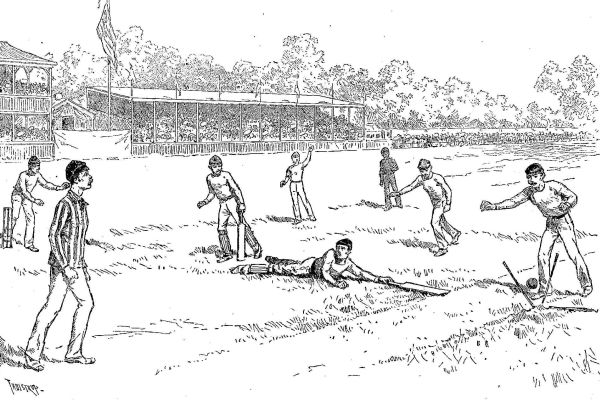
They are stealing runs now; that is, they are running where there is great risk of the ball being thrown up to the wicket before they can reach it; and if the ball strikes the wicket before the batsman reaches it, he is "run out." Stealing runs is a risky game, and— Yes; well, there is a proof of it. Yonder long-legged fellow has slipped and fallen, and though he stretches out his bat as far as possible, he can not reach his "ground"; he is "run out," and the innings is over for one hundred and ninety-nine runs.
The fielders retire to the shade of the tent, and two of them soon come forth to take their places with the bat, while the remainder enjoy their well-earned rest. Those who have had their innings take up their positions in the field, and the first innings of the other side begins.
Then the excitement is renewed. Shouts of applause or encouragement greet every good or unlucky deed of the players, and as the innings draws to a close, the interest increases. It takes two innings on each side to decide the match, and a game is never lost until it is won. Of course in cricket there is good luck and bad, but in this game, as in all others where skill plays the principal part, luck counts for but little in the long-run. The best players nearly always win.
Cricket may be played six months in the year, and those who play it think six months none too much. It is a social game also, and a good club can always arrange matches with neighboring clubs, and so friendly is the feeling among players that a visiting eleven nearly always declare, when they go home after a match, that they were never better treated in their lives. In the skill required, the variety of excitement, and the friendly feeling that it promotes, lie the claims of cricket to the favor it enjoys.
THE LITTLE ORPHAN.