A FOLDING CAMP-STOOL.
Reading edition
Fig. 1.
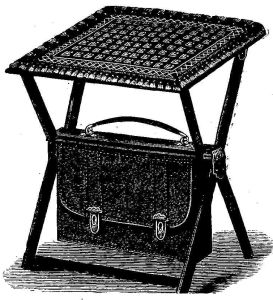
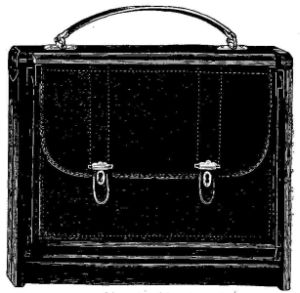
Girls and boys who are looking for a useful and tasteful holiday gift for mother, aunt, or elder sister, may unite in the making of the folding camp-stool, which we illustrate below. It is made of black walnut rods, joined, with hinges and with a broad cross-bar. On the top of the cross-bar is fastened a leather handle, by which to carry the stool when folded (Fig. 2). The upright wooden rods in the back are hinged to and support the cane seat, as shown by Fig. 1. The other upper rods are pushed into the notches on the under side of the seat in unfolding the chair. A leather satchel may be added, as in the engraving, but this is not necessary. The seat is covered with a four-cornered piece of brown woollen Java canvas, embroidered in cross stitch with fawn-colored filling silk in three shades. Ravel out the threads of the canvas from the last cross stitch row to a depth of an inch and a quarter, fold down the canvas on the wrong side so as to form loops a quarter of an inch deep on the edge, and catch every ten such loops together with a strand of fawn-colored silk in three shades, for a tassel, which is tied with similar silk. Cut the tassels even, and underlay the cover with a thin cushion.
Fig. 2.

Have dolls gone out of fashion? Very few of our little girls mention them in their letters. We hope that there are dolls and play houses and lovely little tea sets, just as there used to be, and we shall be glad to have the younger ones write about them. How many of you are learning to decorate china, and which little girls have painted the prettiest cups and saucers for mamma's birthday? What are the boys doing in these bright days of autumn? Marbles, tops, balls, hoops, and such toys are always the style, we know, among the boys. Which boy has drawn the best map? Who has made the finest work-box or bracket with his scroll-saw? Write about these things.
Now that the long evenings are coming, you may tell us, if you please, about your home amusements. Hands up! Every uplifted hand is the sign that its owner knows a pleasant evening game, and Our Post-office Box will be delighted to hear how it is played, so that all the young people may play it if they wish to do so.
And now one word more to exchangers. Listen, please. Try to confine your exchanges to useful, unique, valuable, or beautiful things of which you are making collections. As we have said before, in every case exchangers should write to each other, and arrange the exchange, settle the postage, and determine the details before they trust their articles to the mail or express. Every day brings us complaints, and some of them very bitter ones, from boys and girls who accuse others of having treated them unfairly. This would be made impossible if there were always an exchange of views before the exchange of goods. Hereafter we shall publish no notices of withdrawal from our exchange list. When your supplies are exhausted it would be well for you to notify your correspondents, for the reason that several weeks must elapse before we can publish your notice of withdrawal, and all that time you, though innocent, are exposed to the suspicion of being either dishonest or careless.
Eagle Grove, Iowa.
Not seeing any letters from this place, I thought I would write and tell you about my pets. I am a little girl nine years old, and live on a farm, and have to depend on my pets for playmates, as my little brother is dead, and I have no sister. I have a little gray kitten which I call Maggie, and my dog is a shepherd, and I call him Brave. He will speak for something to eat, and shake hands with me, and when I am at school, will watch until school is out, and then come and meet me. I have a little colt named Rosa, and a little calf named Mera, and a black cow named Mink. Our hired man takes Young People this year, and I want to take it next. I read all the little letters, and I think that "Susie Kingman's Decision" was splendid, and I hope "Tim and Tip" will be as good. I thought Jimmy Brown's monkey was funny. I do wish he would tell us some more of the monkey's tricks. My ma is writing this for me, but I tell her what to say, as it is such hard work for me to write.
Ethelyn I. G.
It is in order for any little girl to employ her mother as an amanuensis, and if she dictates the letter, we consider it her own.
Paris, France.
We left Lucerne August 2, and crossed the Brünig Pass as far as Sarnen, where the horses were watered. We only stopped there fifteen minutes. The next place we slopped at was Lungern, and we reached Brienz for the night. We took a funny big row-boat, and two men to row it across to Giessbach Falls, and reached Interlachen August 3. We drove to Grindelwald, and saw two glaciers; and August 11 we came to Berne, saw the Bears' Den, the distant snow mountains, and the Cathedral clock. We heard the organ, which was the finest I ever heard, more beautiful than the organ in Lucerne. We drove one afternoon in the woods, and saw some chamois that are kept by the city. We left Berne, and came back to Lucerne. There we staid till the snow fell on all the mountains near the lake, and it was very cold.
September 1, we left Lucerne, and came to Bâle. On the journey, part of the way the train went in the water, for it had rained a long time, and the country was flooded. The peasants stood about talking and trying to save their gardens and fences. Two or three little children at one of the houses were being carried along over the water on a big horse. There was one little village saved from flooding by their cutting large drains through the principal roads.
When we reached Bâle the river Rhine was overflowing its banks, and it was rushing down and carrying great trees, parts of houses, fences, etc., along with it. There was great fear that it would carry away the old bridge, and the firemen of the city put large piles of railroad irons to weight it down, so that it should not be floated down the river, and carried away from its supports. The cellar of one of the buildings was full of stores, iron safes, etc., and they bricked up the doors to keep out the water. One street was so flooded that they made a board plank-walk above the water.
We saw the Münster, and the cloister walk, and curiosities in the tower of the Münster. In one room they had old musical instruments, and books, with the music in them written in all the old ways. In the Museum we saw Holbein's sketches. He was born in Bâle, and they are proud of his pictures. We liked a sketch of two lambs and a bat. At the Zoological Gardens we saw a fish-otter. He twirled round and round in the water, would dive and swim and turn somersaults.
September 4, we left Bâle by the night train for Troyes, France. There we got into a funny little "'bus," drove to a little hotel, and had our coffee and milk. We saw the Cathedral, and then took the train for Foutainebleau.
Harry G.
San Francisco, California.
We take Harper's Young People, and like it very much. We liked the "Two-headed Family," but wished it had been a continued story. "Tim and Tip" is a very nice story so far, but I hope it will not end so sadly as "Toby Tyler" did, by Tip's getting killed. I liked "Phil's Fairies" very much, and "Aunt Ruth's Temptation." We would like to have the violin which some one offered for exchange, but have not got enough curiosities to make four or five dollars' worth. This is our first letter to Young People. We have taken it from the first number. I have two King Charles spaniels, and they are very clever. I have a great deal of pleasure in teaching them tricks.
Helen T. F. and Joseph M. N.
Washington, D. C.
I have returned from my summer vacation, which I spent in Virginia. My baby brother was very glad to see me. I have four pets—a red bird, goat, pigeons, and a little dog. I drive my little brother out in my goat-wagon. When papa left me in the country, on his way home, the cars ran off the track, and smashed the tender, and he was six hours detained in the hot sun. I was waiting every day to hear from home, to know whether he was hurt, but no one was injured. When my brother and I were coming home, a mule got on the track, and delayed the freight train, so that we were seven hours behind time, and I did not get home in time to see the President's funeral.
W. H. T.
How thankful you must be that your dear father escaped unhurt!
Hillhurst, Washington Territory.
I am a little girl seven years old. I have taken Young People since Christmas, and like it ever so much. This is the first letter I have ever written. I have lived in New Tacoma ever since I was one year old, until about two months ago. I am now living in the country, fourteen miles from New Tacoma. I like it much better than I did in town, for there are so many pretty ferns, leaves, and mosses, and other things too. I read so many letters from little boys and girls who write to Young People, I thought I would write one. I hope you will print this. I want to surprise papa. He does not know I am writing this. I will show it to him when it is printed.
Anna S. H.
Your writing was so large and plain, dear, that we enjoyed reading your first letter.
West Winsted, Connecticut.
Have you room for another in Our Post-office Box? As I was picking grapes yesterday morning, I was surprised at finding a double one about one inch long. I must tell you of a kitten that I found last evening. I was sitting out-of-doors, and I heard a poor little kitten mew. It was nearly dead with hunger. I took it in and fed it, and now it is getting so that it feels itself quite at home. I like Young People very much, and am very eager for it to come. I only wish that it would come every day instead of every week. I hope this will be published, as I have never seen one of my letters in print.
Henry J.
Lebanon, Pennsylvania.
I am thirteen years old, and live in Lebanon. There is a small creek running near our house, and there I go to procure subjects for my microscope. I do a great deal of experimenting in philosophy. I examined a specimen of larvæ of a dragon-fly, so my teacher said. But it don't look a bit like larvæ. It was about half an inch long, and the size (in thickness) of a cambric needle. Under a microscope it presents an appearance I could not describe. I would like to send it to the President of the Natural History Society, but it must be kept in water, and so could not be easily sent.
I like Young People very much, particularly "Tim and Tip." I don't think Tip was so much of a bear-dog, after all.
Frank B.
Baraboo, Wisconsin.
Papa says Young People has been a great benefit to us children, and I for one think the world of it. I have been intending to write to the Post-office Box for a long time. I will be eleven years old next New-Year's, and I have a little sister who will soon be able to read Young People too.
We children are now busy gathering hickory-nuts and butternuts and the beautiful autumn leaves, and when these pleasures are over, our out-door fun will be about finished until coasting-time. It is delightful out-of-doors now. Papa often goes out with us. We find lovely flowers in the early spring, as soon as the snow goes away, and later we search for wild strawberries, and then in their turns come the raspberries, plums, and blackberries, so that all the year there is something sweet and bright to invite us under the blue sky. The birds sing for us on our rambles, and we often see squirrels frisking around in the trees, and sometimes we startle a rabbit, and see him run for his home. Last spring a beautiful red fox fled past us, not more than twenty feet away. Papa said the hounds were after him, and as he was near his den in the rocks, he did not mind our presence.
Yesterday we observed as the funeral day of our dead President, and it was very mournful. The two posts of the G. A. R., and all the other societies, with brass music, fifes, and drums, marched through the streets, and great crowds of people gathered in the court-house and church, as the day was rainy. I suppose it was a sad day over the whole country, but nobody could feel as sorrowful as the President's children and their mamma and grandma were feeling.
Nettie J.
We hope that poor hunted fox escaped in safety to his home, and we are of the opinion that he had nothing to fear from you. You have given us a very pleasant sketch of your life. You ought to have bright eyes and plump rosy cheeks after so much exercise in the fresh air and sunshine. Did you find the beautiful bitter-sweet, with its clustering berries, on your autumnal expeditions, and did you bring home great bunches of golden-rod and aster, as well as of autumn leaves? We always load our arms with more treasures than we know what to do with when we go to the woods or the pleasant country lanes at this season. Far back in our memory are pictures of autumn walks we used to take with our little companions on Friday afternoons, a kind teacher going with us, and helping us discover the most charming places. Only those pupils who had been perfect the whole week were allowed to join these delightful parties. We learned a good deal about botany in our walks, and our love for nature grew deep and true.
In reply to the Holly Springs branch of the Natural History Society I give below a brief synopsis of the katydid.
The katydid is an American grasshopper of a transparent green color, named from the sound of its note. The song that the katydid sings is produced by a pair of taborets, one in the overlapping portion of each wing-cover, and formed by a thin transparent membrane stretched in a strong frame. The friction of the frames of the taborets against each other, as the insect opens and shuts its wings, produces the sound. During the day it hides among the leaves of the trees and bushes, but at early twilight its notes come forth from the groves and forests, continuing till dawn of day. These insects are now comparatively rare in the Atlantic States, though the writer has heard their noise at night, indicating that they were not rare in the hills back of Nyack and Verdritge Hook, better known as Rockland Lake Point, on the Hudson River. In some parts of the West their incessant noise at night deprives people of their sleep. From good authority I can state that katydids are found only in North America. They are called "grasshopper-birds" by the Indians, who are in the habit of roasting and grinding them into a flour, from which they make cakes, considered by them as delicacies. The katydid is interesting in captivity, and if fed on fruits, will live thus for several weeks. Like other grasshoppers, after the warm season they rapidly become old, the voice ceases, and they soon perish.
I would suggest that some of our members learn all they can about the golden-rod, and send what they find out about it to the Post-office Box.
President C. H. Williamson, 293 Eckford St., Brooklyn, N. Y.
Most of you have known what it is to be awakened in the night by the tolling of fire-bells, or perhaps you have been frightened by hearing somebody rushing past the door shouting "Fire! fire!" at the top of his voice. It is always an alarming and thrilling experience, and none of us ever grow used to it. But if you have read in this number the article entitled "A Forest Fire," and have looked at the picture of the lonely dog lingering beside the ruins of his home, you are sure that no fire you have ever seen was so dreadful as that. Think of the poor birds scorched, or blown to sea and drowned, and the wild animals so terrified that for the time they grew tame! One little girl of whom we heard was determined to save her canary-bird, so she took it with her, under some carpet which her father kept wet while the family crowded close together beneath its thick folds. The poor pet was dead when they at last were able to stir from their shelter. Hundreds of children who had comfortable homes like yours were deprived of them during those dreadful days of smoke and wind and flame.
We are permitted to make some quotations from a private letter written by a young lady to a friend in Brooklyn:
Port Sanilac, Michigan.
You asked some of us to write a vivid account of the fire to you, but to do so goes entirely beyond the power of my pen. It was simply awful! During those dreadful days I was too frightened to know what I was doing. I cried every time I would think that just as we had got a home it would all be swept away in a minute. I was nearly sick when the danger and excitement were over.
The heat was perfectly unbearable. It seemed as if we would suffocate unless we could get a free breath of fresh air. The air was just as if it had come from an oven, and the leaves on our trees in front of the house are as brown as if they had been put into an oven and baked, and this even after all the rain we have had since.
It was so dark here on the Monday after you left that we lit our lamps at two o'clock, and at five I went out of the door to go into the office, and I could not see my hand before my face, and so hot! It was enough to make stouter hearts than mine quail. Most of the people here had their trunks packed. We did not, because we felt, if our house went, we did not care for anything else. My eyes ache so that I can not see to write much in the evenings now, or to do any work. I send you some papers giving fuller descriptions of the calamity than I can.
Eva.
There is a great deal of suffering in this part of Michigan, and it will take a great many hands and heads to relieve it. It will be a long time before the farms can be in good order again, the homes rebuilt, the schools and churches once more erected. Cold weather is coming. We hope you will ask your parents and teachers if they can not suggest to you some way of helping the poor people there. They need tools, books, food, clothing, and in fact everything which makes life comfortable. Boys and girls can have a share in the privilege of aiding them, if they really wish it, for in a great undertaking like this we can all help if we try.
Troy, Alabama.
This is my second letter to Young People. Everybody here is so sorry about the death of the President. Our post-office and court-house are draped in mourning. All the business of the town was suspended on Friday, September 23, and there were addresses in the evening by some of the orators of the place.
Eddie M.
The sorrow at the death of our dear President has been universal. We are sure all the boys who read Our Post-office Box will grow up better and stronger men if they learn all they can about James A. Garfield, who was a noble boy before he became a great and good man.
Verona, New Jersey.
I have taken Young People for a long time, and like it very much, as I think everybody must who reads it. The stories that I prefer are "Aunt Ruth's Temptation," "Penelope," "The Violet Velvet Suit," "A Bit of Foolishness," the Jimmy Brown stories, and Aunt Marjorie's "Bits of Advice." I have spent the summer at Verona, but am soon going home to Brooklyn. I have two brothers and one sister, all younger than myself. I will be very much obliged if you will tell me what Queen Victoria's last name was both after and before her marriage?
Etta.
The family name of the royal family of England is Guelph, and the Queen, being a queen, did not take her husband's name when she was married, as other ladies do. We do not wonder that you did not know the Queen's name, as neither she nor any of her family ever use it. And we do not wonder that you feel an interest in knowing all you can about this good Queen, who has won every American heart by the sympathy she has shown us in our great trouble this summer.
South Glastenbury, Connecticut.
Most of the girls who write to you seem to love cats. I hate them. I think they are very treacherous, and incapable of caring for anything but their own comfort. I have never had one, and never mean to. My pet is a noble St. Bernard dog, named Bruno.
Augusta C.
You are in good company in your liking for dogs. Prince Bismarck has a magnificent hound, which accompanies him everywhere. Sir Walter Scott was devoted to dogs, so that he grieved very deeply if any of his favorites died. But why hate poor puss? She has her good points too, and we hope some of the girls who love her will write us a letter or two in her defense.
Kansas City, Missouri.
I have taken Harper's Young People from the first, and have all the numbers except one or two. I liked "Toby Tyler" ever so much, and think the new story is fully as good. I have a canary-bird that I am trying to tame. I let him fly around in the room for five or ten minutes every day. But as this is my first letter, I will say good-by for this time.
Lida K.
Westfield, New Jersey.
We live in a small town on the Central Railroad of New Jersey. We moved here last spring. My brother and I planted potatoes, corn, peas, and other vegetables. The corn did very nicely, but the drought spoiled everything else. We planted on shares with papa, and he paid us for half the vegetables we raised. My brother takes Young People, and I always read it all through, and enjoy Our Post-office Box very much indeed. While we were up the Hudson last summer, a little bird built a nest between the sash and blind, and the hen laid four eggs in it, but did not brood them, because my sister put her hand in the nest. I have five cats; their names are Brian, Peggy, Lulu, Daisy, and Satan. I have no doubt you think Satan a very funny name, but the reason we called him that is because when he was a very small kitten he caught a young chicken, and he is perfectly black. I think I will close, as I am tired of writing, and think my letter long enough.
William D. W. L.
No doubt the money which you earned by your labor was more precious than an equal amount would have been had it simply been given you by your father.
I have a little incident for Our Post-office Box. One day mamma sent to the store for some raisins. When she received them, she began to look them over and select some for her cake, and in them she found a snail shell. Mamma put it in her fernery, and the next morning was surprised to find that the shell was resting upon a twig of cranberries. She thought papa had taken great pains to put it there, and she looked more closely. She saw that there was a live snail in it. The new-comer lived in the fernery three months. One day, when the glass was off, it crawled away, and was lost. Do you suppose it was a Spanish snail?
Shell marl or pitcher-plants (Sarracenia, mamma says), for pressed sea-weeds or shells from the Gulf of Mexico. Please write to arrange exchange.
Angie B. Wood, Westbury, Cayuga Co., N. Y.
If your raisins came from Spain, no doubt your little guest came from the same place.
Nancy.—Thanks for your little story, but the adventure is hardly of sufficient importance to print. If you wish the manuscript returned, please send your address.
C. Y. P. R. U.
The Postmistress has looked into the history of the word hoiden, concerning which a correspondent inquires. It is derived from the German heyde, which means heath or country place. Originally used to describe a rude (in the sense of rustic or home-bred) fellow, it has come to mean a wild, awkward, and romping girl. The received modern spelling is hoiden, but Churchill, Young, and Milton spelled it hoyden.
The study of language is very interesting. Words are pictures conveying ideas to the eye of the mind almost as vividly as the artist's brush and colors convey them to the eye. From one generation to another, words change their social positions. Fellow, for instance, was once highly respectable. It is now a term of contempt. A very thoughtful writer says that "words once refined, elegant, and even solemn, come in process of time to suggest trivial, vulgar, or ludicrous thoughts or images." In fact, words are continually dropping out of use or gradually altering their signification, and, more slowly, new words, like new coins from the mint, are finding their way into circulation.
The Postmistress was in a public conveyance one day, no matter when, no matter where. She was in a brown-study. But it was not so brown that her eyes and ears were shut to her neighbors. Beside her sat two fine-looking young people, who were making the most of spare moments. He was listening; she was reading. She read charmingly, with the right shadings to her phrases, and the tones of her voice were very musical. Still the Postmistress thought they had made a mistake in bringing their book with them, and reading aloud then and there. The persons themselves enjoyed it, but some of their neighbors were annoyed. An old gentleman who was reading the morning paper was disturbed by her inflections, and more than one young gentleman stared fiercely at him. It would have been better for both to have conversed in a low tone over the reading of the past or about the reading of the future than in the reading of the present to have in any way infringed on the rights of the travelling public.
Have any of you ever kept a home journal? It is a very pleasant thing to have a family book in which every day somebody writes the interesting events of the day. It is not necessary that the writing shall be done by one person in particular, although, for the sake of convenience, a sister or brother may be the chief scribe. The book should be kept in the sitting-room, free to all; and if the lesser and larger family happenings are set down in it from day to day, it will deepen in interest as time goes on. Keep a list of visitors, a record of excursions, a notice of birthdays, and, in brief, the story of your family life, in this home journal, and you will find it worth the trouble.
The articles in this number specially designed for the C. Y. P. R. U. are "The Story of the Negro Fort" (illustrated), by George Cary Eggleston; an article on "Cameos" (illustrated), by Barnet Phillips; and a pretty piece of fancy work for boys and girls, with two illustrations.
PUZZLES FROM YOUNG CONTRIBUTORS.
No. 1.
HIDDEN FLOWERS.
1. Put the bread in the pan, Sibyl. 2. Flo, "Xerxes" is our subject in composition to-morrow. 3. Oh, Maggie, do you know what's on your lip? Ink. 4. "Don't pop Pyrenees Mountains into Switzerland," said a country teacher to a rather stupid pupil. 5. "What is the reason of your mild temperament, Paddy?" said a gentleman to an Irish laborer. "Well, sir, the fact is, I take the world aisy, as it goes." 6. "Forever Ben and I will live together," said the devoted little sister. 7. Kate, Alice, Rose, Mary, and I were all up early this morning. 8. "Jess, am I never to see your face again?" exclaimed a poor child, who had wandered from home, as he thought of his kind elder sister.
Ottawa.
No. 2.
ENIGMA.
In red, not in blue. In three, not in two. In ice, not in snow. In wind, not in blow. In east, not in north, As I gayly go forth. My whole is a river in Europe, my dears, And few among rivers I count as my peers. Ned Empkhe.
No. 3.
THREE EASY CHARADES.
1. My first I am. My second the tiger is.
2. My first is hard. My second is soft. My whole is sweet, and accounted a treat.
3. My first is a tree. My second is the product of a tree. My whole is a fruit which resembles the fruit of my first.
Jer. Z. City.
No. 4.
BEHEADINGS.
Behead a careless action, and leave a medicine. Behead an edible root, and leave a neuter verb. Behead a small room, and leave a beast of burden. Behead a piece of neglect, and leave an important errand. Behead a hurry, and leave grain. Behead what is firm, and leave an article of furniture.
No. 5.
DIAMOND.
1. A consonant. 2. The cry of a sheep. 3. A rod for measuring. 4. A generation. 5. A vowel.
A. H. E.
No. 6.
CHARADE.
A word of five letters I am,
Come puzzle me out if you can.
My first and last are alike, I declare.
My second and fourth are also a pair.
Spell backward or forward, I read both alike.
Behead and curtail me, I'll come before night.
G. W.
ANSWERS TO PUZZLES IN No. 100.
No. 1.
Nat, rat, mat, bat, cat, hat, fat, sat.
No. 2.
Aztec.
No. 3.
GE
ALEADA
GLAREEDWIN
ERRAID
EN
No. 4.
The River Path.
No. 5.
Catamount.
Correct answers to puzzles have been received from F. K. Durham, "Prince," "Aged Fifteen," C. T., "Queen Bess," Rose, A. R. Slade, Charlie B., Alice B., Maggie S., Albert J. Bulson, William H. White, John H. Busch, Jun.
[For exchanges, see third page of cover.]
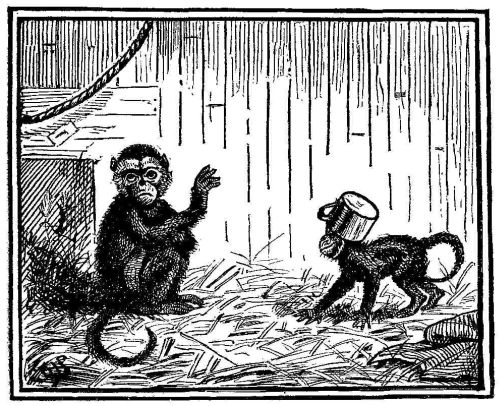
Mrs. Stubbs. "Good gracious, child! I wish you wouldn't wear that tin cup; it makes you look like a common Hand-organ Monkey."