AUTUMN LEAVES.
Reading edition
BY A. W. ROBERTS.
Last year hundreds of persons obtained from the Superintendent of Central Park, in New York, special permits to gather autumn leaves, from the ground only, in any part of the Park. These leaves, when dried, are used by artists and designers as types of nature's beautiful forms and color-work, also by botanists and wax-flower workers, and for home decoration, or are disposed of to city florists, at so much per hundred leaves, to be worked up in various floral designs. Thousands of "American Autumn Leaves" are sent every year to Europe, where they are highly prized.
Fig. 1.
Among some of the best varieties of leaves as regards color, form, and durability are those of the maples, sweet gum, sumac, dogwood, Virginia creeper, and crane's-bill geranium. The popular idea that an early frost is needed to insure the brilliancy and perfection of autumn foliage is a mistake. A lingering and moist fall is all that is required to produce the most brilliant colors.
When gathering leaves, always select those that are fully matured, and are leathery and fibrous. It is always best to secure them in small bunches, each bunch to contain several leaves attached to a small twig. Be careful also not to have the twig so long or thick that it will interfere with the pressing. I have found a small and light box with a close-fitting cover very useful when collecting leaves. A layer of damp (not wet) moss or grass should be placed on the bottom of the box to keep the air moist, and thus prevent the drying up or wilting of the leaves.
For drying the leaves, old and smooth newspapers, useless books, old sheet music, and old account-books will answer just as well as the most expensive botanical dryers. When arranging the leaves in the dryers, try and place those of the same thickness together, so that there may be a uniform pressure when the weights are applied. I have found a soap-box, filled with stones or other heavy material, and placed on the dryers, one of the best of make-shifts in the way of a well-ordered botanical press.
The time required for drying the leaves is governed by the amount of sap they contain, and the dryness of the atmosphere. Never attempt what is known as "hot-pressing"—that is, pressing with a hot flat-iron—unless you wish to sacrifice the delicate tints of the leaves, and turn to an unpleasant brown the masses of heavy and strong color. I have found by experience that coating the surfaces of the leaves with varnish, bees-wax, and other materials of a waxy nature, is not an advantage. This is particularly true of varnish, which gives to the leaves a glossy and unnatural look, while bees-wax, stearine, and spermaceti cause dust to adhere, which soon disfigures and obscures their beautiful colors.
Fig. 2.
Some years ago I became acquainted with a large number of children who lived on "our block," and their mothers and their fathers; in fact, I was one of the fathers. As a rule, they were all pleasant young people, and it became a pastime with me to entertain, amuse, and find them something to do, particularly during holidays and on Saturdays. In course of time two large and vacant rooms were secured in one of the houses, and I received a sort of standing commission from the parents of the children to fit up and furnish the two rooms as a play house. The following description will give a pretty fair idea as to how the walls were furnished.
Fig. 3.
First a reliable and communicative colored kalsominer was called in to kalsomine the walls of one room in alternate perpendicular bands of a very light blue and a very quiet gray tint, each band or stripe of color being nine inches in width. The other room was papered with a cheap wall-paper which cost about nine cents a roll. This paper was twenty inches wide; the pattern consisted of several styles of imitation chestnut-wood graining. Having on hand a very large quantity of autumn leaves, we set to work disposing of them on the walls of the rooms in the following manner:
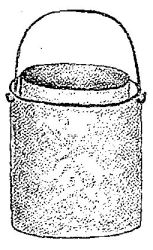
First two glue-pots were made, as shown in Fig. 1, from empty fruit cans, the inner or smaller can to contain the glue, and the outer or larger boiling water. To the outer can a wire handle is attached. With the two cans a constant supply of hot glue was always on hand.
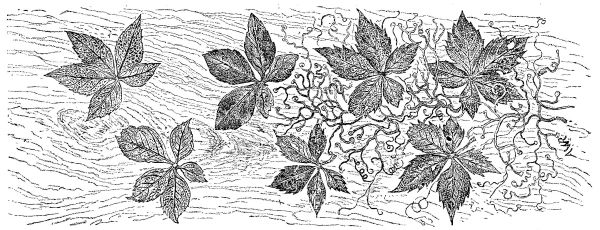
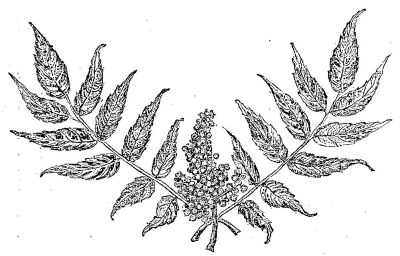
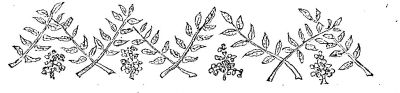
To the grained paper the leaves and tendrils of the Virginia creeper were fastened as shown in the right hand part of Fig. 2. The design, which is here horizontal, will of course be upright on the wall. To every other stripe of graining the leaves of the Virginia creeper without the tendrils were fastened, so as to avoid too much sameness. In this room the top bordering consisted of sumac leaves and berries, as shown in Fig. 3.
Fig. 4.
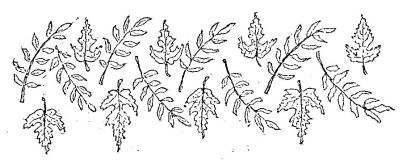
To the blue and gray bands of kalsomine were fastened the brilliant leaves and clusters of the crimson berries of the staghorn sumac, as shown in Fig. 4, and a top bordering of sumac and maple leaves, as shown in Fig. 5.
The leaves were used in a bold and vigorous manner; all fine and close work was avoided, as it would be lost, and the general effect spoiled. For the amount of time expended and the labor and trouble this work cost, we felt well repaid, and every one decided that the result was a great success, and that we had certainly discovered a novel and beautiful use for autumn leaves.
Fig. 5.