A YARN FROM THE LOG-BOOK OF TOM FAIRWEATHER.
Reading edition
A Visit to an Ostrich Farm.
BY LIEUTENANT E. W. STURDY, U.S.N.
"Hello!" cried Tom, "we're off."
Off from Cape Town, South Africa. Wasn't Tom a lucky fellow? He was cruising around the world in his father's ship. To-day he was going a few miles inland to visit Mr. Van Zeilin's ostrich farm. Queer kind of farm, eh? Are you wondering whether the ostriches were the farmers? Well, you'll see.
It was a lovely trip in a railway car, much like our cars at home, by-the-bye, over fair fields bright and sweet with flowers.
Tom enjoyed it after having been cooped up on ship-board for some time; in fact, he grinned from ear to ear with pleasure. I have a colored photograph of him I would like to show you. Blue, roving eyes, yellow hair, round, rosy cheeks—dressed in a suit of sailor clothes. His messmates thought him a nice boy, and called him "Little Boy Blue."
"Ostrich farming is a new thing, is it not?" asked Tom's father, Captain Fairweather, of Mr. Van Zeilin, the owner of the farm they were going to visit, and who, as his name showed, came of the early Dutch settlers of the colony.
"Yes; the attempt was first made only about twenty years ago." (Tom thought twenty years made a very old thing of it.) "We have been fairly successful; our only profit is in the feathers, as you doubtless know."
"Don't you sell the eggs, sir?" asked Tom.
"As other farmers sell hens' eggs? No. The eggs are worth five dollars apiece. We hatch a good many of them by artificial means. These birds are careless of their eggs, and leave them lying around, so that it is part of our business to collect them. In other parts of Africa the natives eat the eggs, however, roasting them in the shell, and stirring the meat with a stick. They also use the thick hard shells for drinking-cups."
The party reached their journey's end, and after eating luncheon at Mr. Van Zeilin's comfortable house, started off to explore.
"Good gracious!" cried Tom; "what's that?" In the next breath he recognized the strange object before him as an ostrich, but just at first he was thoroughly amazed. It was hard to realize that any mere bird could be so big. It was as tall—well, its head would be on a level with the top of an ordinary-sized wardrobe. Its legs alone were four or five feet long. Bird, indeed! it looked more like a young camel than anything else; only it had but two legs. Tom stared and stared. He had expected to see something like a prize turkey, and now this! Meanwhile Mr. Van Zeilin had halted. He began cutting off branches from the tree beneath which they were standing.
OSTRICHES.
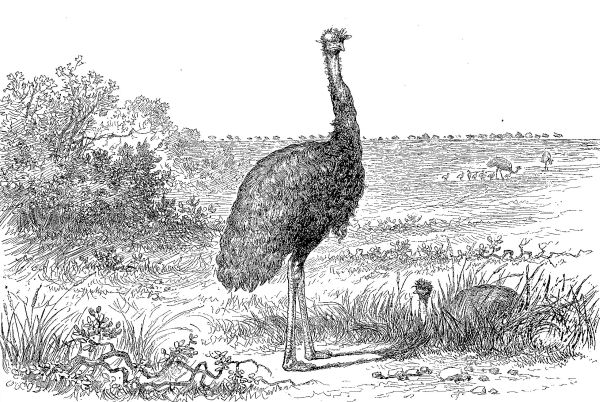
"I wish to show you a nest," he said; "but we shall have to be wary. We may meet with a warm reception. Tom, you are a traveller. What do you propose doing if the ostrich shows fight?"
"I'll fight back," said Tom, valorously. "He's only a bird. I guess I can whip him."
"Not so fast," said Mr. Van Zeilin, continuing to trim his branches, which he forked at one end. "Ostriches are very strong. Their strength is in their legs, and they fight with them. An ostrich has been known to knock down a lion with one well-aimed blow; so I fancy an angry bird would make short work of you, my plucky little fellow. No, I wouldn't advise you to fight."
"He who fights and runs away may live to fight another day," laughed Tom's father. "What do you say to taking to your heels, my boy?"
"You would be likely to get the worst of that too," replied Mr. Van Zeilin. "The ostrich outstrips the horse. He is said to run sixty miles an hour at the start, although he can not keep up this speed. He would soon catch up with you."
"I give it up," said Tom, heartily.
"Fortunately," continued Mr. Van Zeilin, distributing the branches he had been cutting to their party of six, "the ostrich is as stupid as he is strong and swift. I will give you two points. In the first place, when you are pursued by an ostrich, if you come to a fence, get over it, and you are safe, even if it is only two feet high. The fellow could get over it with the greatest ease, but he doesn't know it, and I doubt if he ever will."
"What is your other point, sir?" inquired Tom.
"Just this. If an ostrich makes for you, present a forked stick at him—thus—and slowly retreat. It does not occur to him to dodge you. He conceives himself to be hopelessly pinned, and he abandons the attack. You see now, gentlemen, why I have provided you each with a branch."
"I wonder you don't run up a lot of fences all over your field, sir," suggested Tom.
"That might be a good idea," returned good-humored Mr. Van Zeilin, "except that the ostriches require a long tether. They would die if we fenced them in."
They had entered a field where were collected a number of ostriches in groups, in pairs, and singly.
"The male and female take turns in hatching the eggs," said Mr. Van Zeilin. "But there is a nest that is deserted for the moment. That huge black bird over there is the owner. I wish you to see the nest, and as there are enough of us to intimidate him, I think we may venture."
So saying, the party approached; but the black ostrich showed such evident signs of annoyance, coming up angrily, and craning his neck in a defiant way, as though measuring the strength of the party, that Mr. Van Zeilin directed some of his men to drive him off with their branches.
Mr. Van Zeilin went on: "The long plumes grow in the tail and wings, you observe. Now for the nest. As you see, it is merely a huge hole scraped out in the ground."
"One, two, three, four, five, six eggs," counted Tom. "How big they are!"
Tom dropped behind the party presently as they strolled away, but a piercing scream from him suddenly rent the air. His friends turned in consternation, and saw him tearing after them in a panic, the black ostrich in hot pursuit.
Mr. Van Zeilin had barely time to throw himself between the boy and the bird. In another moment he would have been too late, and Tom's cruising around the world would have come to an untimely end. When Mr. Van Zeilin had succeeded in driving off the ostrich, he turned to Tom. "How did it happen?"
"He looked so quiet, I thought there could be no harm in taking another look at the nest. I only just looked in, and he flew at me."
"But your branch—why didn't you use your branch?"
Tom owned up like a man. "To tell the truth, I was so scared, sir, I didn't know what I was about. I threw away my branch."
It was hard to keep from laughing, now that the danger was over. Tom's hair nearly stood on end, his eyes started from their sockets, and his voice shook with fright. His enemy stood eying him for a moment or two at a little distance, then went back with great strides to his nest, over which at that moment was standing a gray ostrich. Black eyed his visitor suspiciously, then angrily.
"These fellows can not endure any approach to their nests," said Mr. Van Zeilin. "Look at him now!"
Black, in fact, was going through a most singular performance. He threw himself on the ground, wallowed about in the dust, and struck the earth with his wings as though he had gone crazy.
"He is trying to work himself up to a fighting pitch," said Mr. Van Zeilin. "See! the gray is coming nearer. Watch him. Look! he is going through the same manœuvre as the other."
It was extraordinary to see the two birds. The gray did his best to work himself into a passion, the black meanwhile keeping his eye on him, and walking about in an uneasy way. Finally the rightful owner of the nest made one rush, and the other, alas! ran away.
"Oh, what a coward!" cried Tom.
"Not at all," returned Mr. Van Zeilin. "He recognizes the rights of property, and knocks under to the real owner of the nest."
"Hi!" exclaimed Tom, suddenly, and he jumped two feet at least. An ostrich had come up to him quietly, and had begun to peck at the brass buttons on the sleeve of his jacket.
Mr. Van Zeilin laughed. "No danger this time," he said. "That is a female bird. The females are very gentle. Now she is pecking at the locket on my watch chain. Her eyes are as soft as those of a gazelle, are they not?"
"She is a pretty creature, but she has no long plumes," said Tom, examining her.
"No, only short downy feathers, useful for trimming."
"My sister has a coat trimmed with little soft feathers like these," Tom said. "I wonder if ladies and girls ever think of the trouble it is to get their feathers for them?"
"Trouble and danger too," said Mr. Van Zeilin. "I tell you what, I once saw an ostrich come down on a man like a battering-ram. He knocked the breath out of him with one blow; then he rolled him over and over until he thought he had finished him, when he walked away. The man picked himself up slowly, blinded and bleeding. He had kept his face and head covered as best he could, and had realized that his only chance lay in making no resistance."
"Oh, Mr. Van Zeilin," said Tom, "how glad I am you rescued me in time!"
But this yarn is too long already, so we will not stop to tell you about Tom's return trip to Cape Town. Some other time we may spin you another taken from the log-book of "Little Boy Blue."