THE TRAIN BOY'S FORTUNE.
Reading edition
BY ELIOT McCORMICK.
I.
"Papers! Harper's Weekly! Bazar! All the monthly magazines!"
Jim Richards wished that he might have a dollar for every time he had repeated that cry. He was sure he had said it, during the three years he had been train-boy on the road between Philadelphia and New York, as many as fifty thousand times. Even ten cents each time would give him five thousand dollars. What could he not do with as much money as that? His mother should have a new dress, for one thing. He would give little Pete for his birthday the box of tin soldiers in the toy-shop window; and Lizzie, for hers, the doll on which her heart was set. Then they would all move into a new house somewhere in the country, instead of their wretched tenement in New York. Jim himself would give up his place as train-boy and go into the company's machine shop, which he could not do now, because his earnings from the sale of the papers were pretty good, while the machine-shop wages would be for some time small. But these were dreams; the train was approaching Trenton, where Jim would find the New York evening papers, and he had still to go through the last car. It was Saturday evening, and he must make enough to buy his mother's Sunday dinner.
"Papers!" he cried, slamming the door after him, and beginning to lay them one by one in the laps of the passengers. The first passenger was an old gentleman, and in his lap Jim laid a copy of a weekly paper.
"Take it away!" exclaimed the old man. "I don't want it."
Jim, in his hurry, had passed on without hearing.
"What! You won't, eh?" the old man went on, provoked by Jim's seeming inattention. "Then I'll get rid of it myself."
Crumpling it up into a ball, he turned around and threw it violently down the aisle, narrowly missing Jim's head, and landing it in the lap of an old lady on the opposite side.
"You won't lay any more papers in my lap, I guess," he added, shaking his head threateningly as Jim came back.
Jim was angry. He picked up the paper and smoothed it out as well as he could, but it was hopelessly damaged, and no one would think of buying it.
"You'll have to pay me ten cents for that," he exclaimed.
The train was now slacking, and the old gentleman, who was evidently bound for Trenton, had risen from his seat.
"Not a cent," he declared; "not a single cent. You hadn't any business to put it in my lap. I told you not to, but you persisted in leaving it there. You train-boys are a nuisance. It'll be a lesson to you."
"But I'll have to pay for it myself," cried Jim.
"Serve you right. You'll have ten cents less to spend for cigarettes."
By this time the train had stopped, and the passengers were crowding out. The old man was already on the platform, and Jim was standing by the seat, angrily uncertain whether to follow him out or stay and pick up the few papers he had distributed before returning to the baggage-car. In his moment of uncertainty he happened to look down upon the floor. There in the shadow of the seat lay a long leather pocket-book. No one but the old gentleman could have dropped it. Jim stooped and picked it up. Here was a chance to pay off his venerable friend.
In another instant, though, a better impulse came to him.
"What would mother say?" he thought. He threw down his papers, rushed to the door, jumped from the steps, and ran along the platform through the crowd in pursuit of the old man. In the confusion and darkness it was not easy to find anybody. Jim thought he saw him a little way ahead, but at the same moment the bell rang for the train to start. Should he follow the man or not? There must be time, he thought. In a moment more he had caught up with the person, but it was not his man at all. It was too bad, but he had done his best. He did not know that where he had failed, two other persons—dark-looking men, whom he had noticed getting off the car—had succeeded, and were now following the old gentleman along the passageway that leads up to the street.
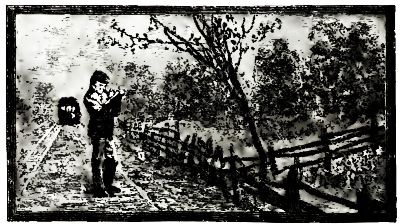
Still uncertain what to do, Jim turned around, only to see the train moving off. It was but a few steps back to the track, and Jim ran with all his speed. But when he got there, the rear platform of the last car was a hundred yards away, and all that he could see was the red lantern winking at him, as it seemed, through the darkness.
The train had gone off with all his papers, including those which he had expected to sell between Trenton and New York. There would be no Sunday dinner to-morrow; indeed, Jim would be lucky if he were not discharged from his place.
"$5000!"
For a moment Jim was bewildered. Then he bethought himself of the pocket-book. He would, at any rate, find out what was in that, only no one must see him do it.
So he walked down the track until he was quite out of sight, and by the light of a match carefully opened the leather flap. On the inside, in gilt letters, was the owner's name—John G. Vanderpoel, 11 Sycamore Street, Trenton. Jim had no excuse now for not returning it at once.
The sight of the name, though, brought back his anger.
"Old screw!" he said, half aloud. "I guess if he'd only known what was going to happen, he'd have paid me my ten cents. Let's see what's in it, anyhow."
The match had gone out, but Jim had another. Striking it, he looked into the pockets, one of which seemed to contain something green. Jim pulled it out with a beating heart. Yes, it was money—a package of greenbacks—and the label on the outside, though Jim's hands shook so that he could hardly make it out, read "$5000."
II.
Not only was Jim ignorant that the old gentleman was being followed, but Mr. Vanderpoel did not know it himself. He walked out of the station with a firm, brisk step, his overcoat tightly buttoned over the place where he supposed his money to be, and congratulating himself that he had at length collected the debt which it represented.
It was not far to his house, which was in a side street, and occupied several lots of ground. A long path led up from the front gate, lined with shrubbery, and lighted only by the pale rays that gleamed from the front door. Alongside of the path stretched a little duck pond. It was a quiet, retired street, and when Mr. Vanderpoel turned into it, he left the crowd behind. He did not leave, however, the two men who had kept him in sight all the way from the station, and who now quickened their steps so that when he stopped at his gate they were not more than a few feet in the rear. Mr. Vanderpoel opened the gate, and went in. The gate swung back on its hinges, and was held open by one of the men, while the other entered. Not hearing the latch click, Mr. Vanderpoel turned around, and was met face to face by the intruder.
"Well, what do you want?" he demanded, angrily.
For an answer the old gentleman's arms were promptly seized and pinioned behind his back, and he himself was laid at full length along the garden path.
"Keep still now," hissed a rough voice. "We ain't no idea o' hurtin' ye, but what we want is them five thousand dollars."
It was not the slightest use to struggle. One man held him fast, while the other went through his pockets. Presently the first inquired of his partner,
"Where do you s'pose he's hid it?"
If it was the money they were speaking of, Mr. Vanderpoel knew perfectly well where he had hid it. It was, or ought to be, in the very pocket which the man was now searching—the breast pocket of his overcoat—and he waited breathlessly for the man's answer.
"Don't know," growled the thief, after a moment. "'Tain't here."
Mr. Vanderpoel almost jumped. If it were not there, where could it be? He had certainly put it in that pocket. He was glad, of course, that the thieves could not find it, but that did not relieve his mind as to its safety. However, if it had already been stolen, or if he had lost it, he could afford to lie still and enjoy what promised to be a humorous situation. Indeed, he felt almost inclined to laugh; and the robbers themselves, it seemed, began to realize that they were the victims of a sell.
"'Tain't on him nowhere," gruffly remarked the one who had been making the search.
"Feel in his breeches pocket," suggested the other.
The man transferred his hand from the coat to the trousers without success. "'Tain't there neither," he growled. "I don't believe he fetched it tonight."
"There's his shoes," observed the first man, who was evidently the more persevering of the two. "See if it ain't in them."
The other tore open the gaiters and dragged them off. The cold air struck Mr. Vanderpool's stocking feet very unpleasantly, and filled him with dismal visions of rheumatism and gout; but he bore it bravely, and by a tremendous effort stopped a threatening sneeze.
"I tell yer he ain't got it," declared the first man. "We're left; that's what it is. What'll we do with the old chap?"
His partner scowled. "Chuck him into the pond."
He chucked into a pond at his time of life, and with his rheumatism! It would be the death of him. The prospect of a ducking loosened his tongue.
"Help! murder! thieves!"
At this moment the gate clicked. Both men heard the sound, and started for the shrubbery at the side of the path. Almost before the old gentleman was aware that they had gone, their retreating footsteps were echoing down the street.
Mr. Vanderpoel felt that he was saved. He would have risen to his feet but for the fact that his shoes were off. The person who had come in the gate, and who was now standing before him, was a lad dressed, as it seemed to Mr. Vanderpoel's confused sight, in the District Telegraph uniform.
"Well, young man," he exclaimed, "I guess you've saved my life. Just help me on with my shoes, will you, and we'll go into the house."
It was some time before Jim could take in the situation, and he stood gazing at the old man without saying a word.
"What are you staring at?" cried Mr. Vanderpoel, hotly. "Do you suppose I'm sitting here in my stocking feet for amusement? I've been knocked down and robbed—or I would have been robbed if some one else hadn't done it already. If anything could reconcile one to the thought of being robbed by one set of thieves, it would be that they left nothing for the next set. But I certainly believe they would have killed me if you hadn't come up. Easy, now"—as the boy drew the gaiter over the old man's knobby foot—"look out for that corn. Now the other one. There! never mind the buttons. Lend me your arm, will you? I'm lame and bruised where I fell. It was lucky I didn't hit my head. Well, I'm sorry I lost the money, but I'm mighty glad those fellows didn't get it."
"Was it much?" asked the boy, briefly. They had now gone up the steps, and, while Mr. Vanderpoel drew out his latch-key, were standing in the light that gleamed through the door. As Mr. Vanderpoel turned around, he recognized, as he had not done before, the boy's features.
"HE HANDED OVER THE BOOK, WHICH MR. VANDERPOEL SEIZED."
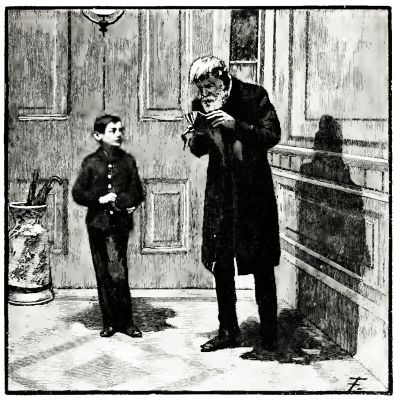
"Hello!" he cried, "you're that train boy. Yes, it was a good deal. Do you know anything about it?"
Jim's face took on a non-committal look.
"Well," he said, "I found something in the cars. Perhaps you'd better identify it. Prove property, you know."
"Come in," said Mr. Vanderpoel, drawing Jim inside and closing the door. "Was it a pocket book you found?"
Jim nodded.
"With money in it?" eagerly.
Jim nodded again.
"Five thousand dollars?" Mr. Vanderpoel whispered.
"I didn't count it," said Jim, briefly. "There it is."
He handed over the book, which Mr. Vanderpoel seized and breathlessly opened. The money was in fifty dollar bills, and did not take long to count. When counted it proved to be all right.
"Yes," said Mr. Vanderpoel, delightedly. "It's all there. It must have dropped out of my pocket when I threw that paper at you in the car. Served me right for making such a lunatic of myself! But what a sell!" rubbing his hands gleefully. "What a tremendous sell on those villains that they didn't get a penny of it! Now come in to dinner"—leading the way through the hall—"and tell me all about yourself. You saved my life, and I'm going to do the correct thing."
And so the train-boy came into his fortune. In the end it amounted to a good deal more than $5000, for Mr. Vanderpoel's ideas of correctness turned out to be on a liberal scale. The family was brought to Trenton and put in a neat little cottage; Pete had all the tin soldiers that he could use, and Lizzie more dolls than she could possibly take care of; the mother got her dress, and Jim had his heart's desire, by being put, not in the company's machine-shop, but in a great deal better one, in which Mr. Vanderpoel was interested, and where Jim himself will no doubt one day be an owner. But better than all is the sense which Jim has of having fought against and overcome a great temptation. And this sense, I think, is the train-boy's fortune.
THE NOVICE.—From a Painting by M. Alexandre Robert.