THE GOLDEN GLOVE.
Reading edition
There was a young, rich, and beautiful lady who was about to be married to a lord. A day or two before the wedding the lord brought his friend, a gallant and handsome young farmer, to see the lady of his choice. The lady fell in love at first sight with the farmer, and ere they parted, the farmer was as deep in love with her.
When the morning of the wedding had come, the lady, love-sick for the young farmer, instead of betaking herself to the kirk to be married, took to her bed, and the wedding was put off. Nevertheless, in the afternoon, she disguised her face, and dressing herself in manly apparel, went with cross-bow on her shoulder, and with her dogs at her heels, to hunt on the grounds of the young farmer, which were part of her own estate.
She crossed and recrossed the fields, whistled and hallooed to her dogs, without meeting the farmer. As she was beginning to fear that he was absent, and was about to withdraw, she met him coming up the road.
She professed to be surprised to see him, as she understood he was to be at the wedding to give away the bride to the lord.
"Ah!" said the young farmer, with a sigh, "I would she were as poor as myself, that I might ask her to give herself to me."
"Are you, then, in love with the promised bride of the young lord your friend? How would you answer to him, should the lady favor your hopes?" said she.
"With sword and axe I would give him a meeting, and let the best man win."
"HERE IS A GLOVE I PICKED UP ON THE WAY."
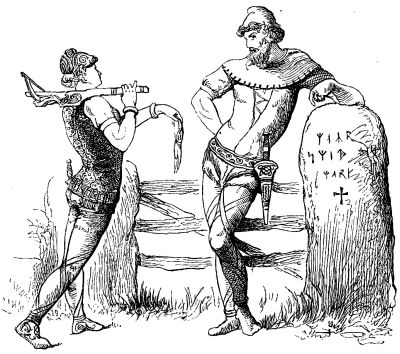
At parting, the lady drew from her pocket a glove embroidered with gold, and said to the farmer, "Here is a glove I picked up on the way thither; as I am a stranger here, I will leave it with you in order that you may find the owner."
Next day she sent out the crier to say that she had lost a glove embroidered with gold, and that she would take the man who found it for her husband, if the man were willing.
The young farmer heard the proclamation, and, half wild with joy, and half doubting his good fortune, took his way to the house of the lady. He presented the glove, and modestly reminded her of the reward promised to the finder, and although that reward was far above his hopes, it was what his heart most ardently desired.
Before he left her, she confirmed the promise of the crier, and agreed to take him for her husband. The report was soon spread abroad, and coming to the young lord's ears, he demanded that the farmer should resign his claim to the lady, or else meet him in single combat.
The farmer answered that he would never resign the lady while there was breath in his body, but that he would meet the young lord when and where he pleased, and with whatever weapons he liked to choose.
Swords and bucklers being chosen, on the day appointed for the fight the lord and the farmer, accompanied by their seconds, or shield-bearers, and their friends, met to settle their difference. With the assistance of their shields the combatants warded off each other's blows for some time, but at last the farmer clove his adversary's shield in twain, and following up his advantage, brought the young lord to his knees by a blow on his helmet.
Then putting his sword to his throat, he made the young lord resign all claim to the lady, and beg his own life.
Soon the handsome young farmer and the rich and beautiful lady were married, and after a time she told him of her device of the glove, and how the game that she hunted that day with her dogs and her cross-bow was the young farmer himself. Both agreed that for the hunter and the hunted that hunting was the happiest that had ever been undertaken in Thulê.
Nature's Barometers.—Certain movements on the part of the animal creation before a change of weather appear to indicate a reasoning faculty. Such seems to be the case with the common garden spider, which, on the approach of rainy or windy weather, will be found to shorten and strengthen the guys of his web, lengthening the same when the storm is over. There is a popular superstition that it is unlucky for an angler to meet a single magpie, but two of the birds together are a good omen. The reason is that the birds foretell the coming of cold or stormy weather, and at such times, instead of searching for food for their young in pairs, one will always remain on the nest. Sea-gulls predict storms by assembling on the land, as they know that the rain will bring earth-worms and larvæ to the surface. This, however, is merely a search for food, and is due to the same instinct which teaches the swallow to fly high in fine weather, and skim along the ground when foul is coming. They simply follow the flies and gnats, which remain in the warm strata of the air. The different tribes of wading birds always migrate before rain, likewise to hunt for food. Many birds foretell rain by warning cries and uneasy actions, and swine will carry hay and straw to hiding-places, oxen will lick themselves the wrong way of the hair, sheep will bleat and skip about, hogs turned out in the woods will come grunting and squealing, colts will rub their backs against the ground, crows will gather in crowds, crickets will sing more loudly, flies come into the house, frogs croak and change color to a dingier hue, dogs eat grass, and rooks soar like hawks. It is probable that many of these actions are due to actual uneasiness, similar to that which all who are troubled with corns or rheumatism experience before a storm, and are caused both by the variation in barometric pressure and the changes in the electrical condition of the atmosphere.
Slain by her Defender.—During King William's wars on the Continent, soon after the Revolution, it was usual, at the end of the campaign, for both armies to retire into winter-quarters, and numbers got leave of absence to go home and see their friends. Among others who availed themselves of this privilege was a young Highland officer, whose relations lived in the upper parts of Perthshire. He visited about in that district, and entertained his friends by talking of the battles in which he had fought, and the wonderful events he had witnessed; and he everywhere met with the most cordial reception. He was at last invited to the house of a gentleman who had an only daughter, whose beauty was the universal theme of admiration. He there, as usual, recited his martial feats, till, like Othello, he made an impression on the young lady, which the gallant soldier soon perceived, and he contrived to settle a plan with her for their eloping together at midnight. They got off unperceived, and having travelled several miles, they at last came to an inn, where they thought they might refresh themselves in safety. The enraged father, however, as soon as he had discovered his daughter's flight, assembled men, and pursued the fugitives with such speed and eagerness that he overtook them soon after they got into the inn. The lover, though he had nobody to support him, yet was determined not to yield up his mistress, and being well armed, and an excellent swordsman, he resolved to resist any attack made upon him. When the party pursuing entered the inn, his mistress ran for protection behind him; but as he was preparing to give a deadly stroke, the point of the sword accidently struck her a violent blow, and she instantly expired at his feet. Upon seeing what had happened, he immediately surrendered himself, saying he did not wish to live, his earthly pleasure being gone. He was executed the next day, but we fail to perceive on what ground, either of justice or of humanity.