Kissing through the Chair.
Reading edition
BY THE AUTHOR OF "JOHN HALIFAX, GENTLEMAN."
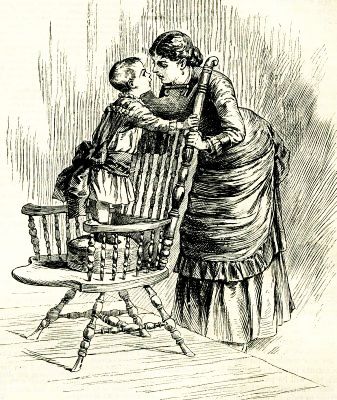
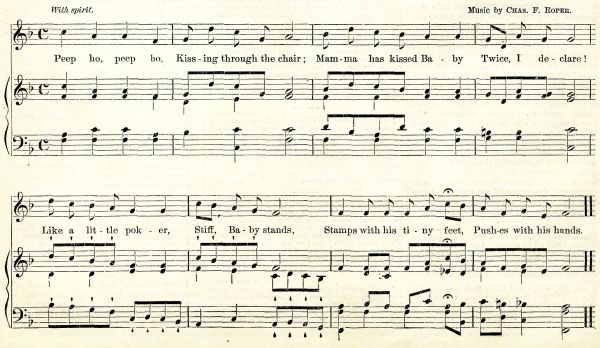
Peep-ho! peep-ho! Kissing through the chair; Mamma has kissed Baby Twice, I declare! Like a little poker, Stiff, Baby stands; Stamps with his tiny feet, Pushes with his hands. Peep-ho! peep-ho! What a funny chair! Baby is as tall as Mamma, standing there! Quite upon a level— And so very grand; Baby might be Prince of Wales, Or king of any land! Peep-ho! peep-ho! Just another kiss! Then he may run away After some new bliss; So wide his world is! So long his year! Baby has no end of joys; Mamma's joy is—here!
The next Number of Harper's Young People will contain the opening chapters of two new serials—"Mildred's Bargain," by Mrs. John Lillie, a delightful story for girls, full of incident, and inculcating a principle which all little maidens should learn as early in life as possible; and "Ten Weeks with a Circus," a story overflowing with experiences of exciting interest to boys, and showing how "all is not gold that glitters."
Those correspondents whose letters offering exchange have been once printed are desired not to repeat their requests, except in cases where an entirely different article is offered. In justice to the new exchanges, we can not make room for repetitions. If any boy finds that his offer to exchange postage stamps, for example, having been published several months since, is now overlooked, he can continue adding to his collection by answering the new offers which appear weekly in the Post-office Box.
We can not undertake to rectify mistakes and settle disputes between those who are exchanging. Considering the very large number of requests for exchange which have been printed in the Post-office Box, we have received very few complaints of unfairness, and in those few cases, as we can not hold court and allow both sides a hearing, it is impossible for us to judge of the justice of the accusation. Very satisfactory reports are given by nearly all of the boys and girls of the successful and pleasant manner in which they have added to their different collections, and we are gratified to find that, with two or three exceptions only, packages of stamps and curiosities of all kinds have been safely and pleasantly exchanged by our young friends. Remember, boys, that these small exchanges you are now making with each other represent in miniature the large business transactions to which you will be parties when you are men. Act always honestly and honorably, and instead of trying to gain an undue advantage for yourselves, make it your constant study to give a fair equivalent for what you receive. In that way you will form characters which will help you to become upright men, and entitle you to the respect of all with whom you may have dealings.
In spite of our oft-repeated advice to correspondents in regard to the care necessary in addressing the letters they send, as well as to give their own address in full, we receive communications constantly from boys and girls who are the recipients of letters they can not answer, as the sender has given only his name, and neither the town nor State in which he lives, and in many cases no signature whatever. The young exchangers who receive these unsigned epistles are so honorable as to feel much distressed because they can make no acknowledgment of the favor, and request help from the Post-office Box in obtaining the address of their negligent correspondent. We can not give up space to the rectification of these acts of carelessness, and the writer of the unsigned letter will realize, when he receives no answer, that inattention will surely bring its own penalty.
Redmyre, Sydney, New South Wales, Australia.
I am a little girl twelve years old. I am going to write this letter all by myself. I go to school with three other little girls. Last Thursday night we all went to see the Juvenile Pinafore. All who acted were children, and we enjoyed it very much. We are having Michaelmas holidays just now (September 28).
I tried Nellie H.'s and Sadie McB.'s recipes for candy, and I liked them very much. I send a recipe for sugar-biscuits: Mix together a pound of flour, six ounces of butter, two tea-spoonfuls of baking powder, half a pound of sugar, three eggs, and a pinch of salt. Mix well the flour, sugar, powder, and salt, rub in the butter, then add the eggs, well beaten. Add enough milk to make a dough. Roll it out thin, cut it into small round biscuits, and bake in a hot oven.
I like Young People very much. We never get it here until a month after it is printed.
Gertie R.
Dresden, Saxony.
My young friends, if you would like to make glass slides for your magic lanterns, I will tell you how to put any drawing you wish on the glass. Take a glass of the required size, put a thin layer of wax on it, and after having heated it for a while over a candle flame draw the figures or landscapes in the wax with a knife point or a pointed stick until your instrument touches the glass. Then take a lead vessel with an opening almost as large as your piece of glass. Put into this vessel a small quantity of fluoride of calcium, and mix it with sulphuric acid. When this is all prepared cover the lead vessel with the glass plate, the waxed side downward, and heat the vessel a little. While heating it you will perceive bitter-smelling vapors of hydrofluoric acid, which come in contact with the glass where the wax has been scraped off. After about fifteen or twenty minutes take away the plate, heat it, and wipe off the wax. You can also wash it off with spirits of wine. When the glass is cleaned you will find your drawing engraved on it, and you may afterward color the design to suit your taste.
One thing must not be overlooked. When you try this chemical experiment, do not inhale the vapors of the hydrofluoric acid, for they are very injurious, and burn the skin very badly. Always experiment in a room to which plenty of fresh air has free access.
I wish you much success, and hope you may thus have some pleasant hours during the coming winter days. If any one of you knows some other experiment, I should be ever so glad to see it in the Post-office Box.
Louis G. E.
We hope the members of our Young Chemists' Club, who will no doubt try this pretty experiment, will not overlook for an instant the dangerous qualities of the chemicals, and bear constantly in mind the caution given by the correspondent, as a little carelessness might lead to very serious trouble. If Louis G. E. knows any easy method of coloring the glass slides for a magic lantern so that the paint will be sufficiently transparent and yet firmly set on the glass, he would confer a favor upon many readers of Young People by describing it.
Binghamton, New York.
I like Harper's Young People very much. The stories and the little letters are all pretty. I intend to have volume first bound before Christmas. If I knew enough readers of the paper who lived near me, I would begin a society right away like the one N. D. wrote about.
I have four pet rabbits which I can lay on their backs like kittens. Their names are Jerry, Billy, Dicky, and Bessie. Jerry is white with pink eyes, Billy is gray with black eyes, and Dicky and Bessie are black with blue eyes.
T. P. G.
Richmond, Virginia.
I like Harper's Young People. I have been reading it in bed, for I have been sick for two months. I have had the scarlet fever. I have made a waltzing fairy, and a cucuius out of cork.
I had a pet hare, and once I forgot and left it tied in the hot sun. It had a sunstroke and died. It used to sit on its hind-legs, and take its fore-paws and wash its face real clean. I had a pet deer, too, that was sent me from the White Sulphur Springs, but he would cut me with his fore-hoofs, and he was so wild he broke off his young horns, and we had to kill him.
I have a collection of Indian arrow-heads and minerals. I am eleven years old.
Davis C.
Keswic, Iowa.
I will tell Jessie Lee R. how I make scrap-books. I get some large volume that is worthless—an old agricultural report or book of advertisements will do—and cut out every other leaf. I make paste or starch, and lay it on the scraps with a brush or a knife. After pasting, it is a good plan to lay clean paper between the leaves until the paste is dry. It is better to let the leaves dry slowly under heavy pressure than to iron them.
May L.
Detroit, Michigan.
I went to Cincinnati lately, and I visited the Zoological Garden. I bought some candy, and gave it to the monkeys and the Rocky Mountain grizzly bears. They would stick their mouths through the bars, and open them for me to throw in the candy. There was a white polar bear who was swimming all the time. When I threw a stone in his tank he would dive after it, and bring it up and throw it at me.
N. P. G.
Oswego, New York.
I am fourteen years old. I enjoy Young People very much. I always read all the stories and all the letters. I wish some little girl would tell me how to make some Christmas presents, some that would be pretty and not very expensive. I have made almost everything I can think of.
I am going to try the hanging basket described by Daniel D. L., which I think will make a very pretty ornament. I would like to ask him if it is necessary to empty the cup, and put in all fresh water every morning, or if only to fill in what has evaporated is sufficient.
Carrie V. D.
St. Louis, Missouri.
We have had a big snow-storm here. It begun in the night, and lasted until noon to-day (November 6).
I have taken Young People since the first number, and now I am beginning the second volume. I am going to take it always.
J. T. M.
Berlin Heights, Ohio.
Correspondents wishing a catalogue of birds' eggs can obtain one by sending ten cents in stamps or silver to W. J. Knowlton, 168 Tremont Street, Boston, Massachusetts.
Milton D. C.
All boys from eleven to sixteen are invited to become members of a debating society on a legal basis. The debates are carried on by mail. For further particulars address, inclosing a three-cent stamp for answer, the recording secretary,
A. G. Norris, 2222 Pine Street, Philadelphia, Pennsylvania.
We hope this new society will meet with better success than the one noticed in the Post-office Box of Young People No, 52. The idea is very good, and if well developed might prove beneficial to the youthful debaters. We are requested by N. L. Collamer, to whom communications for the first society were to be addressed, to inform those from whom he received answers to his proposition, that in spite of all his efforts, and much to his regret, the club he tried to form was not successful. Correspondents will please accept this statement as an explanation why their letters to him have remained unanswered.
I wish to inform those boys with whom I have been exchanging that as the nesting season is over I have no more eggs.
I have two United States half-cent pieces, one of 1804 and one of 1825, which I will exchange for some United States Department stamps, or old issues of postage stamps.
Wallace Ross, Lock Box 97, Rutland, Vermont.
I have a collection of birds' eggs, and would like to exchange with any subscriber of Young People. I will exchange the egg of a king-bird for one of a martin. I would request all correspondents to label distinctly all eggs they may send.
Charles Matthews, P. O. Box 15, Fort Covington, Franklin County, New York.
I would like to exchange postage stamps. I have some very rare stamps from Greece and from South America.
Peyton A. Savin, 1262 Lexington Avenue and Eighty-fifth Street, New York City.
I have a collection of nineteen hundred and twenty stamps, and a great many duplicates. I would like to exchange with Charles H. W., of Brooklyn, New York, who has such a large collection. If he will send me his address and a list of his duplicates, I will send him a list of my best ones.
K. S., P. O. Box 203, New Bedford, Massachusetts.
I live in a little town of about eighteen houses, on the Champlain Canal, thirty miles from Saratoga. I have a printing-press, a collection of birds' eggs, and some white bantams and some rabbits. I have to go five miles every morning to a military school. I stay there all day, and ride home in a stage at night.
I would like to exchange flower seeds, birds' nests, and specimens of quartz for postmarks, stamps, birds' eggs, or curiosities.
Will you please tell me how to mount postmarks properly?
George E. Baker, Comstocks, Washington County, New York.
Postmarks should be mounted in the same manner as stamps. You will find directions for mounting specimens neatly and conveniently in the paper entitled "Stamp Collecting," in Young People No. 54.
My brother and myself are collecting coins, minerals, birds' eggs, shells, and stamps, and will be glad to exchange with any readers of Young People. Some one sent us a box of shells and a star-fish, but unaccompanied by any address. If we can find out who sent it, we will be glad to send something in return.
L. F. Brehmer, Penn Yan, Yates County, New York.
Harry Gustin, of Bay City, Michigan, is also troubled because he has received several unsigned letters which he wishes to answer, and can not for want of an address. Leon M. Fobes, of Portland, Maine, has sent stamps and written several times to a correspondent, but has received no answer. All this trouble is the result of carelessness and negligence on one side or the other. Always remember to direct your letters properly, and to give your full address.
I like very much to read the letters in the Post-office Box. I, too, am trying to make a collection of stones, one from each State. I would like to exchange with any readers of Young People. I will give a stone from either Wisconsin, Illinois, or Colorado for one from any other locality.
Mamie H. Ball, Augusta, Eau Claire County, Wisconsin.
I would like to exchange a box of good paints for a little engine.
E. Benson, Care of W. H. Francis, 749 Broad Street, Newark, New Jersey.
We wish very much to get a bow from the Indian country, and if any boy or girl living there would send each of us an Indian bow about five feet long, with a few arrows, we will give in return pressed leaves, or a winter bouquet of Minnesota grasses, or any curiosities we can get in this locality, or in the spring we would send in return a collection of birds' eggs.
Maud Pool and Phebe Eddy, Morristown, Rice County, Minnesota.
We are compelled to condense the following offers for exchange:
Coins and postage stamps.
Willie T. Knox, 2318 Third Avenue, New York City.
Postage stamps and eggs.
Perez S. Burr, Freeport, Maine.
Postage stamps for postal cards and stamps.
Anita R. Newcomb, 1336 Eleventh Street, Washington, D. C.
Ohio postmark for postmarks from any other State, and old issues of United States postage and revenue stamps for foreign stamps.
George E. Frazier, Caldwell, Noble County, Ohio.
Postmarks for different kinds of buttons.
Mary P. Bice, 39 Second Street, Utica, New York.
P. S. B.—A cheap, substantial squirrel cage may be made in the following manner: Take a piece of board about eighteen inches wide and three feet long for the bottom. Fasten upright boards about three feet high at each end. These end pieces must be rounded at the top. Now buy from any dealer in hardware a piece of coarse strong wire netting long enough to go over your wooden frame, and nail it securely to the bottom board on one side, and to each of the end pieces, bending it over the rounded top. If you fasten it with stout tacks, it will be strong enough, and there will be no danger of splitting the wood of the ends. On the front of the cage the netting should stop within three inches of the bottom, so as to leave room to put in a drawer, like the drawer of a bird-cage, which you must pull out and clean every morning. Make the drawer of a sheet of tin. Any tinsmith will turn up the sides for you, leaving the front a little higher than the others, so as to overlap the netting. If you can procure the wire netting only of a certain width, grade the length of your cage accordingly.
If you can get a stout branching bough of some hard wood, fasten it securely from end to end of the cage before putting on the wire covering, as your pet will enjoy climbing about on it much better than running in a revolving cylinder, which is neither healthy nor natural exercise for a squirrel. The end boards must also be of some hard wood, or the sharp teeth of your little pet will soon make sad havoc with them.
Now for the sleeping apartment. Cut a round hole in one of the end boards near the bottom, and fasten on the outside a neat little box, the bottom of which must be level with that of the cage, so as to present the appearance of a tiny extension. In this box there must be a hinged door large enough to allow you to change the bedding, which must be clean dry moss or cotton-wool, and through which you can feed your pet. You can also cut a small hole in the wire netting at the top of the cage large enough to admit a nut, and the squirrel will soon learn to climb up and take food from your hand. After cutting the hole, bend back the ends of the wires, so as to leave no sharp edges. Give the squirrel a little milk occasionally. You can put it in a dish like a canary's bathing-cup, which is low enough to slide out and in with the drawer. If you are ingenious, you can make a neat and comfortable cage at a very trifling expense.
Victor L.—The first of the historical sketches entitled "Old Times in the Colonies" is in Young People No. 35.
E. M. B.—Your "first attempt" is correct and very pretty, but unfortunately the same solution appeared in Young People No. 22, therefore we can not use it.
L. B.—Mexico has so much commercial intercourse with the United States that Mexican postage stamps are as easy to obtain as those of any Spanish-American country.
L. B. S., Hempstead.—It is contrary to the rules of our Post-office Box to print letters offering articles of any kind for sale.
Correct answers to puzzles are received from Isabel L. Jacob, John N. Howe, Emma R., Allie Maxwell, Alice Ward, G. Volckhausen, Bell, Annie Volckhausen.
Favors are acknowledged from H. L. J., Arthur H. Gould, Theresa Morro, Harry McG. Wood, Edith Bidwell, Agnes D. C., Charles De Gaugue, Bessie Guyton, Clyde E. Marsh, Gilbert P. Coleman, F. L. Van Valkenburgh, S. P. Duffield, Mary Louisa Olmstead, E. W. Rice, Nellie Anderson, R. D. Britton, E. A. De Lima, Percy Cunningham, Mary F. Wright, Winifred Serl, Arthur Kramer, Libbie M. Hayes, Josie A. Dole, Thurman Allen, Charlie L. Lewis, Louie E., M. Leona N., May F. Brinckerhoff, Freddie Barnes, Harry Clark, Eddie Williams, Grace A. Lindsey, Dora A. Knobel, Bertie Reid, H. W. S., Frank E. Boyd, Josie M. Patten, Arthur D. Thaller.
ANSWERS TO PUZZLES IN NO. 54.
No. 1.
H
LAG
LILAC
HALCYON
GAYLY
COY
N
No. 2.
SOFACORD
OPENODOR
FEETROSA
ANTSDRAY
No. 3.
EDINBURGH
BENARES
BERNE
ECK
E
ULM
LYONS
BARNAUL
SINGAPORE
No. 4.
Astronomy.
CHARACTER TREES.
1. Pear. 2. Bay. 3. Pine. 4. Date. 5. Crab. 6. Fir. 7. Box. 8. Broom. 9. Sloe. 10. Spruce. 11. Bread-fruit. 12. O-range. 13. O-live. 14. Mace. 15. Locust. 16. Cork. 17. Haze-l. 18. Plantain. 19. Cedar. 20. Plane. 21. Beech. 22. Sandal. 23. Vine. 24. Red ash. 25. Palm. 26. Judas.
Throwing Light.—Hair, hare.
Anagram in letter on page 30—Scythe.
PUZZLES FROM YOUNG CONTRIBUTORS.
No. 1.
TRANSPOSITIONS.
Transpose joined, and get separated. Transpose a cave, and get a coward. Transpose a language, and get an eating-trough. Transpose a person of rank, and get to confuse. Transpose indifferent, and get a soup-dish. Transpose a species of gems, and get curious. Transpose brutal, and get profit. Transpose to confuse, and get displeased. Transpose a chief, and get a current.
Bolus.
No. 2.
EASY NUMERICAL CHARADES.
1. I am a bird composed of 9 letters.
My 4, 6, 3, 9 is part of a wheel.
My 8, 2, 1 is an opening.
My 7, 2, 5, 9 is to venture.
Aristotle.
2. I am an animal composed of 9 letters.
My 8, 2, 4 is a fish.
My 1, 6, 3 is a pronoun.
My 8, 7, 5, 9, 3, 2 is a bird.
Snowdrop.
No. 3.
EASY SQUARES.
1. First, to resound. Second, a company. Third, a part of the body. Fourth, birds.
G. B. D.
2. First, a shining body. Second, a story. Third, a tree. Fourth, to stagger.
3. First, a bird. Second, something always found in ships. Third, a jewel. Fourth, a spring.
4. First, a river in England. Second, employed. Third, a germ. Fourth, a collection of ancient poetry.
Bell.
No. 4.
ENIGMA.
In stocking, not in shoe.
In white, not in blue.
In grave, not in merry.
In bright, not in dreary.
In foot, not in arm.
In tropic, not in palm.
In denial, not in yes.
In gown, not in dress.
In bread, not in pie.
In laugh, not in cry.
In second, not in third.
The whole a singing-bird.
Maggie L.