THE PIANO-FORTE.
Reading edition
BY MRS. JOHN LILLIE.
I wonder how many young people who sit down to practice or take a lesson at the piano-forte know the story of the instrument now familiar in every household of the civilized world. Look at it as we have it to-day, almost perfect in size and quality and tone. It is capable of producing the fullest and the softest sounds, just as its name indicates, for piano means soft, and forte means loud. Can you realize that little more than a hundred years ago pianos were a rarity? Only one or two makers produced any instruments worthy of the name, and few households possessed one. "But," I can hear my young readers exclaim, "the music we play on our pianos—Bach and Haydn, as well as old English airs—were certainly played on some horizontal instrument." Of course they were, but not on our kind of piano-fortes; and the story I am going to tell will take you back far into the sixteenth century, when ladies of rank, and monks and nuns, and some troubadours, had the instruments from which our piano is descended. These were known as the clavichord and the virginal.
The clavichord was perfected about 1500, and the name was derived from "clavi" (a key) and "chorda" (a string); so you see at once that it contained the two principal elements of our piano-forte. Although it went out of use in Bach's day, yet that dear old master, whose gavottes all our young people are playing now, loved to use it. The piano-forte had been invented, but Bach loved his old clavichord. As he sat thrumming it, I think he liked to fancy himself away in the early sixteenth-century days, when Henry the Seventh's court enjoyed madrigals and queer little bits of music on the same sort of an instrument. Following the clavichord, we have that graceful, romantic instrument called the virginal. This was an improvement on the clavichord, and toward the close of the sixteenth century we find its name in poetry, romance, biography—indeed, in history.
VIRGINAL.
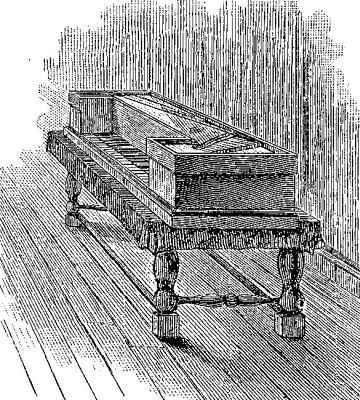
The virginal produced a low, tinkling sort of sound not unlike that of the German zither. Only ladies of quality, musicians, or nuns or monks in convents, performed upon the virginal, and so I think we associate it with all the grace and beauty and the slow stateliness of that romantic epoch. When I think of a virginal, it seems to me to bring many suggestions of rich colors, softly fading lights, the flash of jewels, or the movement of white hands, oak wainscoting, and tapestried walls—perhaps some very sad and sorrowing heart, perhaps some young and hopeful one, but always something that is picturesque and dreamy.
Perhaps we would not think it so sweet an instrument to-day, but assuredly in the sixteenth century it moved people to very tender, elevated thoughts. Shakspeare wrote of it with deep feeling, and there are some quaint lines of Spenser's about it. "My love doth sit ... playing alone, careless, on her heavenlie virginals."
In 1583, Sir James Melvil was sent by Mary Stuart to England as Ambassador, and in his memoirs he relates how he heard Queen Elizabeth play. He says that Lord Hunsden took him up into a "quiet gallery," where, unknown to the Queen, he might hear her play. The two gentlemen stood outside a tapestried doorway, from within which came the soft tinkle-tinkle of the virginal. I wish he had told us what the Queen was playing. Presently, it appears, his curiosity to see her Majesty overcame his prudence, and he softly raised the curtain, and went into the room. The Queen played on, "a melody which ravished him," he says, but for some moments did not see that any one was listening. Is it not a pretty picture?
At that time the Queen had not lost the charm of youth, and in her splendid dress, with her head down-bent, her figure at the quaint virginal against the rich and sombre colors of the room, must have looked charming, and the silent Scotch gentleman just inside the doorway listening in rapt attention: it is so poetic a picture of the time that we can almost hear her music, and if we read on a little further, we see that the Queen, suddenly seeing Sir James, came forward, remonstrating with him for having come in, for, she said, she was not used to play before people, but only to "shun melancholy." Then she sat down upon a low cushion, and honest Sir James, according to the custom of the time, fell upon his knees before her. The Queen, with a truly feminine spirit, inquired whether he thought she or Mary Queen of Scots played the best. Sir James said that his sovereign played "reasonably, for a queen." This answer would not serve to-day, as the Queen of England is one of the most perfect of amateur musicians.
ITALIAN SPINET, ORNAMENTED WITH PRECIOUS STONES.
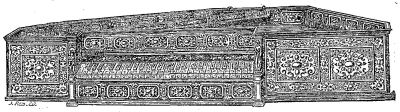
The virginal and spinet belong to the same period. From them, as need of a more elaborate performance grew, we have the harpsichord. A very fine harpsichord looked something like a grand piano, but it had two rows of keys, one upper and one lower. I shall not here go into a description of the harpsichord. It is only needful to say that it was the outgrowth of clavichord and virginal and spinet, and had some of the defects as well as the good points of all three.
HANDEL'S FAVORITE HARPISCHORD.
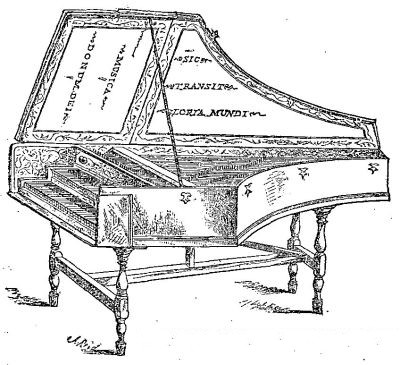
Our great-grandmothers played upon harpsichords. They were tinkling little affairs, yet I fancy that Mozart's and Haydn's music must have sounded very quaint and pleasing upon them. Where have they all vanished to, I wonder?—along with the flowery brocaded gowns, the slender fans, the powder and patches and paint, of that dear old time?
In an old house I once visited, a harpsichord of seventeen hundred and something used to stand neglected and disused in an upper hall. Sometimes we children thrummed waltzes upon it; sometimes I remember our getting out a faded old music-book with the picture of a shepherdess on it, and picking out the funny little songs that were printed there a hundred years ago. On the fly-leaf of the book was written in a very flourishy hand, "To Isabel, from J——." Who was Isabel, and who was J., we used to wonder.
I can fancy that the music she played to please her mamma and papa, and perhaps her uncles and aunts, was of a very primitive order, for when harpsichords were used, young ladies were not at all proficient. Music was then considered a "genteel" sort of accomplishment, and good masters were very rare, and never tried to make their pupils do more than strike the notes correctly and in good "dum-dum" sort of time. Consider our advantages now, and yet I fancy those young people of "Isabel's" day valued their musical instruction much more than we do ours.
PIANO OF ABOUT 1777.
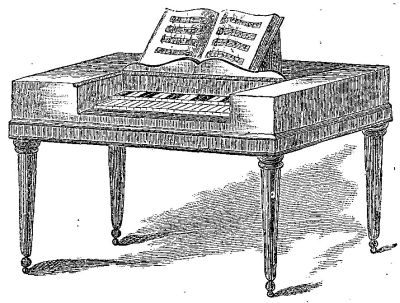
Well, then, from this pretty, picturesque harpsichord period, we find ourselves by slow degrees in that of the piano, and I suppose the first thing you will wish to know is how a piano-forte differs from these other instruments of which I have been writing. The principal difference is that the strings are struck with a hammer. About the beginning of the eighteenth century this idea had originated with three men at once—an Italian named Cristofali, a Frenchman named Marius, and a German named Schröter; but all investigators seem convinced that Cristofali was the real originator. His ideas were the best. So, later in the century, when harpsichords began to be thought incomplete, different makers tried to produce something better, and the result was the primitive piano-forte.
At this time the composer Sebastian Bach was in Berlin. Frederick the Great was eager to hear him play, and as that famous sovereign possessed several of the new piano-fortes (or forte-pianos, as they then were called), Bach came one evening to the palace, where a crowd of gay ladies and gentlemen were assembled.
The composer had to go from room to room, trying first one of the new pianos, then another. These instruments were manufactured in Germany, but, later, English and French pianos took the palm, and about the beginning of this century American ladies were growing proficient in the art of piano-playing—proficient at least for that day. Have you not all seen your grandmammas' music-books, in which "The Battle of Prague" is an honored "piece"? True, there were hundreds of nobler works, but only public performers seem to have attempted them.
As time went on, and the interest in the instrument grew, the mechanism of the piano-forte was improved, and at this date (1881), it is considered perfect. Here and there as you play, as you listen to the sounds of the little hammer falling on the strings, let your thoughts wander back to Mary Queen of Scots and Elizabeth of England, with their virginals and spinets—indeed, farther into the' realm of poetic, dreamy sound, for beyond these were clavicytheriums, citoles and citherns, dulcimers and psalteries, and in the East, among the people whom we see now in sculpture, a whole line of lyres and harps and lutes.
It may not seem that so far away as early Egyptian days was the first idea of our piano, yet certainly such is the case. In some far Eastern country you might see, graven in stone of centuries gone by, a figure holding an instrument dimly shadowing that on which you now may play all written music.