KING HAZELNUT
Reading edition
King Hazelnut, of Weisnichtwo, A jolly King was he, And all his subjects, high and low, Were happy as could be. They feasted every day on pie And pudding and plum-cake, And never broke the law—for why?— There was no law to break. Oh, jolly was King Hazelnut, Especially at noon; Then many a caper he would cut, And hum a merry tune. And from his golden throne he'd hop, And fling his sceptre down, And on the table, like a top, Would spin his golden crown. Then he would slap his sides and sing Unto his serving-man, "That rolly-poly pudding bring As lively as you can."
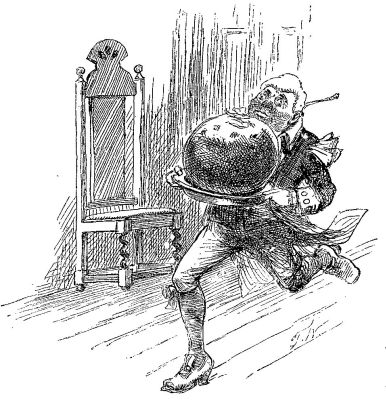
.

A HAPPY THANKSGIVING and a splendid time to all our boys and girls!
Glencoe, Louisiana.
Viola E. would perhaps find the names most familiar to your young Creole subscribers in Louisiana as unaccustomed as are those of which she writes to the ears of children outside of Virginia. In this house the young girl to whom Young People is addressed was christened Elmire, but is known only by her petit nom of "Fillette." Her mother's name is Gracieuse—is it not musical? An impish little ebon-hued maid in the yard is Mariquite. Another, with gleaming ivories, is Yélie. A cousin who comes often, and is nearly old enough to cast his vote, is yet "Bébé," despite his sponsors having called him Édouard. And "Guisson," his brother, who would guess his name to be Émile?
A little knowledge of creole interiors would correct the ideas so prevalent as to creole indolence. Away down here, on a sluggish little bayou that makes its way through the plantation to the not-far-distant Gulf, these young girls, though not perhaps speaking so good English as their Virginia sisters of Anglo-Saxon extraction, having learned it rather from the lips of negro servants than from their parents, are, at any rate, their peers in womanly accomplishments, if practical knowledge of the details of a ménage constitutes such—the ability to wash, starch, iron, straighten a room, make a gumbo, mix a cake and bake it, etc. The very neatly made calico dresses they wear are their own handiwork. After five hours spent in the school-room with their institutrice, and the required time given to the practice of their piano, one of them is amusing herself by making a quantity of under-clothing for a beloved little filleule. A basse-cour of about six hundred turkeys, ducks, and chickens is cared for almost wholly by the two girls and their mother. Domestic virtues these, worthy even of Yankee girls, are they not? Just as much, though, as Yankee girls or as Virginia girls do these young Louisianians claim their heritage as Americans and their place among your "Young People."
L'Institutrice.
We have read this letter with great pleasure, and now we would like to hear from somebody about our Western girls; and the New England girls too will find a corner waiting if they choose to write.
Harper, Iowa.
I can now read all the long stories in Young People. I liked "Tim and Tip" very much, and think the bear hunt was quite funny. I had a pair of white doves given me as a present. One of them, in trying to fly through the screen door, broke its neck, and the other flew away with some wild ones. So I lost my pets, and was very sorry. I am sorry for Jimmy Brown. He makes me think of myself sometimes. My sister teaches piano music. My two brothers play in the Cornet Band, and I am learning music; so we have plenty of music. We all go to school.
Harper R.
Manhattan, Kansas.
I have three brothers and two sisters. This summer we all went to New Mexico. We stopped at Las Vegas, and saw the Hot Springs, and the water in the springs was so hot that we could not hold our hands in it. And we stopped over Sunday at Santa Fe, and saw the Corpus Christi procession. We saw a horned toad that ran as fast as a horse. We brought back two donkeys, and mine threw me off, and broke my two front teeth. Uncle Henry gave us some saddles. Our baby is only two months old, and has red hair. I liked "Toby Tyler" best of any. I am nine years old. My name is
Maggie P.
ROSA MAYFIELD'S LOSS.
Let me introduce my readers to a bright, sunny-haired girl who on a pleasant morning in July is playing in a large garden. She first sits down in a pretty little arbor, and sews for a short time; then she puts her work away, and goes to plant some seed which old James, the gardener, has given her. Suddenly she hears some one calling to her from the house.
"Rosa! Rosa! come here a minute, my child."
"Yes, mamma," said Rosa; "I will come as soon as I have put away my tools."
When she reached the sitting-room, her mamma was not there, but on running to the bedroom, she found her, all dressed to go out, and putting on her gloves. As soon as she saw Rosa, she said: "Would you like to go to the cattle show with me, dear, and then go to your cousins, in the country for tea? The carriage will be round presently."
"Oh yes, indeed I should, mamma," said the little girl, as she skipped away to nurse to be dressed.
"Oh, you darling mamma," said Rosa, as she settled herself in the carriage beside her mother. "I always enjoy going to tea with May and Clara Haliburton so much! and I have never been to a cattle show;" and here she clapped her hands and laughed so loud that her mother had to tell her to be quiet, as the passers-by would think she must be a very badly behaved little girl.
At last, they reached the cattle show. Then they got out of the carriage, and went inside. There they saw dogs, cats, rabbits, and all sorts of animals. Rosa was greatly delighted with a beautiful white rabbit with pink eyes.
After they had seen enough, they drove to the rectory, where the Haliburtons lived. After Rosa had said good-afternoon to her aunt, May and Clara took her to see the chickens and rabbits, the donkey, and all their other pets. Never had she spent such a delightful afternoon, and was very sorry when the tea bell rang, and they had to go in. But what a tea they had! Muffins, cakes, and preserves of all sorts, and such delicious fresh bread and butter, and new milk from her uncle's farm. At a quarter to nine the carriage came to take them home, and they had to say good-by.
Rosa was so tired that she fell asleep in her mamma's arms, and never woke till the next morning, when she found herself in her own little bed.
In Mrs. Mayfield's room some parcels are waiting, addressed to Miss R. Mayfield, one large, and the others small; and as it is Rosa's birthday, she is to open them herself. All the small ones are opened. In one she finds a gold brooch from her mamma; in another is a prayer-book from her father; in the others are presents from all her little friends. At last she unties the string and draws off the paper of the large parcel, and gives one scream of delight as she sees in a beautiful lined basket the little rabbit she saw at the cattle show. The lady to whom it belonged, being a friend of Mrs. Mayfield, had heard Rosa saying she would like to have it, and had sent it to her. Rosa ran off with her new pet to feed it, and after showing it to everybody she took it into the garden and put it into a cage close by her arbor, in a sunny corner, where she could always see it. She kept it carefully for three months; but on going to feed it one morning, with her hands full of lettuce leaves and clover, she found her pet was gone. A cruel cat had come every day and watched her feeding her rabbit, and at last, seeing her just pull the door to, and not lock it, had seized the opportunity, and had carried off her pet.
Poor little Rosa cried herself to sleep that night, and for many nights after, and never loved any of the pets her mamma gave her as she had loved her little white rabbit.
Gussie Tobias (aged 10 years), Liverpool, England.
Okahumpka, Florida.
I am a little girl ten years old, and live away down in South Florida, where the sun is always bright and the trees always green. In our quiet little home there are only mamma, Addie, and I. Our dear father is dead. Sister Addie is six years old. We have no school, church, nor Sunday-school. Mamma gives us our lessons daily at home, and a kind English gentleman gives me music lessons. We do not know who sends us the Young People, but hope our kind unknown friend will see this letter, and learn how much we enjoy the gift and appreciate the kindness. I am suffering from sore eyes, and not allowed to read or write, so mamma is writing for me; but when I get well I will write myself, and tell about our pets and other things.
Rosa M. J.
Scandia, Kansas.
I have been taking your paper almost a year, and like it very much. It was papa's Christmas present to me, so I thought I would write you a letter. I have a pet hen. I call her Brownie. She is getting old now. She answers me in hen language when I take her up and talk to her. I have a canary-bird. I call him Dickey. He is just learning to sing.
Laura H.
Harlem, New York.
I have had my cat Till seven years. We think he is a very wise cat, for he sits upon his hind-legs and begs. When I go down stairs in the morning, if I say, "Good-morning, Till," he will shake hands with me. He is a very dainty cat. He will not eat roast beef unless it is very rare, and he does not care at all for the heads of chickens and turkeys; but he loves cheese and crackers, and will eat all the cake I will give him. I am eleven years old.
Mabel M. S.
Milwaukee, Wisconsin.
I have a great many dolls, and a large doll house in the conservatory, which I enjoy very much, so I thought you would be pleased to have a letter from me. Mrs. Love Lee and her ten children live in the large doll house, which is a little taller than I am. I am six. The babies Faith, Hope, and Love are triplets. I wish we had three live babies. Cozy has two kittens. Cozy is my cat. Arthur and Arabella are twins, about in the middle. Blanche is the young lady, and Fifine the big school-girl. Rosebud is only six inches tall, and her eyes open and shut, and she moves her head and arms and legs. Daffodil is just the same, only smaller, and Joe is the little boy. Ida takes care of the children in the nursery. Dinah is the cook. She is colored very much. Chechon sets the table, and keeps the dining-room in order. Chechon is a Chinese. The twins have a very nice cabinet of shells and stones. I gave them some out of mine. Each of the children have something to do to help their mamma, just, as I do.
I go to Kindergarten, and once a week I speak a little piece out of Baby-Land, or St. Nicholas, or Harper's Young People, or The Nursery. I can say all of "The Cat, the Parrot, and the Monkey." It is just at the end of my bound Harper's Young People. It is called "Filbert." That is the best story I know. I like "The Story of a Parrot," too, but it would have been better if some one had carried him home at last. Papa says he don't see why I like that story so well, but he reads it to me 'most every Sunday. He likes "Toby Tyler" a great deal better, or even "Tim and Tip." They are pretty good too. I don't like story boys as well as I do story animals. I like live animals too. Dogs and cats are never afraid of me, but will come right to me in the street or anywhere. I found a little mud-turtle at Minnehaha Falls, and brought it to papa and mamma by its tail, and it played with me a little while, and then I carried it back to its cave at the side of the path down the gully.
This fall I caught a live star-fish, when the tide was coming in, down on the beach at Portland, Maine, and we brought it home to put in my cabinet when it gets dry enough. It is sticky yet. It is out in the wood-shed drying. When we were going there I caught a mouse. It ran into its hole in the corner of the dépôt, all but its tail. I suppose I took hold too tightly, or else too high up, for he turned around and bit my thumb. I wasn't going to hurt him, but just to play with him a little while. I wish animals could talk. That was at the Montreal dépôt.
You asked about dolls. I have a doll, about a foot high, wheeling a little cart in front of her. When I draw the cart by a string, the doll goes trot, trot, trot on behind, and every one I meet turns around, and says, "Did you ever see anything so funny?" Uncle Ebb found it at Manistee, Michigan, and sent it to me by express.
Blossom is my very large wax doll. I draw her around the block in her carriage every pleasant afternoon. Sometimes Daisy, who is almost as large, rides in the front seat. If it is too warm for Blossom to go out, Daisy will ride in the back seat, and Charity in front. Charity is indestructible and good, but not beautiful. Cisily I took with me to Vermont and Boston and Maine, because she had never been anywhere. She ought to have a new dress Christmas, if Santa Claus only knew it. Joe is just as tall as Cisily. I measure them often with my foot-rule. They are once and a half tall. They have the same furry hair. They have a very nice carriage, and always ride out together. I shall take Joe next. He has never been anywhere yet, but Cisily wore his overcoat and rubbers East, and took his little knife I in her pocket. He thought she might want it to whittle in Vermont or Boston. Uncle Ebb often helps me play, and speaks for the dolls. I am all there is here of children.
I have a good many more dolls. There is a small doll house full, and Mother Goose with her shoe full of them, and some of the children in the doll houses have dolls for themselves. The "log-cabin" has a family in that. The "Swiss cottage" has only wooden people. The frame house has twelve children. I like large families. They are more convenient for the children. Mamma reads your letters to me. I could read them, but they are printed so fine it is hard to read. I am in the Second Reader, and the same words are easy to read in that. I read a lesson every day in the connecting class, after Kindergarten is over at noon. I read, spell, write, and draw about fifteen minutes each, and am home to dinner at one. Then come the kitties and dolls.
Nellie B.
Saybrook, Connecticut.
I see you want to know whether dolls have gone out of style. No, I think not. I am eleven years old. I was very sick when I was six years old, and have not been able to walk since except in braces. I have a rolling-chair that I am wheeled in when out-doors, and I have many nice times with my dolls. I have eight of them. I think Young People is very nice. I hope this is not too long to be printed, as it is my first letter to any paper. I have eight pets.
Belle M. I.
I want to tell you about my little dog. He is a black and tan, and is so cute. He will speak, sit on his hind-legs and beg, and catch anything thrown to him. His name is Bijon.
I will send twenty-five rare foreign stamps for ten gilt picture advertising cards, and give twelve internal revenue stamps for five gilt picture cards. One $2 stamp; nine $1; a 30 cent, 50, 25, 20, 15; two 10, two 5, and one 2 cent stamp. Please give your full address when you send cards. My name is
Nellie Mason, P. O. Box 636, Madison, Wisconsin.
Hill View, Kentucky.
My teacher gave me Young People as a prize for being a good scholar. Ma raised about one hundred turkeys this year, and I raised twelve guinea-fowl with them. I like the paper very much. I am always glad when Saturday comes.
Carrie McK.
South Norwalk, Connecticut.
I am sorry the girl in South Glastenbury does not like cats. If she knew my cat, I think she would like him. My brother caught fifty little fish for him, each about as long as my little finger. After he had eaten twenty-five, he could scarcely eat any more, but would not let us take them away, as he wanted to play with them. Sometimes he goes to the door, and asks us to let him come up stairs, when he gets into my doll's bed, pulls the sheet off her, and gets close to her. When she sits up in a chair, he gets in her lap. He does not like to hear the noise made by dishes, so, when they are washed, he mews till they are done. My brother plagued him once, and Kit ran to the door, and stopped a minute to consider, then ran back, and struck him with his paws. He is lazy, but you need not put that in Young People.
Jessie B.
A puss that has fifty fish offered him at once is quite excusable for being lazy. We think he is a very interesting cat.
Oakdale, Pennsylvania.
Papa gave me a male canary about two years ago, and last spring my uncle gave my sister a female, and we thought we would try to raise some little birds. The mother bird laid five eggs, and they all hatched and grew to be big birds, were very tame, and we used to carry them around the room, and let them ride in our dolls' coaches. She laid five eggs again, but we only raised three more birds. They are all singers. We have seven cats—Polly, Beauty, Tom, Milly, Pussy, Harry, and Lottie. Polly is a Maltese. Our dog is named Friskie. I am ten years old.
Mary E. D.
Pine Bend, Minnesota.
I thought I would tell you about some hens we had when I was four or five years old. One would come in the pantry, if the window was left open, and lay her egg in a pan of eggs on the shelf. Another was determined to make her nest up stairs, and we did not dare leave the front-door open. Another hen laid three times in the wood-box in the kitchen, in spite of being driven out many times.
Mary M.
Denver, Colorado.
I like the paper real well, and the little letters too. My mamma reads 'em to us, 'cause we can't read ourselves. Grandpapa sent it to brother and me last New-Year's. My dolly I like so much! She has nice clothes, and the dearest little button boots and stockings what come off; and I have lovely dishes. Grandpapa sent 'em to me. I have lots of nice times with my things, but there are too many to tell about. We had a nice time at a birthday party Saturday. I just started to school this fall. I will be seven years old to-morrow. Mamma "finks" my letter pretty nearly too long now, so I won't write any more. I'll try and not be "'spointed" if you can't print it, 'cause you have so many letters. Mamma's writing for me. Good-by.
Nellie D.
I am Charlie, Nellie's brother. I like all the stories so well, I can't tell which I like best. We can see the mountains from our doors and windows just as plain all the time, only when it's stormy. My kitty got up in mamma's lap at table the other day, and wanted to eat out of her plate. I had a live frog in a pail. One morning I went to school, and forgot to fill up the pail, and just as I came from school kitty had him. He killed him, and was going to eat him. I took him away, and gave him to the chickens, and spanked Sam—that's my kitty's name; I named him for grandpapa. I will be nine years old April 3, but it's so hard to write. Good-by.
Charles Fred D.
Brooklyn, New York.
I am eleven years old, and I save the pennies I get for doing errands to buy Harper's. I earned four dollars this season to help papa buy me a winter suit. I have been to Boston, and would like to live there all the time. I have only one sister, and she is my pet. She has a little white bantam hen for her pet. I have nine aunts, and I am going to write to them all some day, and send them one of my Harper's Magazines. Mamma wrote this letter, but I told her what to say. Good-by, from
Daniel A.
C. Y. P. R. U.
The Postmistress is very happy to give the readers of Our Post-office Box the pleasure of reading a description of the little yacht Toby Tyler, now cruising in Southern waters:
Dear "Young People,"—The Toby Tyler, named after the hero of Mr. Otis's most successful story, is a very small steamer, being only about forty-five feet in length, and drawing but three feet of water. She was built so small and of such light draught because it is intended that she shall explore most of the rivers on the west coast of Florida, some of which are very shallow. Perhaps she will go farther than Florida, and explore a country that abounds in material for interesting adventures and thrilling stories.
As the Toby is so small, she can not go away out to sea and around Cape Hatteras, like the great steam-ships that carry passengers to Florida. She has to take what is known as the "inland passage."
After leaving her dock at the foot of West Twenty-ninth Street, in New York, the Toby steamed down the North or Hudson River until she passed the Battery. Then she was in the Upper Bay. Crossing this, and turning to the westward, she steamed along the north shore of Staten Island, through the broad river-like body of water called the Kill Von Kull. Passing New Brighton and the Sailors' Sung Harbor and Elizabethport, through the Arthur Kill and Staten Island Sound, both continuations of the Kill Von Kull, the Toby reached Perth Amboy, and turned into the Raritan River, which here empties into Raritan Bay.
The Raritan River is so shallow and so crooked that the yacht proceeded very slowly and carefully for seventeen miles, until she reached New Brunswick. Here she entered the Delaware and Raritan Canal, and found herself in company with great numbers of heavy canal-boats drawn by mules or horses. The canal in which the little Toby now sailed runs through a very beautiful portion of New Jersey, and her passengers enjoyed travelling on it very much. They especially enjoyed going through the locks, always in company with some other craft, which was sometimes a canal-boat, sometimes another steamer, with sometimes a big schooner, whose tall masts and white sails looked very funny among the trees on the canal banks.
The principal places that the Toby passed while in the canal were Bound Brook, Princeton, Trenton, and Bordentown. At the last-named place she passed through the last of the twelve locks, and having had forty-three miles of canal sailing, steamed gladly out into the broad Delaware River.
A run of twenty-nine miles down this beautiful river brought her to Philadelphia, where she rested for a few days, and gave her passengers time to get acquainted with this dear old city, in which so many of the readers of Harper's Young People live.
On leaving Philadelphia the Toby steamed merrily down the Delaware for forty miles to Delaware City, in the State of Delaware, where she entered the Delaware and Chesapeake Canal, which connects the Delaware River with Chesapeake Bay. This canal is only fourteen miles long, and has but two locks, one at each end, so that the little yacht, soon found herself at Chesapeake City, in the State of Maryland, and at the southern end of the canal.
After an all day's run down the upper end of Chesapeake Bay, the Toby entered the Patapsco River, and steamed up to Baltimore, where she landed her passengers in time to witness the great Oriole Celebration.
Then she went back down the Patapsco and again into Chesapeake Bay. This bay is so wide that it is almost as rough and stormy at times as the sea itself, and the poor little Toby had a very hard time, and was roughly handled by the great waves before the pleasant Wednesday morning when she turned into the broad mouth of the York River, and dropped anchor amongst the big ships in front of Yorktown. As the little boat ran in between two of the great war ships, they began firing guns and banging away at such a furious rate that in a few moments not only the poor little Toby but they themselves were completely enveloped in a dense cloud of smoke. In a few minutes those on board the Toby learned that the government steamer Dispatch, with President Arthur on board, had just arrived, and that all this firing of guns was only a salute to him, as though the big ships had said, "How do you do, Mr. President? We are very glad to welcome you to Yorktown."
After leaving this place the Toby went back down the York River into Chesapeake Bay again, and for a short distance out into the ocean, before steaming past the grim walls of Fortress Monroe and into Hampton Roads.
Without stopping to see the fort or the Indian schools at Hampton, the Toby hurried on, and an hour later sailed into the quiet harbor of Norfolk, at the mouth of the Elizabeth River.
The upper deck or cabin roof of the Toby Tyler extends nearly over her entire length, so that, though small, she can be made very comfortable in any weather. Her cabin, which is also dining-room and sleeping-room for four, is back of the engine-room, and occupies the whole of the after-part of the yacht. Her engine is in the middle, right under the smoke-stack, and forward of this is the cockpit, of which the sides are open except when inclosed by heavy canvas storm curtains. Here, in very warm weather, hammocks can be slung at night, in which the passengers may sleep.
On the upper deck is a light cedar canoe—the Psyche—with paddles, masts, and sails, intended for exploring rivers and lakes that are too shallow for the Toby, and beside the canoe is lashed a good-sized tent with its poles, so that when Mr. Otis and his friends tire of living on board the yacht, they can, if they choose, establish a camp on shore.
In various lockers on the yacht, besides the baggage of her passengers and crew, and the coal, are stored four hundred pounds of canned provisions and fruits, a tool chest, medicine chest, ammunition chest, blankets, writing and sketching materials, books, charts, etc.
Captain C. K. M.
THE POET COWPER.
William Cowper was born November 26, 1731, in Hertfordshire. England. His mother died before he was six years old. He was sent to a school where he suffered a great deal from the teasing of the other boys. He had an affection of the eyes, and so he was placed at an oculist's house, where he had smallpox, and that cured his eyes. After that he became a clerk in a lawyer's office, and studied for admission to the bar. The strain on his mind was too great, and he sought relief by trying to commit suicide by hanging. In this he did not succeed. A friend placed him in the country, where, after skillful treatment, he recovered from the fits of mental depression that he was subject to. He was fickle and inconstant to friends, but loving and kind to his pets. He had three leverets, or hares, given to him, and in these he found much amusement, for he was sick, and wanted something to occupy his mind. The hares were males, and their names were Puss, Tiney, and Bess. He built them a house, and each had his own bedroom to sleep in. Puss lived to be eleven years old, Tiney to be nine, and Bess died soon after Cowper received him. The poetry about the chair is found in the "Task," and is called "The Sofa." Cowper died in the town of East Durham, on Friday, the 25th of April, 1800, and was buried in St. Edmund's Chapel, in the church of East Durham.
Edna L. Maynard.
This little description of the poet Cowper is very creditable to its writer, who is only eleven years old. But the Postmistress must disagree with her in the opinion that he was inconstant and fickle as a friend.
In this number we begin the publication of a series of articles calculated to be of especial interest to the members of the C. Y. P. R. U. They are from the pen of the popular English novelist Mr. James Payn, and, under the head of "Perils and Privations," deal with stories of fact relating to shipwreck more thrilling than any tales of fictitious adventure.