SEÑORITA CATITA MALTESA.
Reading edition
BY AMANDA SHAW ELSEFFER.
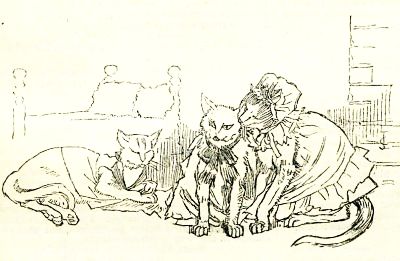
Señorita Catita Maltesa Declared there was nothing would please her But the daintiest mouse To be found in the house, And that anything else would but tease her.
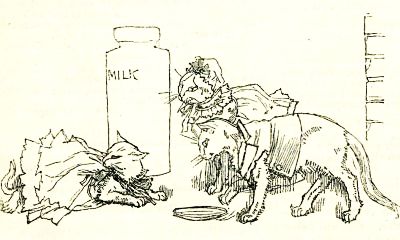
Señor Don Tomaso Felini And Señora the grand Grimalchini Brought her cream in a dish, But she only said, "Pish!" With the air of a young Tigerini.
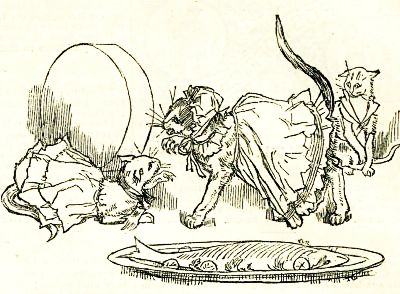
Then they fried her a salmon in batter, And brought her a cheese on a platter; But she laughed them to scorn, And she bade them begone, Or her nerves they would certainly shatter.
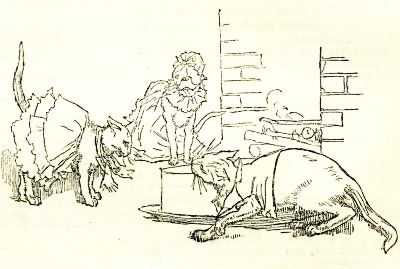
Then Señor and Señora were wroth, And declared that from now and henceforth Their cantankerous child, Who had driven them wild, Should have nothing but buttermilk broth.
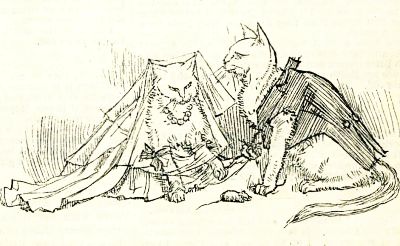
But a knight of the house of Angora, Who had long been Catita's adorer, Took her home to his house, Brought the daintiest mouse, And gallantly placed it before her.
South Boston, Massachusetts.
I am almost six years old. I had two lovely little kitties to play with this summer. Their names were Ringy and Daisy. Their mother's name was Diogenes Praxiteles Demosthenes Gosnold.
I have a velocipede and a railroad track. I almost cried when I heard about poor "Coachy's" fate. I like Harper's Young People, and I am always going to take it. I sent it to my little cousin in Woonsocket for one year as a Christmas present, and he likes it too.
Frank Getchell N.
Bay City, Michigan.
I have a pet kitty, and a bird named Cherry, but it does not sing.
A little baby friend of mine, when told that she must act like a little lady, said she was not a little lady, but only a girl.
May C.
Alleghany City, Pennsylvania.
I love Young People. This year mamma paid for it, but next year I am going to pay for it myself. I earned the money helping papa. We all enjoy it. I read it aloud to mamma while she is sewing. I like best the history of "Old Times in the Colonies," because it tells so much about my country.
I have no pets now, for my dog Beauty and my bird Jenny both died.
I am nearly ten years old, and this is the second letter I ever wrote to go by mail.
Howard K. M.
The following three letters are from three little boys, companion scholars, in a school at Evansville, Indiana:
I will be nine years old on Thanksgiving-day, and hope to celebrate my birthday by eating plenty of turkey and oysters.
We all brought a nickel to school, and had our teacher get Harper's Young People. I like it very much. We like to read the letters the little boys and girls write, and hope you will print ours.
John A. J.
I am eight years old. I attend the public school, and am in the Fifth Reader, A grade.
Our teacher reads Harper's Young People to us every Friday. We all fight for the paper when it comes, for the pictures are so pretty!
Willie H.
I love to read the letters in Young People very much, and we all love the stories.
I have a fine dog named Scout. He chewed up my hat. It was the only one I had, so mother gave me money to buy a cap. I also have a pet rooster, but he is sick. I gave him butter, as some one said it would cure him.
Charlie D. M.
Muscogee, Indian Territory.
We are twin sisters only nine years old. Our mamma and papa take Harper's Weekly for themselves, and Young People for us. We like it very much, but we like the "Jimmy Brown" stories the best of all.
We see a great many Indians here, but they never hurt us. We saw lots of blanket Indians go by when we were at Sunday-school this morning. Their faces were all painted red and yellow.
We go to school, and study algebra, arithmetic, English history, grammar, geography, Fifth Reader, and spelling. There are lots of tamed little Indians go to the school. They are a great deal better when they first come than they are after they have been here a while.
We have a great many ponies. We ride a great deal, and have lots of fun. We have no pets but our two little sisters and a black cat. Our little sisters' names are Edith and Millie. They are one and three years old. They are real cunning.
Katy and Jessie W.
Smithfield, North Carolina.
The plant that Roscoe E. E. speaks of answers the description of the cotton-plant exactly. I am pretty well acquainted with cotton, for I live in the midst of a two-hundred-acre field, and sometimes go out with my brothers, and pick it for amusement.
Mattie P.
Huntsville, Alabama.
I thought I would write and tell you what a sweet, lovely pet I have. It is a baby brother one month old. I am seven. I go to school, and I love to go very much.
Mamma reads to me in Young People, and I am going to have it bound.
Edwin L. W.
Mount Vernon, New York.
We would like to tell Reba H. something that we think quite as odd as peach blossoms in September. On the 9th of October we had nine ripe strawberries brought to us from Columbia County, which grew out on the vines. On October 20 we picked from a vine hanging over the fence in our back yard a small china saucerful of beautiful red raspberries of a delicious flavor, and on the 26th of the same month nine more large ripe ones.
We are three little readers of Young People, who are very anxious to find out who Paul Grayson is.
Gerty, Will, and Bert.
Alden, Minnesota.
I send to subscribe to Young People for another year. I like it so much! especially "Old Times in the Colonies."
I live on a farm in this cold State. There is a snow-drift in our yard to-day (October 17) four feet deep.
I raised some early potatoes, and sold them to get money to pay for my paper. I have a nice Berkshire pig to sell. He is a real beauty.
I have a pony named Billy, and he and I have herded cattle part of every day this fall, but we can not to-day, because of the snow-storm.
I have saved all my papers, and mamma is going to put them in a cover for me. I am almost nine years old.
Arthur G. W.
Mount Holly, Vermont.
I am a little girl four and a half years old. Only a few weeks ago I had a dear sister, who was, oh, so very kind to me! Now she is in heaven with the angels, and I am so lonesome I don't know how I can live. She was almost nine years old, and she used to be very happy when Young People came, and would read all the pretty stories to me, and tell me all about the pictures. We have had such nice times together it makes me cry to tell you about it. In one corner of our large yard we had a swing, and a little arbor close by among the lilacs and rose-bushes. All our mud pies we made there, and our two kitties, Pet and Jet, used to come every day to visit us. Rainy days we had a room up stairs where we played school, kept store, dressed our dolls, and did lots of other things. She used to play on the piano, and she taught me to sing a different part from what she sung. The last time she went to Sabbath-school she sung, "Suffer the children to come unto Me" all alone. I have ever so many things I want to tell you about her, but mamma is writing this for me, and it makes her cry so she can't see.
Papa is going to get a binding for all of Nenna's Young People, and have her name put on it. I am going to take it now. I want to thank all the boys and girls for writing such nice letters.
Mabel M. A.
Dallas Centre, Iowa.
I want to tell the Post-office Box something funny that one of our hens did. We had an old hen that wanted to set in a box. In one end of the box our old cat had three little kittens. The old hen left her eggs, and would set on those kittens all the time. The old mother cat did not like that much, so she moved her kittens to another place. The old hen soon found the kittens, and set on them again. Finally the cat concluded she would not be imposed upon in that way, and she moved her kittens into a third place, where the old hen could not find them.
Albert D. S.
Detroit, Michigan.
I have two brothers and two sisters, and we are very much obliged to Mr. Harper for publishing such a nice paper for us.
We have a rabbit and a duck and three chickens for pets. The chickens are very tame. They were hatched by artificial heat. So was duckie. I had a pretty white kid last year, but it grew too big for me to keep. I was born on St. Valentine's Day.
Caroline V. K.
Bay City, Michigan.
I have a little sister two years old, and I think there could be no nicer pet. I have a bird named Dick, and three kitties; but they have no names, because two of them are so much alike that I can not tell them apart.
I live near the mouth of the Saginaw River. I am twelve years old.
Jessie M.
Atlanta, Georgia.
I dearly love to read Young People. Papa says he thinks it is just the best little paper for girls and boys he ever read, and so do I. I want very much to know if Bessie Maynard went to Europe and carried her doll Clytie.
Mamma's birthday is very soon, and we are all going to make her a present, but I can't think what my present to her shall be. I wish you would tell me something nice for a gift. I am eight years old.
Florence D. F.
If you know how to embroider, even in plain cross stitch, work your mamma a pincushion cover with her initial in the centre, or some other pretty thing she can use. She will value the work of your little fingers a thousand times more than anything you could buy for her.
Hartford, Kentucky.
I have taken Young People ever since it was published, and think I shall take it always. I am ten years old. I go to school, but I have been sick this week.
I had three pets last summer: a pretty green parrot; a sweet, gentle ring-dove named Coocoo; and Willie, my canary. All are dead now but Willie. I took good care of them, but they would die.
We have nice times now getting hickory nuts, and it is such fun to hunt them among the brown leaves. I am learning to ride. My horse is named Frank.
Isabelle McH.
Massillon, Ohio.
I am ten years old, and having no brothers or sisters I find a great deal of company, as well as comfort, in my dear little paper. I like every part of it. How I did enjoy reading the story of Bessie and her pet hen Coachy, although it made me cry. But I was not the only one in our house who cried over it. Then there is Paul Grayson. I can hardly wait to know more about him.
Last night, after ten o'clock, a company of boys passed our house making a great deal of noise and talking very improperly. I wished they had Harper's Young People, so that they might find more pleasure in staying at home to read than they could find on the street.
Minnie E. M.
I am making a collection of postage stamps, and would like to exchange with the readers of Young People.
Louis C. LeRoy, Jun., 226 Fifth Street, New York City.
I would like to exchange foreign stamps, minerals, and fossils for other minerals and fossils.
Ormond Perley, P. O. Box 466, Emporia, Kansas.
I have a lot of one, two, three, six, fifteen, and ninety cent Treasury Department stamps, which I wish to exchange for stamps of the Navy and Agricultural departments.
R. L. Preston, P. O. Box 327, Lynchburg, Virginia.
I would like to exchange petrified moss and iron ore with any correspondents for sea-shells or relics. I can get moss in three stages, when it is just beginning to petrify, when it is half petrified, and when it is wholly so. Correspondents will please mark distinctly anything they may send me, and state the locality from which it came.
John H. Bartlett, Jun., P. O. Box 8, Greensburg, Green County, Kentucky.
I regret to inform the correspondents that I have lost my collection of stamps by fire, and will be unable to carry out the exchange I proposed in Young People No. 53.
W. H. Pike, 20 Edinboro' Street, Boston, Massachusetts.
I would like to exchange postage stamps, both United States and foreign, with any of the readers of Young People.
Hermann Boege, Care of Millard & Collingwood, No. 7 Murray Street, New York City.
I have a large quantity of rare stamps and United States postmarks to exchange. I am very anxious to get good United States postmarks, but will exchange in any way to accommodate.
Susie C. Benedict, Little Falls, Herkimer County, New York.
I am collecting birds' eggs, and would like to exchange with any of the correspondents of Young People. I have eggs of the cat-bird, bobolink, goldfinch, Savannah bunting, and others. I am anxious to obtain eggs of the scarlet tanager, cardinal-grosbeak, brown thrush, fish-hawk, and woodcock. Correspondents, when answering, will please send a list of eggs they wish to exchange.
James R. Benton, P. O. Box 338, Clinton, Oneida Co., New York.
I am making a collection of stamps, and would like to exchange with the readers of Harper's Young People in Canada, British Columbia, Newfoundland, or in any part of the United States.
Willard Church, Topeka, Kansas.
I am a Brooklyn boy ten years old. I take Harper's Young People. I liked the story of "The Moral Pirates" very much indeed, and I like "Old Times in the Colonies" next.
I would like very much to exchange postage stamps with any boy reader of Young People.
Alfred W. Haskell, 33 Troy Avenue, Brooklyn, New York.
I would like to exchange postage stamps with any correspondents of Young People. I have now about three hundred and sixty. I am twelve years old.
W. D. Judd, P. O. Box 56, Holyoke, Massachusetts.
I would like to exchange foreign and United States postage stamps with any collector. I have about six hundred and fifty.
William T. Berridge, P. O. Box 243, Boston, Massachusetts.
I live in the country, and am very fond of trapping, at which I am very successful.
I have a young dog named Rover, and I think a great deal of him. He can hunt very well, for he is a hound. He was given to me, and he ran away twice, but I got him again, and kept him tied several days. Now he is used to staying with me, and does not try to run away.
I like the letters in Young People very much. I am going to take it another year, for I do not know how to get along without it.
We had several snow-storms here in October.
I have written to some of the boys who offered to exchange stamps, and would like to exchange stamps and postmarks with any one. To whoever will send me four old coins, or fifteen stamps, I will send in return twenty-eight postmarks.
Frank A. Harmony, P. O. Box 1235, Lockport, New York.
I should like to exchange foreign postage stamps with any reader of Young People. Or I will give twenty-five foreign stamps, or ten foreign stamps and a piece of satin spar from Iceland, in exchange for two Indian arrow-heads or five birds' eggs.
W. B. Wyman, 108 Sixth Avenue, Brooklyn, New York.
I would like to exchange postage stamps for minerals. I also have about twenty varieties of eggs which I would like to exchange in the same way.
Lewis B. Hilliard, P. O. Box 208, Clinton, Connecticut.
I like Young People very much, and enjoy reading the stories and letters. Sometimes I take it to school, and my teacher reads it to the scholars.
I will be happy to exchange mosses, ferns, or shells of California and the Pacific coast with any correspondent for those of the East.
Edith Drenner, Santa Cruz, California.
I have a fine collection of sea-shells, and petrifactions of fish scales and other things, all gathered on the Pacific coast at Port Macon, Alaska, which I will exchange for foreign postage stamps.
W. H. Emmert, New Oxford, Adams County, Pennsylvania.
I live in the oil regions of West Virginia, and I have a lot of oil sand that came from eight hundred and seventy-five feet below the surface of the earth. It was taken from an oil-well. I will exchange one ounce of this sand for five foreign postage stamps, or I will give some of it in exchange for minerals, ocean curiosities, coins, or Indian relics.
Willie B. Prickitt, Volcano, Wood County, West Virginia.
I would like to exchange minerals with any reader of Young People.
"Commercial," P. O. Box 625, Penn Yan, Yates Co., New York.
I am a little boy seven years old. I have a small black pony with four white feet and a white nose, and two yellow Cochin China chickens, for my pets. I have some postage stamps that I would like very much to exchange.
G. C. Wiggins, Charlottetown, Prince Edward Island.
I have some leaves which I would like to exchange for leaves from the South.
Annie Dryden, care of Mr. John Dryden, Brooklin, Ontario, Canada.
I am twelve years old. I live near the Wissahickon.
I have a few English birds' eggs, and would like to exchange with some correspondent of Young People for Western or foreign eggs.
Charles Hopper, West Walnut Lane, Germantown, Pennsylvania.
I should like to exchange minerals with the readers of Young People. My brother and I have a cabinet. It is not large, but we hope to increase it. We have only about thirty specimens, but some are rare, such as lava from Mount Vesuvius. We have also some pressed flowers. We are making a scrap-book of natural history pictures. I am thirteen years old.
Harry F. Jones, St. Johnsbury, Vermont.
St. Paul, Minnesota.
I have two little eight-year-old sisters, named Lucy and Eleanor, but we call them Dove and Bly. And I have a little brother of six years. When Young People comes, it is given first to the one who has behaved the best during the past week.
Can you tell me how the Black Prince died? I have looked in several histories, but none of them state the manner of his death.
C. C. B. H.
There was nothing remarkable about the death of the Black Prince. He died in England in 1376, after a long and lingering illness, which is said to have been the result of exposure and overexertion during the campaign against the French. After the battle of Navarete in 1367, in which the Black Prince won a victory which restored Pedro the Cruel to the throne of Spain, he returned to his home in Bordeaux sick of an incurable disease, and four years later he resigned the government of Gascony to his brother, and returned to England, where he declared himself on the side of popular reforms, but his health allowed him to take but little part in public affairs. He was a very popular prince, and was sincerely mourned by the whole English nation.
Elsie M. K.—Needles were undoubtedly the invention of prehistoric man, as they have been discovered among the oldest remains of human life. Some rude specimens, made of horse's bone, and evidently intended for sewing skins, were found not long since in a cave in France, together with other traces of primitive life. Needles have also been discovered in the oldest Egyptian tombs, and among the remains of the lake-dwellings of Switzerland. The date of the invention of steel needles is unknown, but judging from the rich embroidered garments described in ancient record, it would appear that fine needles, of steel or some other material, were in use at a very early period.
John R. G.—An etching is an engraving on a hard metal plate, usually on copper. The plate is first covered with a thin coating of wax and asphaltum, which is allowed to dry. The etcher then makes his drawing with a fine point, called an etching needle, cutting all the lines through the wax coating to the copper. A weak solution of nitric acid is then poured over the drawing, which eats into the lines where the copper has been laid bare by the etching needle. The plate is then cleaned, and the wax coating melted off, when impressions may be taken, as from any other engraving. If the action of the acid has been imperfect, the plate may be finished by using what is termed the "dry point," a sharp-pointed steel instrument capable of making the most delicate lines on the surface of the plate. Pen-and-ink drawings are sometimes called etchings, simply because they resemble that peculiar style of engraving.
Georgie V. R.—See answer to Mark M. in Post-office Box of Young People No. 53.
Cora E.—We fear you could not exchange living birds, especially in the winter season, as these delicate household pets are very sensitive to changes of temperature. If you can propose any safe way of effecting the exchange, we will gladly publish your request, provided you send us your full address, which this time you neglected to do.
Anna and Thomas.—By great patience and persistency you may succeed in teaching your pet crow to speak a few words, but the experiment is not often successful with the common American bird. The English raven is more easily taught to imitate the human voice.
Bob White.—Gray's Lessons in Botany is much used in elementary classes.—The educational works on art by J. D. Harding, the English artist, are excellent drawing-books, and will also give you some idea of handling colors. There are several volumes in this series, but each can be bought separately.
A Constant Reader.—The recipe you require involves the handling of so many dangerous and explosive chemicals that we are unwilling to place it before our young readers.
Bessie H. S.—Your first letter arrived too late for acknowledgment among others of its class, but your name was in the list of favors in Young People No. 26.
"Mab."—It is immaterial what kind of paper you use when preparing copy for printing, but it should be written only on one side.
Flora D.—Transparent tracing-paper may be made by saturating any kind of paper with boiled oil, or oil and varnish mixed, or with a solution of colorless dammar resin in benzole. It may also be made so as to receive washes of India ink by varnishing ordinary writing-paper with Canada balsam dissolved in oil of turpentine. The sheets should be hung on a line to dry, and if not sufficiently transparent, a second coat of varnish may be applied.
Mattie P., Gracie S., Lloyd E., and Others.—The puzzles with which you favor us are excellent, but unfortunately the answers are the same as those of puzzles which have already appeared in Young People, and it will therefore be impossible to print them.
J. T. Morgan and Arthur L. V.—We regret that we can not print your communications. If you will read the introductory note to the Post-office Box of Young People No. 45, you will see that it is contrary to our rules to print letters offering stamps or other things for sale.
Favors are acknowledged from Lizzie Frenzel, G. Fuller, G. W., L. Waechter, Lizzie Burt, Lula M. Jay, William P. Anderson, Clara M. Greene, Henry Van Dusen, Allie Hughes, Fred Huntoon, C. H. T.
Correct answers to puzzles are received from Isabel L. Jacob, W. H. Wolford, "Lamar, Mississippi," G. Volckhausen, G. Dudley Kyte.
PUZZLES FROM YOUNG CONTRIBUTORS.
No. 1.
RHOMBOID.
Across.—An admirer. Pertaining to the government of the seas. Pleasanter. A mechanical help. What every street has.
Down.—A letter from Gil Blas. A preposition. A wagon. Calamity. Breeds. A man's name. A color. A prefix. Another letter from Gil Blas.
Bolus.
No. 2.
DIAMONDS.
1. In Harper's Young People. A useful plant. A river in France. An insect. In Harper's Young People.
Aristotle.
2. In table. A fluid. A bird. Cunning. In table.
Cass (10 years).
No. 3.
DOUBLE ACROSTIC.
A flowering shrub. A voracious bird. A color. Unvaried. Something often heard in a fortress. Harmony. Ferocious. Primals and finals spell the names of two spring flowers.
Lucy.
ANSWERS TO PUZZLES IN NO. 52.
No. 1.
BABYSLAT
AREALIFE
BEARAFAR
YARDTERM
No. 2.
CAULIFLOWER
HEDITORIALM
ODFALSITYNU
REPCOSEYBEL
SCRMTINAICT
EROUDLBCVRI
RECRIMINATION
AMTANFNOOLO
DEOLKEGRUOM
INRLARCHSGI
STJACOBINYA
HOBSCURELYL
IMPERSONATE
No. 3.
Mary had a little lamb, Its fleece was white as snow; And everywhere that Mary went The lamb was sure to go.