A DANGEROUS PLAYTHING.
Reading edition
BY CHARLES LEDYARD NORTON.
Ever since Meg laid her hand on a moderately warm stove, when she was learning to walk, she has been very much afraid of fire, and no one in the house is in the least anxious about her playing with matches, for she could not be hired to do such a thing at any price. Indeed, it was thought a very remarkable event when, having reached the advanced age of seven years, she consented to take one of the long tapers made for the purpose and light the gas in hall and sitting-room.
Her mother was glad to have her do this, thinking that it would make her careful, and at the same time teach her not to be overtimid. And so it did, but not in the way mamma expected; for one evening, as Meg carried her taper under the portière, what should she do but set the fringe on fire!
Seeing that Meg had all her life been in mortal dread of just such an accident, it was very brave in her, without an instant's hesitation, to brush the fire out with her two little hands. She did not even scream, but she was very pale and "trembly" when she went to mamma in the library, and showing her besmirched hands, said, "It's all over, mamma, but I 'most set the house on fire." Sure enough, the fringe, scorched for a distance of two or three feet, proved that it was a narrow escape.[2]
Upon the whole, it would be well if all young people were as much afraid of fire and of matches—the cause of fire—as Meg was. Many a family has had to run for their lives out into the dark night because some heedless youngster saw fit to take this dreadful creature, fire, for a playmate.
RESCUED FROM THE FLAMES.
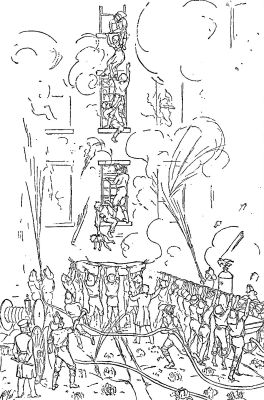
Our artist actually witnessed the incident which he has so cleverly drawn. The flames had seized on the lower stairways and stories of the house, so that escape was impossible for the mother and child on the fourth floor. No ladder could be procured, so one of the most active of the firemen climbed from one window to another, by the help of sashes and blind fixtures, until he reached the frightened pair. Others followed him, stationing themselves in the lower windows. A mattress was brought out, and held by a score of strong arms under the windows.
Baby must go first, though mamma could hardly bear to have him leave her arms; and perhaps the fireman had to be a little rough before he made her loose her hold. It was simple enough to deal with him, however, and he scarcely had time to squall and kick, so deftly was he passed down, first to the man standing in the window below, then to the one who sat on the sill, and finally dropped into the mattress.
Mamma was more difficult to manage, because she was bigger and heavier. But, on the other hand, she could help a little by holding on to the sills, and letting go when she was told. So at last she too was steadily lowered from hand to hand until she reached the mattress and the ground.
If these men had been a little less brave and skillful than they were, there might have been a sad tale to tell as the result of a boy's thoughtless experiment with a match. Sad enough a fire always is, however, for those who lose or suffer by it, and in all large cities the Fire Department is very carefully equipped and organized.
THE FIRST "STEAMER" IN NEW YORK.
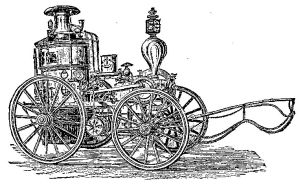
The old-fashioned hand-engines, such as are shown in the illustration, with a row of men at the brakes on either side, are all out of use now, and are seldom seen save in villages and small towns. There even they are fast giving way to chemical engines, and before many years the old piano machines will be almost forgotten. Nevertheless, they did good service in their day, and were manned by as daring a set of fellows as ever ran to a fire, or broke each other's heads in a street fight. Thousands of them served bravely on both sides in the war of the rebellion, but when those that were left of them went home, steamers—the small cut shows the first one that did duty in New York—had come in and crowded out the old "machines." Volunteers were no longer wanted.
Very different affairs were fires in those days from what they are now. Then the first shout of "fire!" set loose a very bedlam of noises. Bells rang, every one who was in the street yelled "fire!" and the whole population rushed madly toward the place where it was supposed to be. It is a wonder that anything was ever done amidst such a scene of confusion; but in reality fires were wonderfully well managed.
How different is everything now in all the large cities! In New York, for instance, there are several fires every day, but most people learn of them through the newspapers. Not an alarm-bell is rung. Very rarely is the cry of "fire!" heard.
You are sitting quietly at home, perhaps. Suddenly you hear the sharp stroke of a peculiarly toned gong. Then there is a thunder of wheels, a clatter of galloping hoofs, and you rush to the window in time to see a vision of gleaming brass, flying sparks, dark figures clinging to the swaying engine, and a pair of noble horses straining every nerve. Perhaps that may be all you know of a great fire until the next day.
Should you take a car, and follow anywhere from one to ten miles to the burning building, you will find an immense, quiet crowd, kept out of harm's way by a strong force of police, while in the cleared space before the building the tireless steamers are at work, each of them throwing two or three steady streams of water into the heart of the fire.
Meg's papa told her all about this, and how seldom it is that a fire nowadays has a chance to make much headway; but her visit to an engine-house was the most comforting. There she saw the splendid horses, and the engine in perfect order, with the wood under the boiler ready to light; and the man on duty explained how the stroke of the alarm-bell unhitched the horses, if they were in their stalls, and how the handsome creatures knew just where to go to be "hitched up," and how eager they were for their race to the fire.
Just as he was quietly showing them all this, a succession of ear-piercing clangs were heard. Meg's papa knew what it meant, and catching his little girl up in his arms, hurried with her into an out-of-the-way corner. The still, well-ordered engine-house was instantly alive with energy. The horses snorted with excitement, as they backed out of their stalls and trotted into place. Hurried footsteps were heard overhead and on the stairs, and in a moment several men were springing to their stations. One turned on the steam and lighted the fire; others made fast the few buckles required to attach the harness. The driver was in his seat, the whip cracked, and away went the already smoking engine at a tearing pace.
Meg trembled like a leaf when it was all over, and her father was afraid that she would be more nervously timid than ever. But to his surprise she said to him as they walked home, "Papa, now I've seen how everything is done, I shall never be afraid any more."
And just after she said so they met the engine on its way back, for the fire was already out.