OUR POST-OFFICE BOX.
Reading edition
Wytheville, Virginia.
We are three little girls who have often read and enjoyed Harper's Young People very much. We meet successively at each other's home every Friday evening, and read the stories in it. We live in a beautiful town in the mountains of Southwest Virginia. We three go to the same school, and like our teachers very much. Our parents take all your papers—the Monthly, Bazar, and Weekly—and we take Young People. We look forward to Wednesday with a great deal of pleasure, for we know it is the day our paper comes. We are so glad to see Mrs. John Lillie is going to write a new story, and we are sure it will be very interesting, as all her others are. Please print this, as we would like to surprise our mammas.
Ellie C., Helen S. S., and Susie W.
Well, Ellie, Susie, and Helen, though I do not know which of you has brown eyes and which blue, which is the tall slender girl, which the merry-faced one with the dancing dimples, and which the plump little maiden who always thinks before she speaks, I send my love to each of you, and am glad to hear of your pleasant Friday evenings. You and the thousands of other girls for whom Mrs. Lillie has written her charming story have a real treat before you in reading it. I sometimes wish myself a girl again just to feel for an hour the delight I used to when beginning a beautiful new story. The girls who form Mrs. Lillie's audience have better times in the story way than girls did when your mammas and myself were at your age. But I, for one, still dearly love a bright sketch or a beautiful serial; and if I were near you, I might sometimes glide in and take an easy-chair in the corner on your reading evenings—that is, if you would let me in on my promising to be very good indeed.
Some of you who have empty cologne or scent bottles may make very pretty presents for your friends by covering them with silk or plush, and finishing off with a dainty lace ruffle and a narrow ribbon around the neck. A beautiful tidy which I saw the other day was crocheted in heavy cord, and looped over crimson silk. Very lovely plaques are made of the birch-bark plates on which butter is sent home by the grocer. They must be covered very neatly with silk or satin, on which a design is worked or painted. The pretty little Japanese umbrellas, which cost but a few cents, may be inverted, opened, and caught at each point with a ribbon. Suspended from a nail, they make dainty little scrap-bags.
The letter which follows contains a suggestion which the Postmistress thinks excellent. She will keep a corner in the Post-office Box for all such letters as our correspondent invites:
Boston, Massachusetts.
Dear Postmistress,—I remember when I was eight or ten years younger than I am now, how hard it used to be for me to find anything new to make for Christmas for all the aunts and cousins, and now, as Christmas is drawing near, my younger sister comes to me and says: "Can not you think of something for Christmas? I want something for Aunt Mary and Aunt Lizzie, something I have not made for them before." I have no doubt that many other little people say the same thing. Now, I have a plan to propose to you, and if you think it a good one, will you mention it in the Post-office Box? Let each little girl—and boy too, if he wishes—write and describe something that he or she makes for Christmas, and then if you will be so good as to publish the letters I think before Christmas we may have quite a variety of ideas. Of course each article mentioned would not be new to all, but it would be new to some, and I think many little girls would be greatly aided. Now what do you think?
One of your Older Readers.
BABY'S DAY.
Awake at five in the morning, Bright as a little bird, Cooing and laughing and crowing Before a person has stirred. Carried on papa's shoulder, Lying on mamma's arm, Never a king was bolder Or safer from slightest harm. Going to ride with sister, Taking a cozy nap, Resting before his dinner On grandmamma's silken lap. Creeping over the carpet, Playing with pretty toys; Baby's the dearest darling, The prettiest, best of boys. Susie Patton.
Olean, New York.
I think that Frankie would be a pretty name for Marion W.'s baby brother. I have nine dolls. Their names are Mollie, Lottie, Edith, Eva, Lena, Christina, Carrie, Johnnie, and Bertie. I like your stories all very much, especially "Toby Tyler," "Mr. Stubbs's Brother," and "Their Girl." I send my love to the Postmistress.
Lena Matthews.
Madison, New Jersey.
I am a little boy six years old. My brother Louie takes Young People, and has every number. Baby Roe and I love to have mamma read it to us. Roe and I have bad colds, so I could not go to school, but Louie could. I learned to print in school. This is my first letter. I hope you will print it.
Howard B. G.
Your little note was printed so nicely that it was as plain as though the letters had been formed by the type-writing machine. After all, there is no machine of which I ever heard so wonderful as the four little fingers and thumb of a boy's hand. Ask papa and mamma if they don't agree with me.
Salem, North Carolina.
I have taken Young People from the first number, and I like it very much. I have written one letter to the Post-office Box, but I thought I would write again. My friend Howard R. has written too. We two have formed a printing firm under the name of P. & R. We made four dollars clear profit, with which we bought each a pair of roller skates. We have over three dollars in our bank now. Some of my playmates and I have formed a club under the name of Holiday Club, and some of my boy friends and I have formed a military company by the name of Home Guards. We parade in the academy play-grounds. The other day we fought almost all the battles of the Revolution.
A. H. P.
All the battles of the Revolution in one day! I wonder you slept a wink the night after such tremendous exertion. But boys are made of steel springs and India rubber, and can stand a good deal of pounding. Please send me word about the various doings of your holiday club, and don't let the fun interfere with your studies, or else the preceptors and professors may veto your good times. I am glad you are so successful as amateur printers.
New York City.
I am a little boy nine years old. I have a cat and a kitten. The cat's name is Gypsy, but I have not named the kitten yet. I take Harper's Young People, and I like it very much. The other day the kitten fell from a chair and hurt its leg, but it is well now.
Cito S.
Dear little Robin D., who often sends answers to puzzles, was not well, and so mamma became her amanuensis, sent her answers and her new puzzles, which will see the light before long, and this pleasant little message to the Postmistress and to Marion W.
I hope Robin is quite well by this time.
Robin says: "Mamma, tell the Postmistress that my little pet bird Jimmie died, and wasn't it too bad, but that now I have a beautiful white dove and a dear little bird whose name is Montie, but I still mourn for Jimmie, whose cage was draped in mourning for a whole week. We buried him in our yard."
Robin thinks that Edgar is a very pretty name for a boy, or Irving. She does not really know which to choose for little Marion W.'s dear baby brother. She says, "If one little girl may put in more than one name for Marion to choose from, put both Irving and Edgar in from Robin D."
I am very sorry little Jimmie died. When Marion chooses a name, she must not forget to send us all word what it is, as we feel quite an interest, don't we, children?
Boston, Massachusetts.
I want to ask you to tell me a pretty name for a little kitty, because I don't know any nice ones. Now I want to tell you about where I went last summer. I went to Falmouth, which is very near the sea-side, and is a very pleasant place. I went in bathing only twice while I was there, but went in wading nearly every day. I went in a sail-boat once, and had a very nice sail, and then I went down the beach a little way to catch minnows, but couldn't. Good-by.
Alice S.
Muff is a nice name for a kitty.
Let me tell you about a kitty which a little boy friend of mine had for his pet. It was a black kitty, I believe, though I am not sure. He carried it everywhere with him, and when he was practicing one afternoon, he set it on the piano that it might hear him play. It nestled its head cunningly on its tiny paws, and listened with all its might.
Somebody called the little boy away for a moment. When he came back the kitty was gone.
High and low they hunted for it. Mamma, nurse, two little sisters, and even the baby, called Kitty! Kitty! but no kitty answered. After a long time there came a faint little mieuw on the air; and where do you suppose they found that small cat? Why, in the piano, where she had taken a cozy nap.
Nashville, Tennessee.
Most boys and girls tell about their pets. I have none, except my little brother, two years and a half old. I have two sisters and this sweet little brother. We moved from Louisville, Kentucky, to Nashville about a month ago, and I am very homesick to go back again. We spent the summer at Bon Aqua Springs, not far from here, and had a nice time. I have a doll, and her name is Eva Wallace; she will be four years old on Christmas. My little brother tries to call us girls "girlie," and he says "dirlie." He calls me "Black-eye dirlie," my sister Grace "Blue-eye dirlie," and sister Florence "Brown-eye dirlie." His name is Theodore. We have taken Young People from the beginning, and think it is the best of papers. Mamma takes the Bazar and Magazine. My papa is away most of the time, and we are always glad when he comes home. I go to school, and am in the Fifth Grade. I study reading, spelling, arithmetic, geography, writing, and drawing. I am eleven years old.
Bessie W.
South Bend, Indiana.
I like Young People very much. I am a little girl eight years old, and live on a farm five miles from the city. I go to school now, but mamma will teach me at home this winter. I have two pets, a white bantam chicken named Polly and a white kitty named Snow. I had a canary-bird, but he was sick and died; his name was Billy. I have three dollies; I do not play with them very much, because I have no one to play with me. Papa has a nice Irish setter dog to hunt with; his name is Paul. I will write again as soon as I can write better.
Georgiana D.
Drifton, Pennsylvania.
I have lately returned from Europe, and I enjoyed the pile of Magazines I found here. I brought home a gondola from Venice, and I also brought a curious swan which I saw them make at the glass-works. I had a splendid time in dear old London. We saw the Queen and the Princess of Wales. We saw the wine-vaults. We crossed the Alps in four-horse carriages, and I made snow-balls in June. Young People is the best paper out.
Ockley B. C.
You have many delightful things to remember about your trip abroad. I hope you kept a journal.
Norwalk, Connecticut.
I am eleven years old, and live in Norwalk in the summer, and in New York city in the winter. I have no brothers nor sisters, except two who are grown up, and I have a brother at college. We are going to New York on the first of next month. I enjoy Harper's Young People very much, and look forward to its coming with great pleasure. As you wanted to hear from any girl or boy who had a garden, I thought I would tell you about mine. I planted in my garden this summer potatoes, onions, tomatoes, strawberries, and celery, besides flowers. I had enough potatoes for the whole family for dinner, so I had them on the table that day, and I hope to have my celery to-morrow. The cook made me some caramels from the receipt you put in Harper's Young People, but it wouldn't harden, so she made a chocolate cake, and I had it on the table one evening. As I have no more to tell about I think I will close.
Harry C. M.
You were a famous little gardener, and deserve great praise.
Alleghany, Pennsylvania.
I am a little girl nearly eleven years old. I will tell you about my summer trip. I can not tell all the places we went to, but one place was the White Mountains of New Hampshire. There are very fine views, especially from the top of Mount Washington. You would laugh to see the funny little cars that go up and down. It is very steep, and as you go up you see nothing but rocks. Mamma thought it was frightful, but I did not. Well, good-by.
Annie H. S.
I might have laughed when I was eleven years old, dear, but I never go up a steep mountain nowadays without feeling, like your mamma, that there is danger as well as pleasure about the ascent. I am glad you have been to the top of Mount Washington, and have looked from there over the great mountains and deep valleys of New England.
Milton, Ontario, Canada.
I am a little girl twelve years old, and live in a small town thirty miles from Toronto. We are always very glad when your paper comes. I love to read the letters in the Post-office Box. I like "The Cruise of the Canoe Club." My father and four of my uncles are in Montana, and my aunt and her children are going out there next week. My uncle and his youngest brother belong to a surveying party, and have been surveying in the Rocky Mountains and Yellowstone Park all summer, and write home delightfully interesting descriptions of the wonders to be seen there—about the geysers and glass mountains, also soda mountains, and cañons. The Grand Cañon is the deepest of all; it is several thousand feet deep, and at the bottom is a rushing, roaring river. One of my uncles descended into it. It is so deep that if you go down into it and look upward, you can see the stars at three o'clock in the afternoon. The geysers spout up water to a tremendous height. One of them—I think it is called the Excelsior—throws water in which are pieces of rock to a height of three hundred feet. Often the eruptions are preceded by rumblings and shakings like an earthquake. Once when the party were near one of the geyser basins, suddenly the earth began to quake, and the water in the basin spouted ever so high, and the sky was filled with water and pieces of rock, and they had to run to get out of the way. Perhaps we will go to Montana if father stays there; and if we do, mother says that we may take an occasional trip to the Park, and then I will write and tell you of some of the things we see there.
Becca R.
The cunning little letter which follows was sent by a little girl five and one-half years old to her young lady sisters away from home. This little girl lives near a railroad, and every day she and her brother watch for their conductors, as they call them, and wave to them as the cars rush past the door. By the "tassels with the board on" little Amy meant a lambrequin which belonged on the mantel. Jumbo is a huge toy elephant greatly admired by the little folks in Amy's nursery:
Tenafly, New Jersey.
Dear Louise and Maggie,—It will soon be Roy's birthday. If you don't come home quick, you won't be here before it comes. Roy creeps. He can walk with our taking hold of him. He can stand up by the bath-tub. May S. don't know some of the words of her music-lesson. I say my lessons every day at home, and then I say them in school. I did not get a bad mark to-day; sometimes I do. I get apples in B.'s yard—they don't care—and take them to school over recess, and then I take them home. Mamma has to sew so hard, and we bother her, and she sends us out-doors. When it rains she don't; then we stay in the house, and play with our toys. Sarah's back, and we're glad, and she irons every Tuesday. We take walks with her sometimes. Mary's here too, and sometimes she goes out with her husband. I like him, and he gives me pennies. I would like to be over there and see your big dog Frank. Some Sunday afternoons papa's tired, and he don't want to go riding. We did go last Sunday. Last Sunday we took Roy. Marian plays with Roy every day, and mamma says Stop! when she hurts him. Clifford has to get his teeth fixed, and we can't go to P. until next Monday. Every day papa goes out to see the men fixing the trestle-work. On Roy's birthday we're going to have a little party; no one is coming, only us. Mamma has to send out when she wants papa—away out to the trestle-work. Mamma writes this letter, and I find the words. Marian has got lots of things in the corner by the bookcase again. Clifford's got lots of cars now, and he plays with them 'most every day. He's got a new tin train of cars from the Fair. We're getting our stoves fixed. There's fire in the sitting-room. Your tassels with the board on is up in the front parlor. We've got a Jumbo from the Fair. We take Jumbo out to see our 'ductors. Mine is away, and ain't home yet. Roy goes around picking up everything, and gets things out of mamma's basket, and dumped it over twice. It's near winter, and we've got the sleds down.
A kiss for Maggie, and a kiss for Louise. Love for Maggie, and love for Louise.
Amy D.
Fremont, Nebraska.
Dear "Harper's Young People,"—My brother Paul takes Harper's Young People, and I think it is a very nice paper. I was eight years old the 7th of September. I have a sister who is four years old. And we have a horse named Dick; he is gentle and a very nice horse, and will eat apples as well as any boy can. He will shake hands with either leg. I go to school, and I am already in the Third Reader. My teacher's name is Miss S. And we have got a calf called Rosy, and she is a very gentle and nice calf, and we have a pretty wild cow.
Burnie C.
San Francisco, California.
I am a little boy nine years old. This is my first letter. I like the story of "The Cruise of the Canoe Club" and "Mr. Stubbs's Brother." I commenced going to school in March, 1881, and am now in the Seventh Grade. I was honorably promoted last June. I am trying very hard to be the same this term. I go to Alameda nearly every Saturday with my papa to take a salt-water bath. I can swim a little. I live in the city, and can not have as much fun as the little boys in the country; but I shall go to the country next vacation.
Allen G. W.
A boy who tries hard is sure to succeed. When next you are promoted write again, as I like to keep an account of my boys when they do well. I am glad you can swim.
Frank and Joe.—The twenty numbers of Harper's Young People containing the story of "Toby Tyler" will cost you eighty cents. By sending $1 to Messrs. Harper & Brothers you may obtain Toby Tyler in a beautiful bound volume, handsomely illustrated.
Salt.—Yes, Daisy, you are right in your supposition that people in very old times were alarmed if any one spilled salt on the table at a meal. It was fancied that the unlucky accident was the sign of a quarrel between two of the company. However, I attach no importance to such signs, even when they are ancient, and if you came to dine with me, and the salt-cellar happened to be upset, I would not trouble for our friendship.
Among the Arabs salt is regarded as sacred, and if you happen to be the guest of a Bedouin, who meeting you in the desert would rob you and be glad of the chance, you are perfectly safe if you share his bread and salt; he will protect you against all enemies. You see, that salt among these wild people is the emblem of hospitality. The Romans thought it unfortunate to sit down at a feast where the salt had been forgotten. The Greeks had the same feeling. It was also considered very thoughtless to leave salt unlocked overnight.
I hope, Daisy dear, that while reading and studying about these curious superstitions you will take care not to believe in them yourself.
For the information of some of our new subscribers who write to ask we repeat that there is no charge for the publication of exchanges. They should be brief. State first what you desire to offer, and then what you wish to receive. Please write with black ink as plainly as you can, and sign your full name and post-office address. Birds' eggs and fire-arms are prohibited as articles of exchange. The Editor reserves the right to exclude any exchange in whole or in part if for any reason it is considered unfit for Young People.
Having sent your letter, you should wait very patiently for your turn, as the department is always crowded, and no exchange can ever be printed in the paper next issued after its reception.
To avoid misunderstanding, exchangers should always write fully to each other and receive replies before sending away their articles. Each should arrange in this way about the necessary expense of the mail or express. Articles should not be sent to the office of Young People, but directly to the persons with whom they are to be exchanged.
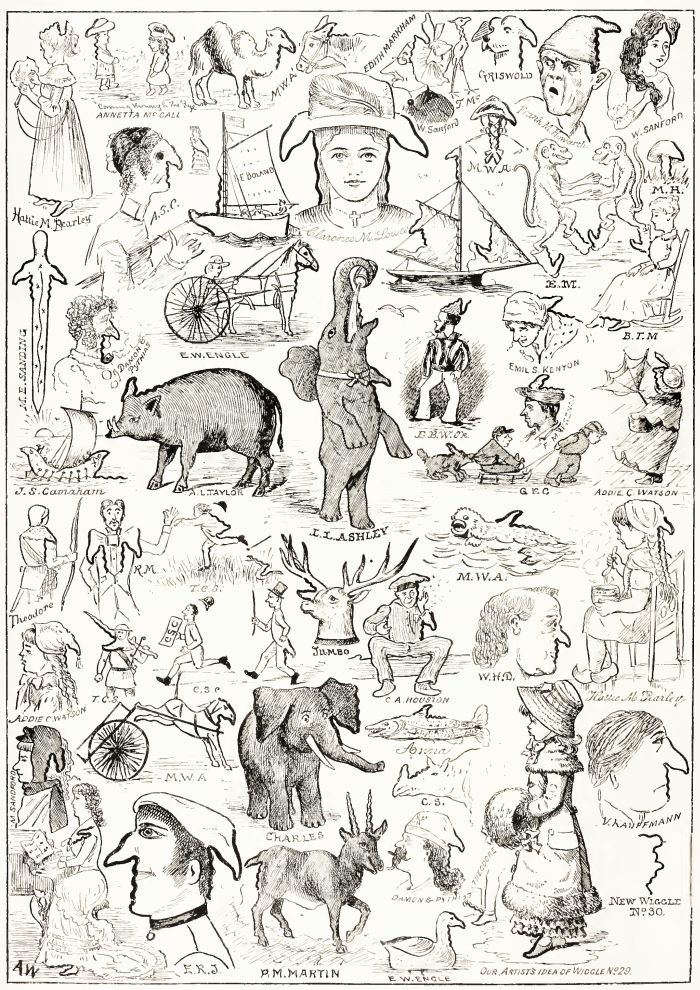
Successful Wigglers.—We should be glad if Hattie M. Pearley, B. F. M., and A. W., who have been successful in reproducing our artist's idea of Wiggle No. 29, would each send us his or her full name and address.
PUZZLES FROM YOUNG CONTRIBUTORS.
No. 1.
GEOGRAPHICAL PUZZLE.
In the month of (a cape in Massachusetts) a lady named (a city in Brazil), and a gentleman named (a cape in Virginia), went to (the capital of Italy) in the (a lake in Minnesota). They walked until noon, when the lady opened a satchel made of (a country in Africa). It contained a fried (river in Minnesota), some fine old (a river in South America), and a (islands in the Pacific Ocean) for each. As it had been (a lake in Minnesota) and the (a river in England) was rather (a country of South America), they wanted to return to their home, but the (an island west of England) lost a cuff button made of (a city in New Mexico), and ornamented with (a river in Mississippi). While they were on the (a cape of North Carolina) they met (a river of South America), who said he thought (an island near Massachusetts), who was a colored woman.
Pansy.
No. 2.
MIXED ANIMALS.
In these examples the problem is to arrange the grouped letters so that they will form a word agreeing with the accompanying definition.
Phelenta—The largest of quadrupeds.
Spophoptiamu—A river-horse.
Reazb—A striped horse.
Elawh—A sea animal.
Tribab—A furry animal.
Bartie.
No. 3.
HIDDEN FISHES.
1. I have bought a new carpet, Angelina. 2. Lucy lost her ring. 3. Tommy had ten chickens. 4. Mr. Stubbs had flung away all Toby Tyler's money.
Bartie.
No. 4.
DOUBLE ACROSTIC.
1. A kind of cloth. 2. A precious stone. 3. A famous musical composer. 4. A glazier's diamond. Primials—A bird. Finals—Part of the bird, connected, to join.
Lodestar.
No. 5.
THREE PROGRESSIVE HALF-SQUARES.
1.—1. A letter. 2. A preposition. 3. A Latin verb. 4. Anything very small.
2.—1. A letter. 2. To exist. 3. The cry of a sheep. 4. To support.
3.—1. A letter. 2. An abbreviation. 3. A covering. 4. To engage in conflict.
J. K. M. Iles.
ANSWERS TO PUZZLES IN No. 156.
No. 1.
JAMES
ADELA
MEDAL
ELATE
SALEM
No. 2.
AraB
DatE
AweD
MinE
No. 3.
Lock. Peach.
No. 4.
Hate.
No. 5.
Cupboard.
No. 6.
DoG
ObI
LeatheR
LulL
No. 7.
EQM
ASPHUTROB
ESSAYQUAILMONEY
PATTINBED
YLY
Answer to Rebus on page 848—"There's many a slip 'twixt the cup and the lip."
Answer to Enigma on page 848—A rainbow.
Correct answers to puzzles have been received from Robin Dyke, William A. Lewis, John Duerk, Alfred and Blanche Bloomingdale, Horace W. Danforth, Alice C. Little, "Junebug," "Fairy Godmother," Lulu Breese, Emily Godwin, Archie Ives, "Mayblossom," Fanny R. Emerson, Ben and Ned, John Twombley, Hugh Remsen, "Fuss and Feathers," Brandt Beekman, Lena Matthews, A. H. Patterson, Frank Sinsabaugh, Edith M. L., Alfred Kauffman.
[For Exchanges, see 2d and 3d pages of cover.]
SOME ANSWERS TO WIGGLE No. 29, OUR ARTIST'S IDEA, AND NEW WIGGLE, No. 30.