MOTHER GOOSE'S MAY PARTY.
Reading edition
BY AGNES CARR.
It was May-day, and the sun popped out of bed early that morning to wake up the little birds and flowers, that they might clear their throats, and wash their bright faces in dew, by the time the old woman had swept the cobwebs from the sky, and left a beautiful blue roof over Gooseneck village; for they knew it was the 1st of May, and that dear old Mother Goose, who taught the Kindergarten, or infant school, was going with all her little scholars to have a May party under the trees in the merry green wood.
And the children knew it too, and they were all on hand bright and early—Tommy Green and Johnny Stout, Humpty Dumpty and Little Bo-peep, Jack and Jill, Little Boy Blue in a brand-new suit of clothes, and Goldilocks with her yellow hair flying in the wind, Tom, the Piper's son, and poor Simple Simon, the dunce of the school, with many others that we have known and loved—and all brought baskets filled with good things for their dinner.
"Oh, won't we have fun!" said Margery Daw to Jacky Horner. "I hope you have got something nice in that big basket of yours."
"Yes, indeed," said Jack. "Cook made me a lovely pie, and stuffed it just full of plums. I will try and pull one out for you;" and he lifted up the napkin over the basket, and was trying to break a hole in the pie-crust, when Mother Goose came in, and seeing him, said, "Here, here, Master Jack! keep your fingers out of the pie. I never saw such a boy. He sticks his thumb into everything, from Christmas pies to inkstands."
"Oh, Mother Goose, do let us start!" shouted the children.
"Yes, yes, my dears, very soon. We are only waiting for Contrary Mary. I have sent Nimble Dick for her; and here they come now."
Sure enough, there was heard a jingling of bells, and in danced Mary, quite contrary, with her fingers covered with rings, and her apron filled with flowers from her garden, with which to make a wreath for the May-Queen.
And now they all started, walking two and two, with Mother Goose at the head, holding the youngest scholar, Baby Bunting, tight by the hand, for fear he should fall down and tear his new rabbit-skin overcoat, while Tom, the Piper's son, played "Over the hills and far away" on his pipe, and all the little folks danced and skipped along to the gay tune.
When they reached the pleasant wood, they were all glad to sit down on the green moss and rest awhile; and Mother Goose said, "The first thing is to choose a May-Queen: now who shall it be?"
"Goldilocks!" "Goldilocks!" shouted the children, for they all loved the dear little girl with pretty hair and sweet blue eyes.
"Oh, no, no!" said Goldilocks, and she hid behind Tommy Tucker.
But they made her come out and sit on a throne formed of Miss Muffet's tuffet, scattered over with wild violets and May-flowers, which grew all around; and Contrary Mary put a beautiful crown of "roses and lilies and daffadown-dillies" on her golden curls, and she looked just the dearest little May-Queen in all the world.
Then all the children joined hands, and danced round the throne, singing,
"Hail to the Queen of May On this our festal day! Gay flowers we'll bring, Sweet blossoms of spring, To crown our Queen of May."
The little Queen then gave each one a flower, and let them kneel and kiss her tiny white hand; and then they scattered through the woods, and played "Oats, peas, beans," tag, and other games, until Little Boy Blue blew a blast on his horn, which meant "Come to dinner"; and when they all came running back at the call, they found Mother Goose had a table-cloth spread on the grass, and all the biscuits, cake, and fruit from their baskets set out on green leaves, while in the centre stood Jack Horner's pie, a bowl of curds and whey that Miss Muffet brought, and a plate of strawberry tarts sent by the Queen of Hearts; and Jack and Jill were bringing a pail of nice cold water from the spring.
How hungry they all were, too, and how good everything tasted! while they had such a laugh at little Miss Muffet, who screamed and ran away when a great daddy-long-legs walked across the table.
They ended the feast with the plum pie, which the little Queen cut, and gave every one a piece; and they all said it was so nice. Jack Horner felt quite proud, and thought he was a bigger boy than ever.
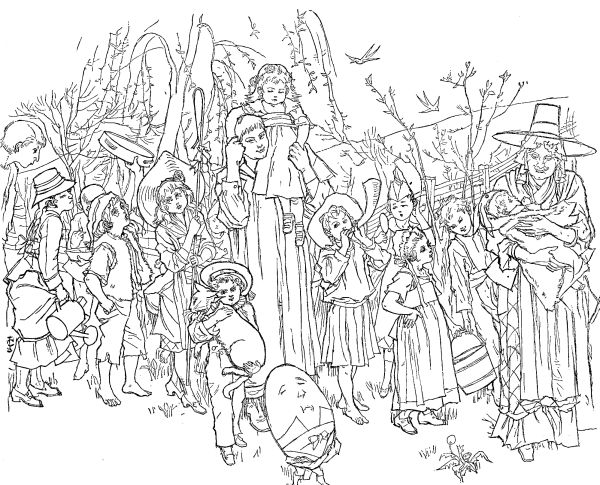
After everything was eaten up, Margery Daw and Little Bo-peep washed the dishes, while Little Boy Blue went fast asleep under the fence, and Mother Goose told all the little ones a story, until the cobwebs began to come over the sky, and the sun whispered to the little birds and flowers it was time to shut their peepers for the night, when they started for home, Goldilocks the Queen riding in the middle of the procession on big John Stout's shoulder; and when they bade their teacher a tired but happy good-night, all said they had had the nicest kind of a day, and hoped next year Mother Goose would give them another May party.
GOING HOME FROM THE PICNIC.—Drawn by Jessie Curtis.
South Norwalk, Connecticut.
I have two large Maltese cats—one nine and the other three years old—a dog, and a parrot. The oldest cat is named Meow, and the other Maltie Beeswax. We called him that, because he sticks so. If he gets in our laps, there is no getting rid of him. He will jump through my hands held three feet high. The parrot does not talk much, because it is tongue-tied. She calls "papa," and screams when she wants to get out of her cage. The dog Spry is the cunningest of all. His body and color are like a black and tan; but his nose is shaggy, like a Scotch terrier, which makes him look very funny. He will sit up, and clap his paws together, and say patty-cake. The way he does it he growls, whines, and barks while some one else says the words. If he don't like what is given him to eat, we only have to say, "Give it to me," and he will eat it all up rather than let any one else have it.
M. F. Le C.
Santa Cruz, California.
I am eight years old. My home is near the sea. There are a great many visitors here in the summer, and they bathe in the surf. We have no snow here. The hills are already covered with green (April 4), and soon there will be a great many wild flowers. My teacher reads stories to us from Harper's Young People.
Edith D.
Marquette, Michigan.
On the 23d of March I picked some willow "pussies." They were the largest I have ever seen here. I think it was very early for them up in this cold country.
May L. B.
Benton, New York, April 10, 1880.
I found the first trailing arbutus in full bloom to-day. It was very fragrant and pretty. We take Young People, and like it very much. I have a pet rabbit that is pure white.
Louise D. T.
Fort Klamath, Oregon, April 1, 1880.
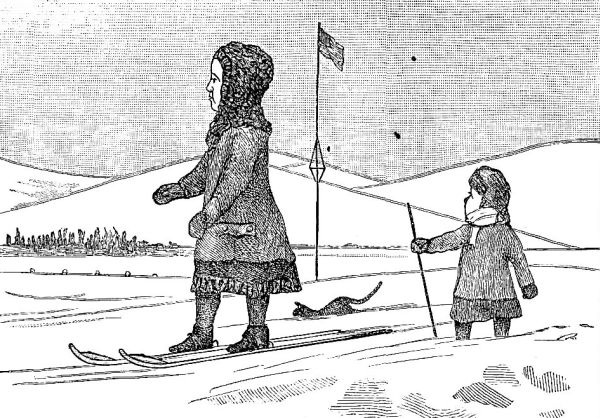
I like Young People better and better all the time, and it seems as if Tuesday was longer coming than any other day in the week, because that is the day I get my paper. The snow is so deep that the mail-carrier has a hard time getting 'way out to this fort to bring us our letters and papers, and it is almost night sometimes before he gets here. I told you that I had a little brother and a dog to play with, and a pair of snow-shoes to go about the country on, so I send you a sketch that, looks just like us when we are out on the parade-ground playing.
Sophie L. W.
AT PLAY ON SNOW-SHOES.
Dunkirk, New York.
I am six years old. I can read the letters in "Our Post-office Box" myself. I have three little sisters. Helen and Ethel like to look at the pictures in Young People, and hear the stories read. I have a pet dog. His name is George William. He has a bad trick. He steals eggs, and will drive the hens off the nests to get them.
Guy H.
Edna, Minnesota.
I wish to thank the children through Young People for sending me so many nice presents since I wrote. A great many of those who have written to me have inquired my age. I am sixteen, but I have been to school only two years in my life. When I was between seven and eight years old, I was taken sick, and six years ago my feet were taken off. Since then I have been at school nearly two years, and before I was taken sick I had learned to read a little. I am not as well educated as I would be if I had been well, like other boys. My home is in Edna, Polk County, Minnesota. When I wrote before, I was staying with a friend in Crookston.
Elmer R. Blanchard.
Green Bay, Wisconsin.
I tried Puss Hunter's little recipe too, but I put frosting on my cake. I made a mistake, and put it in a jar with dried beef. When I treated a slice to the folks, they laughed at me, and said it tasted as if it was flavored with ham. I like Young People, and I like the little letters best of all.
May W. (10 years).
Bellerive, Switzerland, April 5, 1880.
I noticed in Young People of March 16 that it was time to look for violets and anemones. I wish to tell you that I have already found them here, and also the "pussies." I am fourteen years old, and I am at school here in Vévéy, on Lake Geneva.
L. Sullivan.
Fox Lake, Wisconsin.
Here is a recipe for water cookies that my sister asked me to send to Puss Hunter for her cooking club: One cup of sugar; one-half cup of butter; one-half cup of water; caraway seeds; flour enough to make it very stiff. Roll very thin, and sprinkle with sugar after putting the cookies in the pan.
H. F. P.
Bailey's Mills, Florida.
I am staying now on Lake Miccosukie, which is ten miles long and from two to three miles wide. About two miles from the lake the outlet sinks into the ground. The Miccosukie Indians once lived here. There is a large live-oak where they used to dance around their scalp pole at the green-corn feast. I have some pieces of pottery and arrow-heads; some are very pretty. General Jackson fought the Indians here, and drove them across the lake. There is an Indian mound near here which has large trees growing on the very top. I wonder who made it, and what for. The trees here are in full leaf, and many are in bloom (April 13). The orange-trees are filled with fruit.
Willie L. B.
Charlottesville, Virginia.
I am ten years and five months old. I read Young People every week. The answer to the "Personation" in No. 24 is Queen Charlotte of England, wife of George the Third. She was married in 1761, and died in 1818. The town in which I live is named for her. It was incorporated by the Colonial Legislature in 1762. Two miles southeast of this town is Monticello, the former residence and now the burial-place of Thomas Jefferson, the writer of the Declaration of Independence, and former President of the United States. One mile southwest from here is the University of Virginia, founded by Jefferson. When I am old enough I hope to become a student there.
Harry A. G.
Owensboro, Kentucky.
I once had a gray fox, but one night he got loose, and a dog killed him. Last spring I bought a 'coon, and kept him all summer. He was very cunning, but my fox was the best. He would play hide-and-seek with me for hours. Will you please tell me what minnows eat, and must I change the water every morning and evening? Sometimes I leave the water unchanged for days, and the fish seem livelier. I caught them in a ditch.
Willis E. L.
Minnows may be fed the same as gold-fish (see Young People No. 6). Once a day is sufficient to change the water, although if you have certain kinds of water-plants in your globe or aquarium, the water may go unchanged for days, and still remain pure.
Ingleside.
I am a little girl only ten years old. I live on a farm in Cherokee County, Georgia. Last summer I began to make a collection of insects, but did not succeed very well. Will you please tell me what is the best way to kill and preserve them?
Katie R. P.
The best method of catching butterflies and insects is with a net, which can be made in the following manner: Take a common barrel hoop, and slit off a strip about a quarter of an inch wide. Of this make a hoop about a foot in diameter, and fasten it with wire to a light rod about a yard long. Then take a round piece of mosquito netting about three-quarters of a yard in diameter, and bind it firmly to the hoop. Insects captured with a net do not get broken as if caught rudely with the hand. When your treasure is secured, gather the net in your hand, thus confining the insect in a very small space. Then dose it carefully with a few drops of ether, which should be poured on the head. This will probably kill the insect at once; but should it a few moments later show any signs of life, another drop will finish it. The advantage of ether is that it evaporates quickly, and leaves the color and texture of the insect uninjured. The best way to mount your specimens is to have thin pieces of cork glued to the bottom of your case, to which the insect is fastened by a long slender pin stuck through its body. If you have no corks, soft pine wood will do. You must mount your specimen and arrange its wings and feelers immediately, as it soon becomes stiff and brittle, and will break if handled. The great enemies of a collection of insects are mice and moths. Mice will ruin the result of a whole summer's work in a single night if they can get at it. But a little care and forethought will guard against the ravages of these mischievous destroyers.
Kenosha, Wisconsin.
I had a young wild rabbit that grew so tame I could let it out in the yard to eat grass and clover. It would also eat bread and milk out of a dish. I liked it very much. When I caught it I put it in a wire cage, and fed it, and it soon got tame, and played around the kitchen most of the time. I am sorry to say that my little sister squeezed it to death. I am twelve years old, and I live on a farm one mile west of Kenosha. I have three brothers and three sisters, and I am the oldest of them all. Five of us go to school in Kenosha.
E. B. C.
Horace C. W.—See Young People No. 18, page 232.
Mattie L.—There are so many good books of the kind you require, that it is difficult to say which is "best."
A. H. E., and Others.—We receive a very large number of puzzles from our youthful correspondents. If no answer accompanies them, they are not examined. If the solution is one we have already published, it can not be used again. Good puzzles are always welcome, but even after being accepted, they may wait weeks before their turn comes to be printed.
"Subscriber," Cleveland.—The composition for making ink-rollers consists of glue and molasses, the proportions varying from about two pounds of glue in summer to one pound in winter for one quart of molasses. The glue should be soaked about half an hour. The water should then be poured off, and the glue heated until it melts. Then pour in the molasses, and stir it well. It should now be boiled slowly for about an hour before it is poured into the mould, which should be well oiled. You will find it much more difficult than at first appears to make a good ink-roller, and it will be as cheap in the end for you to buy them. If you take proper care of one, it will last a long time. Do not wash it immediately after use, as that tends to make it harder. When it appears clogged with ink, rub it with oil an hour before you wish to use it, and scrape it clean with the back of a knife.
Olaf T.—As we can not examine your telescope, it is difficult to tell where the trouble lies. Possibly the diameter of your tube is too small for the increased size of your glass.
W. T. Chafin.—The authorship of the Arabian Nights is unknown. Antoine Galland, who was employed by Colbert to collect manuscripts in the East, first made the work known in Europe about the end of the seventeenth century. From internal evidence the middle of the fifteenth century has been fixed upon as the probable period of the composition of these wonderful tales.
R. E. S. Vansant.—There are about 38,000 distinct words in the English language. About 23,000 of these are of Anglo-Saxon origin. The vocabulary of the new edition of Webster's Unabridged Dictionary contains about 118,600 words, including derivatives, compounds, etc.; 3000 or 4000, however, are all that are in common use for oral or written communication. The Old Testament contains 5642 different words, Milton uses about 8000, and Shakspeare about 15,000. Only about 300 words are in ordinary use for telegraphic business messages.
PUZZLES FROM YOUNG CONTRIBUTORS.
No. 1.
ENIGMA.
My first is in lost, but not in found. My second is in earth, but not in ground. My third is in no, but not in yes. My fourth is in doubt, but not in guess. My fifth is in stir, but not in mix. My sixth is in set, but not in fix. My seventh is in ocean, but not in land. My eighth is in rise, but not in stand. My whole is a modern painter's name, Emblazoned high on the roll of fame. North Star.
No. 2.
WORD SQUARE.
First, an adverb of time. Second, to possess. Third, without end. Fourth, a Roman Emperor.
Edwin.
No. 3.
NUMERICAL CHARADE.
I am composed of 18 letters. My 10, 2, 18, 17 is indisputable. My 4, 3, 14, 8, 15 is a color. My 1, 8, 7 is a boy's name. My 13, 5, 9, 8 is a flower. My 16, 12, 6 is arid. My 6, 5, 11 is a pronoun. My whole is a noted event of the Revolutionary war. W. R. S.
No. 4.
ENIGMA.
My first is in joy, but not in sorrow. My second is in lend, but not in borrow. My third is in fast, but not in slow. My fourth is in whiff, but not in blow. My fifth is in whole, but not in half. My sixth is in heifer, but not in calf. My seventh is in song, but not in hymn. My eighth is in hoop, but not in rim. My ninth is in fancy, but not in whim. My hidden whole, when it is found, Is the name of a statesman much renowned. Arthur.
No. 5.
DIAMOND PUZZLE.
In merit. A song. A boy's name. A part of the body. In merit.
M. E. N.
No. 6.
DOUBLE ACROSTIC.
A promenade. A Swiss canton. A feast. Fidelity. To enlighten. To compute. Answer—Primals form the first name and finals the second name of a celebrated man of the sixteenth century.
W. F. B.
ANSWERS TO PUZZLES IN NO. 24.
No. 1.
Shakespeare.
No. 2.
Birds of a feather flock together.
No. 3.
Banana.
No. 4.
GarliC
EnigmA
OpaL
MimiC
EmU
ToiL
RouleaU
YeS
Geometry, Calculus.
No. 5.
RULER
UNITE
LITHE
ETHEL
REELS
No. 6.
Montcalm.
Decapitated Charade, on page 328—Prelate.
A Personation, on page 328—Queen Charlotte Sophia, wife of George the Third of England.
Favors are acknowledged from Gracie Allen, John W. Gebhart, Grace Whitney, Walter Vassar, Erne Werner, Edna Hamilton, Charles H. O., E. D. Jennings, Adella B., S. A. S., Maud M., James A. S., J. M. Wolfe, Maggie Taylor, Inez, Fred Lewis, J. B. La Rue, S. B. Pray, Nell B. MacD., Susie Leavens, L. W.
Correct answers to puzzles are received from Louise Goff, May Burt, Vanderbilt Olmstead, Fannie and Florence M., G. W. Raymond, Lulu Pearce, Susie Benedict, Camilla W. M., Birdie Randolph, Eva Castle, Elsina Murphy, Cora M. Kay, Barrett Eastman, "North Star" and "Little Lizzie," Carrie March, J. MacClintock, Bertha Collom, G. C. Macintosh, Alice Hammond, A. A. True, Percy MacGeorge, William D. G., Katie and Frankie L., Edward C., Jennie H., Fred Brown, Willie MacInnes, H. K. Pryer, Maude and Morton H., Lulu A. G., Alice B., Fred C., Nellie D.