THE STORY OF PALAI.
Reading edition
BY E. MULLER.
Grandma Meronne sat in her garden, near Morges, on Lake Geneva, telling stories to Gustave Meronne and an American boy from the school at Geneva.
"Just out there," said Madame Meronne, pointing to the shining blue water, "there lived a boy a long time ago."
"Where, Grandmère?" asked Rob Grayson. "Over at Evian or Thonon?"
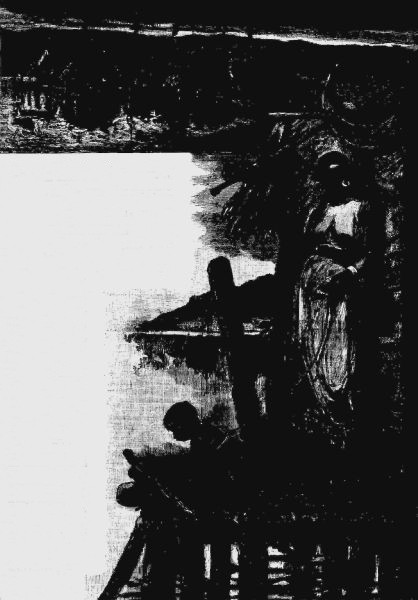
"No; just out there on the water. His house was built far out from shore, on a sort of wooden pier, with a long narrow pathway, on piles, leading to land. There was a whole village of such houses, built of logs, with piazzas all around, and carefully barred up on the land side to keep out the bears and wolves and hyenas."
"Hyenas! Oh, Grandmère! how can you?" exclaimed Gustave.
"Yes, hyenas. This was long ago, I said; and the boy's name was Palai. He was brave and hardy from his babyhood, and even when he could only creep, his mother had to tie a string to him, and fasten him to the house, or he would have crept on land or into the water, for he would not stay quiet a moment. When he could run about, his father showed him how to make a knife out of stone, and many an hour's hard work Palai had rubbing his knife on a great stone slab which lay in the middle of the house on purpose to sharpen things on. His father gave him a hollow bone of a deer to make a knife-handle, and then Palai was allowed to go on shore, and watch the cows and sheep at pasture. He was expected to keep off bears and wolves—yes, and hyenas, Gustave—with no weapons but a wooden club and this stone knife, which, by-the-way, was nothing like your knives, but more like a carpenter's chisel, as its sharp edge was at the end instead of the side. In summer Palai enjoyed his pasture-watching, and busied himself making more knives and spears, and pretty beads from bones and colored stones found along the lake.
"These were Palai's pleasant hours; but in winter, when the cattle were driven close to the lake, and Palai and other boys had to spend long cold nights watching for wild animals, it was not so pleasant. Palai's grandma—yes, Gustave, he had a grandma—used to tell him of the fearful beasts she had heard of in her youth, some of which her grandfather had seen. He had seen a bird so large that its legs alone were taller than he, and one of its eggs held as much as a hundred and forty hen's eggs. This was a Dinornis, and Palai wished he could have gone bird nesting after such eggs. Then there was a great dragon—the Labyrinthodont—which had been seen by Palai's grandma's great-grandfather; and the Dinotherium, a beast twice as large as an elephant, and many other fearful creatures. Palai never said 'Oh, grandma!' when she related these wonders. He had seen the huge bones of some of these creatures lying among the caves and rocks on the hills, and he wished constantly to meet and kill some great animal, for he was very brave. 'Never mind, Palai,' his grandmother said, 'these great beasts may have left this country, but there is always something great to be done, if one is brave.' When Palai was about fourteen, his father allowed him to go hunting with him to kill a cave-bear—an animal nearly twice as large as the bears we see now.
"Palai and his father each carried a club, tied to the waist by deer-skin strings, a knife, and a long wooden spear with a stone head. It was a great honor for a boy to be allowed to hunt the cave-bear; only very brave men attacked this beast, so Palai felt proud."
PALAI AND JURASSA.—Drawn by F. S. Church.
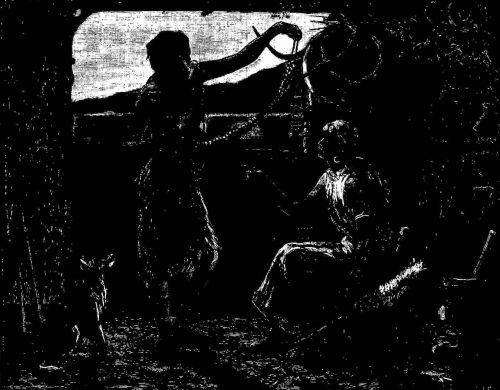
"But he knew the danger, and that he might never come home again, so he gave presents to all his friends and relations to remember him by. To his mother he gave a new distaff and stone spinning weights which he had made; to his grandmother he gave a wolf-skin to make a warm robe; and to his friend Jurassa—a nice little girl who lived in the next house—he gave a long string of pretty beads, which he had cut and polished just for her.
"'I won't forget you, Palai,' said Jurassa. 'But do something brave.'
"'I will,' said Palai.
"The country was not fair and smooth as it is now; great rocks were more frequent than grassy fields. The Bernese Alps were always covered with snow to their very base, as the top of Mont Blanc is now; and in the thick dark forests lived wild beasts which were as eager to find the hunters as the hunters were to find them.
"'Palai,' said his father, 'this bear is of the fiercest; it carried off two of our cows.'
"'I do not fear,' said Palai.
"'This is not play, like killing a wolf in the flock, or crossing the lake in your canoe. You must kill or die.'
"'I do not fear,' said Palai, who knew that his father was trying his courage, as was the custom among hunters.
"Two other hunters joined them, and before long they had climbed the hills, and found the cave-bear at home. Palai's dog, a thin wolfish creature, with long stiff hair, gave the alarm; but before they could throw themselves behind trees, this fearful monster sprang from his cave, and threw down Palai's father. Palai rushed forward, and struck the beast with his club, and the other hunters shouted and struck it with their spears, till it turned on them. Then they ran away. You can not blame them; they thought Palai's father was dead, and it was no use throwing their lives away. But Palai did not run. As the bear rose to grasp him, he threw himself under it, and stabbed furiously at its heart, killing it almost instantly, so that it fell upon him. When the other hunters saw this, they came and dragged Palai out, nearly smothered; and great was their rejoicing, till they found that Palai's father, for whom he had risked his life, was dead.
"Palai's father was a kind of chief among the villagers, so there was great mourning among the people, which prevented their being very glad over the death of the terrible bear. But as soon as their mourning was over, Palai learned that he was to be chief, young as he was, for no other hunter in the village had ever tried to stab a cave-bear by getting under it—and on his first hunt, too. Then all the people brought to his house presents of skins and grain, stone knives and kettles, bone beads, and woven cloths, and canoes, so that he was the richest as well as the bravest in the village. Then his mother and grandmother were proud of him, and so was Jurassa."
"And is that all?" asked Rob.
"That is all I know of Palai," answered Grandma Meronne.
"I never heard you tell such a queer story, Grandmère," said Gustave. "Half fairy story, and half made up."
"No, it is not half 'made up,'" said Grandma Meronne. "When you are old enough to read about the Lake-Villages of Switzerland, and how many things were found in one house, you will believe me."
"But the dragons, the Laby— Oh, Grandmère!" exclaimed Gustave, incredulously.
"They all lived, my Gustave, as surely as you do; but their lives were in the Neozoic Age."
A LONG-AGO BABY—Drawn by F. S. Church.