DO BIRDS KNOW THEIR OLD HOMES?
Reading edition
BY EESUNG EYLISS.
Look on your map for the Sierra Nevada, the range of mountains between California and Nevada. On the east side of them you will find Owen's River, running south through a beautiful valley of the same name. On each side of this valley rises a lofty mountain range. The White Mountains at the north end of the valley end somewhat suddenly in what is called White Mountain Peak, more than thirteen thousand feet high.
It was in the valley at the foot of this grand mountain that I saw the curious scene which I wish to describe to you, and which makes me think that birds do know their old homes, and that they are ready to fight for their rights.
In July, 1874, I stopped for a few hours at the house of Mr. Mack, who owned a quartz mine in the neighboring mountain. As I sat on the veranda I noticed on one of the posts a singular nest, or rather it seemed to be a pile of nests. On examination I found that it was really made up of eight nests, built one upon the other; and that they were of two kinds: first one of soft materials (grass and hair, etc.), then one of mud, then the soft nest again, then the mud, and then in the upper nest (which was of mud) the bird which had built it was sitting on her eggs. In answer to my questions, Mrs. Mack gave me the following account.
In the spring of 1871 a pair of linnets began building a nest in the place which I saw. In this there was nothing uncommon. The linnets love to be about houses, and very frequently make their nests on any exposed beams which they can find in verandas or porches, rather than in trees or bushes. I have seen hundreds of them in such places. This pair of linnets quietly completed their nest, and it already held one or two eggs, when a pair of barn-swallows arrived, and after looking at the place, and evidently talking the matter over in their own fashion, decided to take possession of it for themselves by driving out the linnets, and forthwith a violent battle commenced.
CALIFORNIA LINNET.
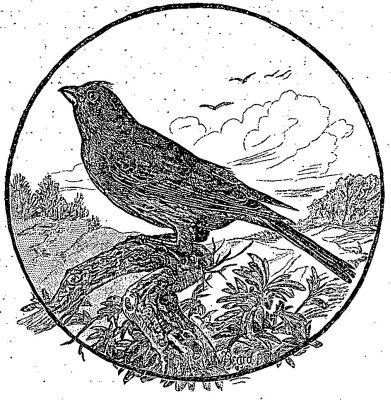
But before going further, I must stop a minute to tell you a little about the two kinds of birds. The linnets you have probably never seen, unless you have been in California. There they are extremely abundant: east of the Rocky Mountains they are not found. The females, and all the young birds until they are at least a year old, have much the look of several species of our brown sparrows. The English sparrow, which has become so very common in our cities and villages, gives you quite a good idea of their size and color. The male bird, however, when in full plumage, is very different. His head and shoulders and breast are richly marked with crimson of a purplish hue, giving him a lively and elegant look, decidedly different from his plainly dressed wife and children. He is a fine singer, and it is not an unusual thing to see him in a cage, and hear him called a California canary.
The linnets in California are not migratory; they remain through the winter as well as the summer. The barn-swallows, on the contrary, are migratory, just as they are here, for, unlike the linnets, they inhabit the whole breadth of the continent. In the fall they go south, as far as Mexico and Central America, and return in the spring all along the Pacific coast of the United States.
Thus our pair of linnets had had time to begin their housekeeping before the swallows arrived from the south. As I said, the swallows appeared to hold a consultation, and then very deliberately began the fight. The attack was resisted as stoutly as it was made, and for the whole of the first day no material advantage was gained by either party. There was a great amount of violent chattering, and many severe blows struck, causing some loss of feathers; but the linnets held their ground, or rather their nest, and when night came, the swallows retired, leaving them in possession.
Early the next morning the contest was renewed, and all through the forenoon it raged fiercely, with short intervals for rest, but noon had come without any apparent results. A little after noon the swallows suddenly, as if by agreement, flew away to the roof of an adjacent building, as though acknowledging a defeat, and the linnets were left once more in peace. They testified their enjoyment of the release by a constant happy twittering; but this was not to last. After about half an hour, the swallows, having sat without stirring all this time on the one spot where they alighted, sprang together from the roof, and darted like an arrow straight at the nest. The linnets were apparently taken by surprise, and in less than two minutes they were driven out of the nest, down upon the floor of the veranda, then upon the ground outside, and finally, with a loss of many feathers, entirely away from the house, and the swallows, with every demonstration of joy, took possession of the nest.
Their conversation seemed to be very earnest, and at the same time very cheerful, for they doubtless thought the victory was won. But what were the linnets doing all this time? At first, for a few minutes, they were apparently quite downcast. They hopped about restlessly and uneasily on the bush to which they had fled, and were entirely still. After a little while they evidently began to confer with one another, and it was plain that the female was more energetic than the male, and was urging him to do something which he disliked. But as might have been expected, she carried her point. Mrs. Mack was watching them, when the conversation came to an end.
They sat perfectly quiet for a few minutes, and then, with a dash as savage as that of their adversaries had been before, they charged full upon the nest, and, to their credit be it said, they won the victory. The swallows were routed, without having time for scarcely a blow in their own defense. They fled for their lives, and were chased off, not only from the veranda and the house, but even from the neighborhood, and the linnets returned in such a frame of mind that they continued the celebration of their triumph for the remainder of the day, the male maintaining a steady song until evening.
But alas! Though their cause was just, and they were only fighting in defense of their home, they were defeated after all. The next morning about ten o'clock the swallows dashed in again, and the battle raged as fiercely as ever, and before noon the poor linnets were driven off, not to return. They were completely quelled, and for a day or two hung about the place disconsolately, but at the end of that time they recovered their spirits, selected a place on the other side of the house, where they built a new nest, and went on with their housekeeping with as much contentment apparently as though no evil had happened.
BARN-SWALLOWS' NEST.
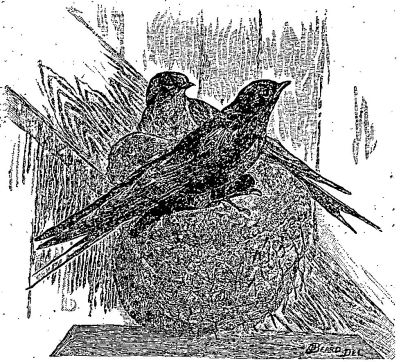
The swallows had won their house-lot, and they speedily began to build. The linnets' nest was beautifully made of soft grasses and hair and other fibrous materials, and the first thing which the swallows did was to plaster that across the top solidly with mud, so as to make a foundation on which they could work. The barn-swallows always construct their nests of mud, mixing with it a small number of pieces of straw or grass. They heap up the mud until often the nest weighs as much as two pounds, and then the hollow top is beautifully lined with soft materials, grasses, feathers, etc., on which the eggs are laid.
These swallows went on as usual, and just as though they had not obtained their home by robbery and violence. They reared their brood of young ones, and in the fall all flew away to the south with the others of their kind.
In the spring of 1872 the scene was repeated. A pair of linnets—probably the same pair—built their nest on the same post, but it was necessarily placed on the top of the swallows' nest of the last year. Their work was completed just before the swallows arrived. One pair of the latter appeared to understand that the place belonged to them, for without any delay or hesitation they attacked the linnets furiously, and after a conflict lasting until the second day, drove them away, buried the soft nest in mud as before, and occupied the spot as their home for the summer.
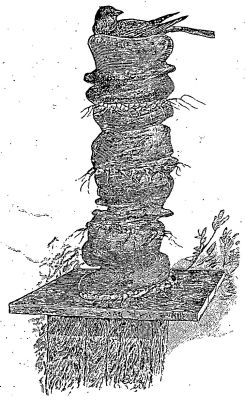
The same thing transpired in 1873, and when I saw the structure in 1874 it had occurred for the fourth time. The linnets had built and been driven away, the swallows had occupied the field, and I saw the female bird sitting quietly on her eggs in a nest which was in the summit of a strange-looking pillar. The pillar was a rough mass, four or five inches in diameter, and more than a foot high, composed of eight layers. The layer at the bottom was very thin, of hair and grass, the one above it being a solid heap of mud more than three inches thick, then a thin one again, and so on until the swallows' nest at the top made the eighth.
You can easily see that the linnets' soft nest would be crushed down by the great weight of mud heaped on it, and would thus make only the thin layers as stated. It was plain that no such scene could be witnessed the next year, for the successive building of the nests had heaped up the mass until it almost touched the roof above it. In fact, the swallow had barely room to creep into her nest and out of it. I saw her come and go, and each time her back rubbed against the shingles. When she had settled down on her eggs, she had, of course, a little more free space.
Now what do you say? Did not both the linnets and the swallows know the old nest, and did not they consider that it belonged to them individually, and that they were determined to occupy it because it belonged to them, and then to fight for the possession of it if necessary? Otherwise why should the linnets in 1872 have persisted in building on the top of the swallows' nest? There were other posts all around the veranda, each one of them just as good as that, so far as I could judge, and then, too, that one was spoiled by having the nest already there, for the linnets are not in the habit of building where another nest has occupied the place. But no: that spot was theirs, and they had been unjustly driven from it the year before, and they seemed to consider that, though it was not so convenient as a dozen other places close at hand, justice to themselves required that they should assert their ownership. No birds with spirit could allow themselves to be despoiled of their rightful possession in any such manner. Then presently came the swallows, with just the same feelings, and the battle followed.
But this brings in another question. Do birds choose their mates for life? We have always thought that it was not so—that their partnership lasted for but a single year. We see, however, that when the swallows returned, they plunged into the conflict as though they both understood it, and were interested in the ownership. It may be, however, that the female came alone, and when she found that her house was occupied, she said nothing until she had selected a mate, and then she informed him that before any housekeeping could be commenced he must be prepared to fight for his "altars and his fires," for his "hearth and home," and so, like a dutiful husband, he toed the mark at once, and the battle commenced.
In whatever light you look at it, it is a remarkable example of the intelligence of birds, and of their power of communicating ideas to one another. I give you my assurance that the story is absolutely true, just as I have written it.
"ROCKED IN THE CRADLE OF THE DEEP."