THE WAYWARD DONKEY.
Reading edition
BY W. H. BEARD.
There was once a little donkey who gave his poor mother no end of trouble, he was so stubborn, unreasonable, exacting, and dreadfully saucy. Why, when angry, he didn't hesitate at all to call his mother an old donkey, right out. One day, when crossed in some particularly absurd desire, he declared he would run away. Immediately putting his threat into execution, off he trotted, heedless of his poor fond mother's entreaties. Away he went, sustained at first by his temper and pride.
But as the day wore on, he became weary, faint, and hungry. The matter of food and shelter became a question of serious alarm, and how to obtain them was a problem too great for his little donkey brain to solve. He now remembered that he had never had to trouble himself with all this before, all the needs and comforts of life having been provided for him without thought or care on his part.
The land over which he was travelling was quite poor, and only afforded a few little stunted thistles, which seemed to consist more of prickers than anything else, which pierced his tender little nose, and made it bleed. He saw plenty of oats and other grains, as well as nice vegetables, growing in fields, but so well guarded by high fences that he could not hope to get at them. Many times, when hunger and fatigue had subdued his pride, would he have returned home; but he had wandered so far that he had not the least idea which way he had come. To add to his distress, he saw the sun was fast declining. Already he felt the chills of evening. But there was no use bemoaning his fate, and he must make the best of it.
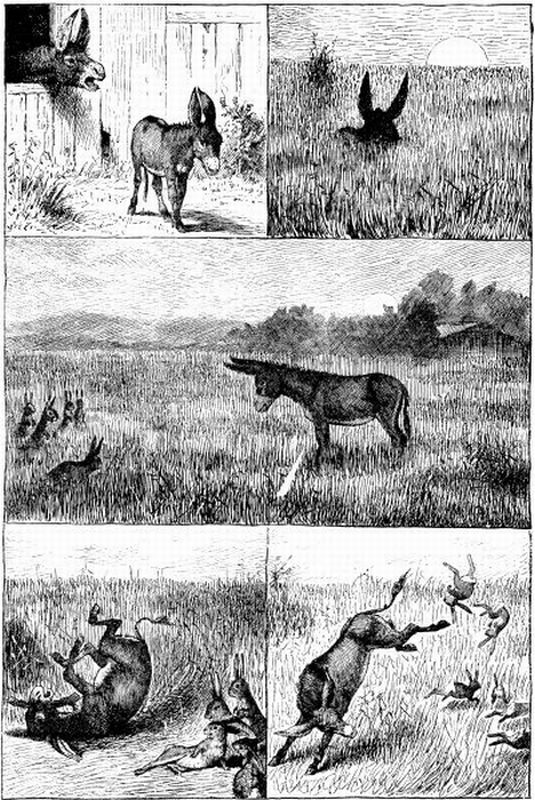
At length, too weary to travel farther, he was forced to lie down to rest, and selected for the purpose an unfenced overgrown piece of ground of considerable extent. Here, as he lay among the weeds, nothing was visible of him above their tops but his two ears, which might easily have been taken for two stakes, or the roots of an upturned stump. As he lay shivering in the damp grass, he felt anything but comfortable. The sun went down, the moon arose and shed a cold light over the face of nature, which made him feel lonely indeed.
Suddenly there appeared above the grass several other pairs of ears, bobbing about, quite like his own. The sight thrilled him with something akin to pleasure, for he asked himself, "To whom can such ears belong but to little donkeys? and if young donkeys are around, they must have mothers, or a mother, near by, who, no doubt, would be very glad to adopt such a fine specimen of the race as I." The reader has already seen that he was a conceited little donkey.
So saying, he arose quickly to his feet; the others stood up also, though not as he did on their four feet, but on their hind-legs—that is to say, they stood up on their haunches—and looked at him in blank amazement; but as he approached them they bounded away so fast that it was useless to try to overtake them. When he stood still, they also stopped, and again stood upon their haunches, and peered at him over the tops of the weeds. Master Donkey did not try again to go to them, but expostulated with them upon their ill-breeding and unkind behavior, called them cousins, told them he was tired and hungry, and asked for food and shelter. This touched their tender little hearts, and they cautiously drew near, and made the acquaintance of their supposed cousin.
On a close scrutiny, however, they doubted his claim to relationship, and flatly told him so. But they good-naturedly said if he was hungry, it was no more than common humanity to first relieve his wants, and discuss the question afterward. Even murderous man would do as much as that, so they brought him carrots and other vegetables in abundance from a farm garden near by, from which they were accustomed to supply their own wants.
When his appetite was satisfied, his humility, such as it was, oozed out, and he became as arrogant as ever, and stoutly claimed that he was their big cousin, though, he said, he was not particularly anxious to be acknowledged by such a pack of little dwarfish thieving creatures as they were, who would steal through the farmer's fence to purloin vegetables for a cousin whom they impudently refused to recognize.
Their spokesman retorted, and said they claimed a right to a share, sufficient for their needs, of whatever grew upon the earth. To be sure, they were obliged to obtain it stealthily at night, as man claimed it all for himself, and it would be almost certain death to be found by him within his inclosure. Indeed, many of their unfortunate fellows had already suffered death for the exercise of this natural right. If, however, he regarded their act as a crime, he was himself a criminal, inasmuch as he had accepted the fruits, and profited by the act, knowing how the food had been obtained. To this the donkey could make no answer; at least he did not think it prudent to try, as night was still before him, and the question of shelter still unsolved.
Good-nature was soon restored, and the discussion renewed. The rabbits could see many points of difference, but two only of resemblance. It certainly could not be denied that the ears were remarkably like, and the complexion was very nearly the same; but the hard feet were so widely different from their own soft paws! And the tail, too, long and dangling like a cow's—what a tail for a rabbit! Then, again, they had observed that he stood while eating, whereas a true rabbit always crouched comfortably near the ground while taking his food. In the matter of voice, too, they flattered themselves there was a wide difference. However, all this might be changed or improved by judicious training, except the feet. The hoofs they despaired of. The tail they proposed to nibble off at a proper length from the body. This operation the donkey positively refused to submit to, but finally consented to hold his tail up over his back as much like a rabbit as possible, and, moreover, would at once set about his lessons to learn their ways, so that he might the sooner adapt himself to their habits, and become one of them.
Accordingly, one of the cleverest of their number was charged with his instruction, and immediately began with the important art of sitting on the haunches with his tail curled up upon his back. In this, though he strained every nerve to perform it, he made an ignominious failure. He could only maintain the position for a moment, and then pitch forward or fall backward, seeming to rock over on his curved tail, and cutting such a ridiculous figure that it made all the rabbits laugh. This made him very angry, and he began to use his heels in a most vigorous and unrabbitlike manner. All ran for their lives, but not all escaped unhurt. The "spraggly" forms of two or three of those nearest to him showed dark against the moon-lit sky before they limped off, and, joining their fellows, gathered in a little knot at a distance from their fractious pupil, and discussed his merits with great freedom. They voted him an ill-natured brute, a stupid dolt—in short, a perfect donkey. Scarcely had they arrived at this unanimous conclusion, when—pop! pop! bang! bang!—four loud reports, and four little rabbits lay in the agonies of death.
The farmer and his son, seeing by the moonlight strange movements in the field, had stolen upon them, in the unguarded moment of their excitement, with their double-barrelled guns, and, as the boy expressed it, bagged four rabbits and a donkey; for poor little donkey stood paralyzed with fear. He had never looked upon death before, and was an easy captive. Without troubling himself to inquire who the rightful owner was, the farmer took him for his own, housed him that night in a stall by himself, where he passed almost the entire night, notwithstanding the fatigues of the day, in such reflections as he was capable of; and though he grew up to be a great donkey, to be sure, the lessons of that day were never forgotten by him.
THE WAYWARD DONKEY AND HIS FRIENDS.—From Drawings by W. H. Beard.

Rock Island Arsenal, Illinois.
I thought you would like to know how spring advances in this part of the country. There are a great many snowy little bloodroots in the woods on the island already (April 22), the mandrakes are coming up, and the spring beauties are in bloom. The snakes are here also, for a friend of mine and I saw a little garter-snake in the woods the other day. It hissed at us in a vicious little way. Yesterday I saw some pretty butterflies flitting about, and there are numerous graceful dragon-flies in the air. Last Sunday, just after a thunder-storm, I was on the front porch, and I saw about eighteen worms, most of them of a kind that is called "hundred-legs," but there were a few of another kind. They were crawling up on the porch to get out of the wet. The robins, bluebirds, cat-birds, woodpeckers, blackbirds, and others are here. This spring some of the gulls from the great lakes were fishing on the river. In Young People No. 24 Arthur L. H. wrote about his caterpillar that turned into a butterfly, and I thought he might like to hear about ours. My brother found a caterpillar that had different-colored cross-bands on it, like a Roman sash. He brought it home, and we fed it on leaves till it made a beautiful cocoon of a thin veil-like material of a pale sea-green color, with a line and a few dots of gold on it near the middle. We expected from all this that it would be a very remarkable butterfly; but it was only one of the common large brown butterflies that we see almost every day in summer.
Bessy F.
Wolverton, England.
I am seven years old. My grandpa and grandma live in Canada, and send me Young People. We have a donkey and panniers. My baby brother and sister ride in the panniers, and my other brother and I take turns in riding on the donkey's back. We call the donkey Jinny. I went on a visit to Canada when I was two years old. I would like to go again.
Nonie J.
Canonsburg, Pennsylvania.
I enjoy reading the letters in the Post-office Box very much. In No. 24 a little girl asks for some cooking recipes. I will send her a recipe for a very nice doll's cup-cake. My little sister and I make it often. We made it once when grandpa came to see us, and he liked it so much that he had to be helped twice. This is the recipe: One doll's cup of butter; two of sugar; three of flour; one of sweet milk; one egg; a few scrapings of nutmeg; one salt-spoonful of baking powder. When well mixed, put it into a buttered pan. When it draws away from the side of the pan, it is done.
Bessie L. S.
Stuyvesant Square, New York City.
Some other girls and myself have formed a Wiggle Club. We are going to get some papers printed with the heading, "Stuyvesant Square Wiggle Club," on which we will all send in our Wiggles, and we are going to have prizes for the best. The one of our Wiggles that is published in Young People will take the prize. We can not draw very well yet, but we will try to improve, and to be the champions. Our names are Bertha, Toonie, Sarah, Nonie, Blanche.
Unfortunately your drawings of Wiggle No. 10 came too late to be engraved. Your ideas were all excellent. In Young People No. 27 we gave you a new Wiggle, which you can practice upon, and send us what you make of it. The plan of your club is good, as it will afford you much amusement, and at the same time give you good exercise in drawing.
Dixon, Illinois.
I like Young People very much. I can read the children's letters, and I thought I would write myself. I have got a great family of dolls—thirteen in all—and I like to look at the picture, on the first page of Young People No. 7, of the two little girls and the basket of dolls. My black cat is named Hippopotamus, but I call him Pot for short. My papa at Christmas-time was dressed up like Santa Claus, and brought us a bagful of presents. I did not know it was papa till weeks afterward. I am seven years old.
Mary H.
Brooklyn, New York.
I wonder if any of the readers of Young People have ever seen a tarantula. It is a large hairy spider that lives in the tropics, and its bite is very poisonous. I had one, with its nest. The nest is made in clay, and is long, like a tube. It is closed by a trap-door, and is a skillful piece of workmanship.
A. R. J.
Brandon, Wisconsin.
My father and brother commenced seeding the 14th of April, as it had been very warm for several days. The morning of April 16 the ground was covered with snow, and it continued snowing hard all day.
Florence.
Fort Wayne, Indiana.
The other night I took my round in the chicken coop to see that all the chickens were in. Three little chicks, four weeks old, deserted by their mother, were just coming in. They jumped on the first roosting lath, and then on the second, and began to walk toward the rooster. One little chap jumped on his back, and the two others crept under his wings. What surprised me most was that the rooster took it very kindly, and has allowed the chicks to continue their tricks every night.
Walter C.
Rochester, New York.
I have a little kitty that we took with us to the beach last summer. When we went out rowing, she used to come with us in the boat, and if she didn't like it, she would jump into the water and swim ashore. When we walked up the beach for shells, she would always follow us, even if we went two or three miles. I am eleven years old, and my name is
Winifred B.
Salina, Kansas.
We have had such hard winds in Kansas this spring that the air would be so filled with thick clouds of dust and sand that we could not see a square away for hours at a time, and the air seemed charged with electricity. They were called electric storms, and the telegraph operators could hardly use their batteries at all. Can any one tell me what caused the electricity?
Charley H. G.
Dallas, Pennsylvania.
I am a lame boy, and can not go to school. I have been taking music lessons, and I can play on the piano and the organ. Papa and mamma are going to send me to the Conservatory of Music. I am eleven years old.
Willie H. H.
Belle Plaine, Iowa.
We have just found some buttercups for the first time this spring (April 15). I want to tell you about my pets. I have a dog named Watch, and I love him ever so much. He is black and white. We have a red and white calf. It butted me once, but I like it all the same.
Artie F.
Yarmouth, Nova Scotia.
I am eight years old. Papa takes Young People for me, and I am going to have it bound as mamma has her Bazar. She did not have it bound last year, for she sent it to Edinburgh to my aunt Annie. I go to school every day, and like to go. One of our large school-houses was burned down the other night. It cost about nine thousand dollars, and nearly three hundred children went to school there. We had a spelling match at my school just before Christmas, and I beat. We have a mare named Nell, and a cow named Maud. We had a pig named Aubrey Percival, but now we call him Pork.
Charlie P.
St. Johns, Michigan.
I am seven years old. Yesterday (April 14) I saw a butterfly in our yard. It was a blue-black with light spots. I tried to catch it, but couldn't. The same day I saw a bumble-bee. I have a shepherd dog named Punch, and when I go anywhere, he always squeals to go too. He is my best playmate, as I have no brothers or sisters. I think the Post-office Box in Young People is very interesting.
Robert E. C.
Nevada, Missouri.
My father is a harness-maker, and I help him morning and evening, before and after school, and at night I read Young People. I saw in No. 24 a little letter from Joseph D. asking how to tame wild rabbits. My brother was out hunting one day, and his dog caught a rabbit by the leg. The leg was broken, so my brother took some pine splinters and cut them into pieces about two inches long and a quarter of an inch wide, and bound them round the leg, and it got well. He tamed the rabbit by reaching his hand into the cage where he kept it, and rubbing it gently. It soon became so tame it would eat out of his hand.
J. L. G. L.
Brooklyn, New York.
I read a letter in Young People No. 13 from a boy who hatched a little chicken by putting the egg in ashes. I wish he would tell me how he kept the egg warm.
Nettie M. T.
Scranton, Pennsylvania.
I have a recipe for Puss Hunter's cooking club: One cup of molasses; three-quarters of a cup of sugar; one-quarter of a cup of butter; four tea-spoonfuls of vinegar; a little vanilla. It makes very nice candy. I have tried the recipe very often, and have never known it to fail. I would like to be a member of the cooking club.
R. C. W.
Hanesville, Maryland.
My papa takes Young People for us children, and I am very much interested in the stories, especially in "Across the Ocean." My brother likes to sing "I am the lad in the blue and white." I like to go to school. We are going to have a picnic in May, and are learning pretty pieces to sing and speak. I expect we will have a fine time; and if any of the young correspondents of Our Post-office Box would like to hear about it, I will write and tell them what kind of a time we really do have.
Elsie J. S.
Hohen Solms, Louisiana.
I am a little Southern girl. My father is a sugar-planter, and we have a nice home on the banks of the Mississippi River. We have a very fine pointer. In reply to the question of Joseph D. in No. 24 about taming wild rabbits, I will say that he must put them in a cage, not too small, and feed and pet them every day.
M. A. B.
Greenfield, Illinois.
I have a coach-dog named Beauty. When I play a French harp, she will cry and act very sad. She comes and lays her head in my lap, and seems to wish me to keep on playing. I can not tell whether she likes music or not, but she always howls when I play. I have a dear little brother named Lynn, a year and a half old. He kisses me good-by every morning when I go to school. I am nearly ten years old.
Jesse L. B.
Orodelfan, Colorado.
I thought I would tell you how much I like to have them hand me my paper at the post-office. My brother subscribed for it for me. I live in the Rocky Mountains. We own one-half interest in a gold and silver mine. We came here for my mother's health. She was very sick, and now she is well. I can have all the specimens from the mine that I wish for.
E. Palmer G.
Elwood, Illinois.
In the piece about Easy Botany in No. 24, Young People, I read that bloodroot grows in New England. It grows out here in Illinois too, and I found some a few days ago. We have a pet dog named Maria. She runs after the chickens and pigs.
Lillie MacC.
Beloit, Wisconsin.
I thought I would write to you about gophers. The gopher is a little animal which lives in the ground. It digs a hole about two feet deep, and it eats corn and other grain. Gophers destroy so many crops that the farmers do not like them, and they pay boys for killing them. I earned forty-eight cents last year killing gophers. I would take a club and a pail of water, and go to their holes. When I poured in some water, they would run out, and I would kill them with the club.
Arthur N. T.
The gopher, or Canada pouched rat, is a very remarkable burrower, as it will dig under-ground passages extending in lateral galleries in all directions. It is difficult to capture, as it keeps open a means of escape on every side. The mischief done by this creature is very extensive. It delights to burrow among the roots of fruit trees, which it gnaws, until often a large tree dies from the under-ground attacks of this troublesome animal.
E. A. C.—It is impossible for us to comply with your request.
W. B. B.—Flowers are beautiful pets, and repay well the attention bestowed upon them. The large plant, with its wide-spreading bluish-green leaves, which bears the castor-bean, is raised from the seed, like any other bean. It is an annual, but it grows so rapidly that by midsummer it is already several feet high. In some countries this plant is called palm-of-Christ, and is much valued as a garden ornament, as its pale green leaves form a beautiful contrast when growing among masses of dark shrubbery.
Addie P.—Your beautiful wild flower was so faded and crushed when it reached us that it was impossible to identify it.
G. H. Fisher and "Nuctum."—In an article soon to be published in Young People you will find all your questions fully answered.
"Subscriber," Brooklyn.—For directions for preserving insects, see answer to Katie R. P., Post-office Box, No. 27.
Marie S.—Ocean Grove, Squan, or Seagirt, New Jersey; Vineyard Grove, Dukes County, Massachusetts; and many places along the New England coast.
Shelton A. H.—Turtles should have a big tub of earth in which to bury themselves in the winter. Or if they are let loose in a yard, they will take care of themselves, and appear again in the spring. Read the answer to Lyman C. in Post-office Box, No. 5, where you will find full directions for the care of turtles.
Charlie W. M.—Your charade is gracefully made, but too personal to be printed in Young People. Thanks for your pretty compliments.
Favors are acknowledged from Frank Graves, Lepine Rice, "Carlo Vite," Katherine Hall, Arthur Morse, Fanny Pierce, Lucy Emmons, Paul R. H., Edith E. G., Evelyn D., "Sister," Graham Herford, Willie D., P. Roodhouse, Bessie MacLachlan, Mamie W. Perrin, Frank H., Lawrence Pugh, Minnie Hilton, J. H. Loewen, C. K. Shelby, Garland S., Jacob Sehen, Wallace Stephens, Harry MacGraw, Agnes S. MacInnes, Dioma Russell, Aubrey C. Smith, Fred Zoller.
Correct answers to puzzles received from Pierre Jay, Edmund Taylor, E. Clark, Lillie MacCrea, J. T. S., Robert R. S., John Whelan, Annie and C. H. MacB., Mary Greene, George H. Radley, Ruth Montague, Clarence Howard, Minnie H. Ingham, Philip D. Rice, Willie G. Springer, Claude and Bessie Comstock, Eugene and Maud Watson, Charley H. Gibson, Paul J. H., Eddie A. Leet, Mamie E. F., Shelton A. H., "Fatinitza," William G. Macdonald.
PUZZLES FROM YOUNG CONTRIBUTORS.
No. 1.
DIAMOND PUZZLE.
In silent. To tear. A flowering shrub. To stuff. In skeptic.
M. W.
No. 2.
GEOGRAPHICAL DOUBLE ACROSTIC.
A French city. A town near the mouth of the Dnieper River. An Italian city. A town in Ireland. A city in Spain. A Mexican province. Answer—Two countries in Europe.
C. P. T.
No. 3.
NUMERICAL CHARADE.
I am composed of 11 letters. My 9, 10, 1, 5, 8 is a boy's name. My 4, 7, 2, 8 is an animal. My 3, 11, 6 is to entreat. My whole is beautiful and sweet. Jennie.
No. 4.
DROP-LETTER PUZZLE.
A familiar proverb:
M—k—h—y—h—l—t—e—u—s—i—e—.
Bertha.
No. 5.
ENIGMA.
My first is in beam, but not in shine. My second is in grape, but not in vine. My third is in crying, but not in scream. My fourth is in fleeting, but not in dream. My fifth is in glove, but not in hand. My sixth is in shore, but not in land. My seventh is in glow, but not in burn. My eighth is in vase, but not in urn. My ninth is in run, but not in motion. My whole came over the stormy ocean. J. A. W.
No. 6.
RIDDLE.
I am a little word of four letters, yet you will find in me a preposition, a negation, and an exclamation. I am as old as the sun, and he could not possibly fulfill his daily course without me. I am a rest to the weary laborer, and a delight to school-children, who greet me with a shout of welcome. I aid in construction and consolation—indeed, they could not exist without me; and although they break me to pieces, I am never in bad temper. Who can find me out?
C. S. N.
ANSWERS TO PUZZLES IN NO. 25.
No. 1.
Leonidas.
No. 2.
Titania.
No. 3.
S
ANN
SNAIL
NIP
L
No. 4.
HOST
OBOE
SOAR
TERM
No. 5.
Magdalena.
No. 6.
MorasS
AffraY
GigantiC
NevadA
OverwhelM
LassO
InsulaR
AccedE
Magnolia, Sycamore.
Charade on page 344—Cross-bow.