I AM THE LAD IN THE BLUE AND WHITE.
Reading edition
BY MARY A. BARR.
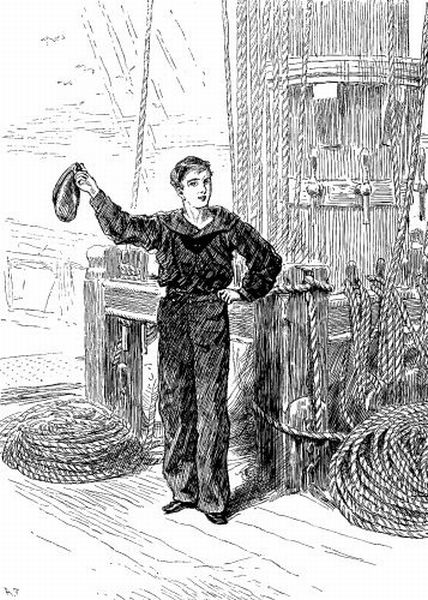
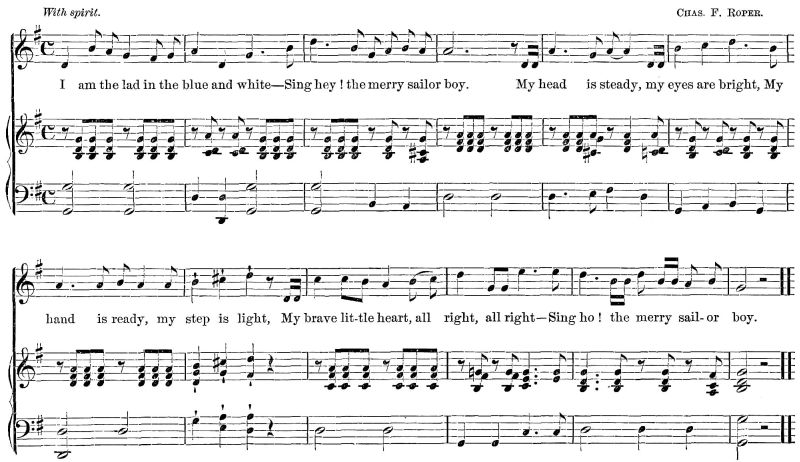
I am the lad in the blue and white— Sing hey! the merry sailor boy. My head is steady, my eyes are bright, My hand is ready, my step is light, My brave little heart, all right, all right— Sing ho! the merry sailor boy. I am the lad in the blue and white— Sing hey! the merry sailor boy. I sit in the shrouds when the soft winds blow, The light waves rock me to and fro; I run up aloft or down below— Sing ho! the ready sailor boy. I am the lad in the blue and white— Sing ho! the merry sailor boy. When the skies are blue and the sea is calm, The air is full of spice and balm, And the shore is set with shadowy palm, Oh, glad is the merry sailor boy! "What will you do when the great winds blow? What will you do, my sailor boy?"— When great winds blow, and are icy cold, Never you fear, for my heart is bold: I'll watch my captain, do what I'm told— Sing ho! the ready sailor boy. "If a foe should come—in such a plight, What would you do, brave sailor boy?"— Run up the "Stars and Stripes" in his sight, Stand by my captain, wrong or right, And give the foe an up-and-down fight— Sing ho! the gallant sailor boy. I am the lad in the blue and white— Sing hey! the merry sailor boy. I carry my country's flag and name; I never will do her wrong or shame; I'll fight her battles and share her fame— Sing ho! the gallant sailor boy.

Everett Station, Georgia.
I want to tell you about a pet squirrel I had. My uncle was having some trees cut down, when the men found three young squirrels in one of them. One of the squirrels got killed, and one ran away, but my uncle caught the other and put it in his pocket, and forgot all about it. After a while he put his hand in his pocket for something, and the squirrel bit him. We tamed it, and it would run all over the trees in the yard, until one day some boys passing by shot it, thinking it was wild. My little brother cried, and I came near crying too. We buried it in the flower garden.
Chesly B. Howard, Jun.
February. 15, 1880.
I am nine years old. I was born in Boston, but for the last three years I have been living on a farm in Lakeville, Massachusetts. There are a number of lakes near here, and some of them have long Indian names, such as Assawampsett and Quiticus. Yesterday was a warm, spring-like day, and I saw two robins, and I heard the bluebirds singing.
Louis W. Clark.
Machias, Maine.
I like Young People very much. I have a summer-house, and in the summer I found a little humming-bird, with its wing broken, all tangled up in the flowers. I took it into the house, and fed it. It ate sugar and water. It had a funny little narrow tongue, and it put it out when it ate. It lived in the house two days, and then it died.
Nellie Longfellow (8 years old).
Sacramento, California.
My papa told me of a pretty way to designate the long months from the short ones. He learned it from a little girl when he was travelling in Oregon, and I think a good many little readers of Young People might be pleased with it. This is the way: close your hand, and point out the knuckle of the forefinger for January, and the depression between that and the middle knuckle for February. The middle knuckle designates March, and the next depression April; and so on to the small knuckle, which stands for July. Then go back to the forefinger for August, and proceed as before until all the months are named. It will be found that all the short ones fall between the fingers, while the knuckles stand for the long ones.
Phebe C. Brown.
Philadelphia, Pennsylvania.
I want to tell you about a young alligator and a water turtle papa had. He kept the turtle in the cellar, and the alligator in an earthen tank; but when it came winter he put that in the cellar too, in a tight box with air-holes. Some time afterward he went to look at the turtle and the alligator, and they had both disappeared. Where do you think they could have gone?
Puss.
Dixon Spring, Tennessee, February 18.
I am a subscriber to Young People, and I like it very much. I am ten years old. The creeks are in the way, so I can not go to school now, but I will go in the spring. Some of our flowers are in full bloom, and the weather is very pleasant. But we had a snow-storm last week, and I enjoyed it so much!
Fannie M. Young.
Philadelphia, Pennsylvania.
I know some little girls who live in the country. They set a little table in the yard, and put on it tin dishes with chicken food in them. Then they ring a toy bell, and the chickens have learned to come and stand round the table and eat. If a chicken hops on the table, it is not allowed to eat any more, and in this way they are taught to behave very nicely.
Sadie.
Decorah, Iowa.
I am a little Norwegian girl, though I was born in America. I am twelve years old. Not all the Norwegian ships in which Leif Ericsson and his company sailed to America were as small as the one described in "Ships Past and Present," in Young People No. 14, for one of them had sixty men and five women on board. Some of the ancient Norwegian ships were quite large. I have read in Traditions of Norwegian Kings, by Snorro Sturrleson, about Ormen Lange (the Long Serpent), a large and handsome ship which belonged to King Olaf Tryggveson. That part of the keel which touched the ground when the ship was being built measured 112 feet. The ship carried a crew of more than 600 men. It was Leif Ericsson, not Olaf Ericsson, who sailed to America.
E.
Tryggveson, who reigned in Norway a.d. 995-1000, had ships which were the wonder of the North. His largest war ship was the Long Serpent, supposed to be of the size of a frigate of forty-five guns. In a great sea-fight with the Kings of Denmark and Sweden, King Olaf Tryggveson was conquered, and is said to have sprung overboard from the famous Long Serpent into a watery grave.
Danville, Illinois.
Here is a recipe that some little girl may like to try. Two table-spoonfuls sugar; one table-spoonful butter; one table-spoonful milk; one well-beaten egg; four atoms of cream of tartar; two atoms of soda; flour enough to make a batter. You must get cook or mamma to measure the atoms. This recipe will make four little patty-pans of cake, and there will be some batter left to thicken for cookies. I cut out the cookies with mamma's thimble.
Puss Hunter.
Washington, D. C.
In our parlor there is a little mouse that has a hole in one corner of the fire-place. Before I fed it it was quite tame, and would run all about the room. I feed it now, and it only comes to get the crumbs I put close by its hole. Can any one among your correspondents tell me how to tame it?
E. L. M.
East Haven, Connecticut.
I have a rabbit, kitten, parrot, dog, canary, and a pair of chickens. I had a crow, but it died. I have a burying-ground for my pets, and in it there is the poor crow, a dog, two bantams, and seven canaries.
Susie D. B.
Buffalo, New York.
I want to tell you about my dog Joe. He is a setter. He does a great many capers. He watches for the boy who brings the evening paper, and takes it, and brings it up stairs to us. He plays hide-and-seek with me, and sometimes I tie a rope to his collar, and he draws me on my skates. How fast we do go! One day I hitched him to a sled for the first time, and he did not know what to make of it. He ran a little way, and then tipped me into a snow-bank, and made for home.
A. O. Thayer.
Barton, Maryland.
I had a pair of pet rabbits which I prized very much. Papa built a hutch for them, and they enjoyed their home very much. I fed them with clover, cabbage, and apples. Sometimes I gave them a dish of sweet milk to drink. They were growing so nice; but we had an old cat which I suppose thought if the rabbits were out of the way, she would get all the milk herself. One morning I fed them, and forgot to give Spiney her milk. (That was the old cat's name.) So she went down to the hutch and watched them drink their milk. When they had finished, they popped their little heads out between the bars. Old Spiney sprang on them, and that was the last of my poor rabbits.
Maggie Bermingham (10 years).
Bertha A. F. saw the bluebirds at Sag Harbor, Long Island, on the day before St. Valentine's, and on February 20 she picked willow "pussies." O. T. Mason says he found the "pussies" in Medway, Massachusetts, as early as January 18, but he neglected to report them.
Leon M. F.—If you dampen the skin under the feathers with water, and sprinkle on it a little finely pulverized sulphur, your pigeons will probably be relieved.
Aggie R. H.—Nourmahal, afterward called Nourjehan, or "Light of the World," was the wife of Selim, son of Akbar, Mogul Emperor of Hindostan. Selim succeeded his father in 1605, and was henceforth known as Jehanghir, or "Conqueror of the World." In the early part of his reign Selim was intemperate and cruel, but after his marriage with the beautiful Nourmahal his conduct greatly improved. Her influence over her husband was very great. He took no step without consulting her, and as she was an extraordinary and accomplished woman, her advice was always wise and judicious. Jehanghir died in 1627, and was succeeded by his son Shah Jehan, who was the father of Aurungzebe, whose beautiful daughter, Lalla Rookh, is the heroine of Moore's poem. The historical facts concerning the beautiful Nourmahal are very meagre, but a few glimpses into her life are given in the notes to the "Vale of Cashmere," the last story in Lalla Rookh.
W. Clarence.—To make a kite, the sticks must first be tied tightly and firmly together in the centre. A string is then put round the outside. The end of each stick should be notched to hold the string in place. The paper, which should be thin and tough, is now pasted on. A tail of pieces of paper or cloth tied at intervals in a string must be fastened at the bottom to balance the kite in the wind. The length of the tail depends on the size of the kite.
W. F. B.—O. N. T. is simply a trade-mark, and stands for "our new thread."
E. L. C.—There are so many French magazines, it is difficult to say which is the best. The Revue des Deux Mondes has a high literary character. Jewett's Spiers's French-and-English Dictionary is the best for ordinary use. Translating is not often remunerative.
"Patriotic Boys."—Scholarships, subject to certain conditions, can be obtained at nearly any college in the United States.
Johnny P.—The long-bow was the English national weapon in early times. It was originally used by the Norse tribes, and was brought into Western Europe by Rollo, first Duke of Normandy, a direct ancestor of William the Conqueror. When the Normans invaded England they carried the long-bow with them, and as the Saxons had no weapon so powerful, they readily adopted it. The proper length of the long-bow, which was made of yew or ash, was the height of the archer who used it. The largest ones, however, were six feet long, and as the arrow was always half the length of the bow, the longest arrows measured three feet, which is just a cloth yard. They were therefore given the name of "cloth-yard shaft." The arrows were made of oak, ash, or yew. They were tipped with steel, and ornamented at the other end with three gray goose feathers, from whence comes the name of "gray-goose shaft," usually applied to those arrows which were shorter than the cloth yard measure. The arrow or bolt of the cross-bow, or arbalast, was also tipped with steel, and varied in length according to the size of the cross-bow.
"Subscriber," New York.—It is not easy to stop a canary from moulting. The best way to treat it is to feed it with nothing but rapeseed, and two or three times a week give it a slice of hard-boiled egg. It should have plenty of fresh drinking water, in which you might put every morning a few drops of "bird tonic," which can be purchased at any bird store. Do not hang the cage in a very hot room.
Kate Williamson.—Your letter was very gratifying. Tell your little friend Madeleine we would be glad to receive a French letter from her.
Favors are received from Matthew Laflin, Clyde L. Kimball, Julia W., Florence D., Nettie Denniston, Emma Barnwell, Harry Moore, J. M. Brennan, Della L. G., George W. Herbert, C. L. C., S. Engle, Edward G., A. H. Ellard, Mary Valentine, Julia Grace T., Katie C. Yorke, Franklin J. Kaufman, Charles A. H., W. K. M., J. O. F., John L. Stillman, James A. S., George L. Bannister, Elwyn A. S., Dannie C. Douglass, Hattie H., Robert A. A., Herbert D. Stafford, Clarkie W. Lockwood, Dwight Ruggles.
Correct answers to puzzles are received from Anna and Charles O., Lulu Pearce, S. G. Rosenbaum, L. Mahler, E. M. Devoe, C. W. Hanner, Harry Austin, F. M. Richards, G. K. MacNaught, J. R. Glen, Addie Allen, "Puss," James Smith, Peter Slane, John B. Whitlock, Gordon Shelby, "Subscriber," Henry J. L., Mary, Sadie, E. Allen Cushing, Ernest B. Allen, E., Jack Gladwin, Lena E. S., Harry L. A., Lillie V. S., Allen N., Bertha A. F., G. C. Meyer, May Shepard, Clara B. C., Essie B.
No. 1.
NUMERICAL CHARADE.
I am composed of 14 letters. My 9, 10, 7 is a tavern. My 12, 9, 13, 14 is a heap. My 6, 7, 8 is an insect. My 11, 10, 14 is a unit. My 1, 6, 4, 5 is to throw. My 4, 2, 10, 3, 14, 8 is a short poem. My whole is a city in Europe. Chester B. F.
No. 2.
DOUBLE ACROSTIC.
A measure of quantity. A valediction. A public speaker. A Jewish prophet. A well-known liquid. A nobleman. A town in Texas. Answer.—Two famous painters.
Charles L. B.
No. 3.
ENIGMA.
My first is in barn, but not in shed. My second is in green, but not in red. My third is in stone, but not in brick. My fourth is in branch, but not in stick. My fifth is in head, but not in feet. My whole is something good to eat. Mary.
No. 4.
WORD SQUARE.
First, not cold. Second, a surface. Third, true. Fourth, masculine.
M. L.
No. 5.
NUMERICAL CHARADE.
I am composed of 32 letters. My 13, 22, 8, 12 is a wild animal. My 9, 3, 21 is a tree. My 19, 8, 9, 17 is not hard. My 16, 3, 6 is what we all must do. My 28, 14, 11 is what most all of us can do. My 4, 23, 29, 2 is a number. My 7, 20, 15 is a large body of water. My 26, 27, 15, 16, 6, 21 is a school-book. My 32, 24, 5, 10, 15, 12 is a ruler of a country. My 1, 8, 18 is an adverb. My 25, 15, 30, 31 is used for seasoning. My whole is a proverb. Mary E. N. (9 years).
No. 6.
DIAMOND PUZZLE.
A consonant. A tribe of Indians. A long-legged bird. A period of time. A consonant.
E. S. C. M.
ANSWERS TO PUZZLES IN NO. 16.
No. 1.
Charles Dickens
No. 2.
HAIL
ANNA
INNS
LAST
No. 3.
Bryant.
No. 4.
Bonaparte.
No. 5.
BelL
EbrO
ReturN
LeaD
IndigO
NuN
Berlin, London.
BROKEN RHYMES.
Scold, cold, old. Skate, Kate, ate. Brink, rink, ink. Trice, rice, ice. Crash, rash, ash. Sledge, ledge, edge.