PERIL AND PRIVATION.
Reading edition
BY JAMES PAYN.
II.—ON THE KEYS OF HONDURAS.
Ashton's first task was to range the island. It proved to be thirty miles or so in length, but its only inhabitants were birds and beasts; it was well watered, and full of hills and deep valleys.
In the latter were many fruit trees, and also vines and currant bushes. There was one tree which bore a fruit larger than an orange, oval shaped, and brown without and red within. This he dared not touch until he saw the wild hogs eating it, lest it should be poisonous. Fruit was his only food. He had no weapon to kill any animal, or the means of cooking it when killed. One often reads of producing fire by friction, but unless one has flint and steel this is very difficult. Some savages only know the secret of it, and it is doubtful whether any white man has ever succeeded in it. In Philip Ashton's island there were no matches.
He found tortoise eggs in the sand, which he dug up with a stick, "sometimes a hundred and fifty of them at a time." These he ate, or strung on a strip of palmetto and hung them in the sun. They were very hard and tough, but he was glad to get them. Enormous serpents, twelve and fourteen feet long, were numerous. When they were lying at full length he often took them for "old trunks of trees covered with short moss," and was much astonished when they opened their mouths and hissed at him.
What annoyed him much more, however, were the "small black flies," which harassed him in myriads. To escape them he longed to swim over to a small "key," which, being without trees, and exposed to the wind, was probably free from those pests. He was, however, a very indifferent swimmer, and had no canoe nor the means of making one.
At last he hit on the idea of putting a piece of bamboo, which is as hollow as a reed and light as a cork, under his chest and arms, and so trusted himself to the sea.
Once the bamboo slipped from under him, and he was nearly drowned. At another time a shovel-nosed shark struck him on the thigh, and but for the shallowness of the water, "which prevented its mouth getting round" at him, he would have perished miserably. Practice, however, soon made him a good swimmer, and in spite of the sharks he swam over to the little island daily to escape the flies.
He had built a hut, if it could be called such, by taking fallen branches and fastening them by means of split palmetto leaves to the hanging boughs. This sheltered him from the noonday sun and the heavy night dews. The entrance of this hut "was made to look toward the sea," in hopes of rescue.
"I had had the approbation of my father and mother," he piously reflects, "in going to sea, and I trusted it would please God in His own time and manner to provide for my return to my father's house."
But in the mean time he endured frightful sufferings. His feet became very sore from walking on "the hot beach, with its sharp, broken shells," and sometimes, "though treading with all possible caution," a shell on the beach or a stick in the woods would open an old wound, inflicting such agony that he would fall down suddenly as if he had been shot. Rather than risk any more such misery, he would sometimes sit for a whole day, with his back against a tree, looking with tearful eyes for the vessel that never came.
ASHTON PROTECTING HIMSELF FROM THE WILD-BOAR.
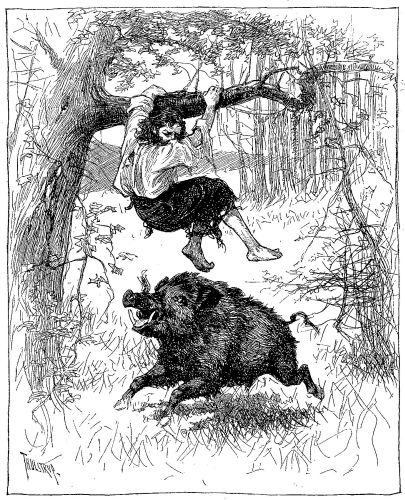
Once, when faint from such injuries, a wild-boar ran at him. He could not stand, but caught at the bough of the tree above him, and hung suspended while the beast made his charge. "He tore away a portion of my ragged trousers, and then went on his way, which I considered to have been a very great deliverance."
These hardships, and the living almost entirely on fruit, brought him to great extremities. He "often fell to the ground insensible," and thought every night would be his last. He lost count of the days of the week, and then of the month. The rainy season came on, and he grew worse.
At one time—as he judged in November—he saw a sight which, had he been himself, would have filled him with joy. He beheld a small canoe approaching the shore, with a single man in it. The spectacle excited little emotion. "I kept my seat on the beach, thinking that I could not expect a friend, and being in no condition to resist an enemy."
The stranger called out to him in English, and Ashton replied that he might safely land, for that he was the only inhabitant of the island, and as good as dead.
The whole incident is most curious, but the strangest fact of all is the unenthusiastic terms in which our hero describes the matter. It is clear he must have been almost at death's door. This stranger proved to be a native of North Britain; Scotchmen were then so called. "He was well advanced in years, and of a spare and venerable aspect, and of a reserved temper.... He informed me he had lived two-and-twenty years with the Spaniards, who now threatened to burn him, for what crime I did not know. He had fled to the 'key' as an asylum, bringing with him his dog, gun, ammunition, and also a small quantity of pork." Ashton goes on to say that the stranger showed him much kindness, and gave him "some of his pork."
On the third day after his arrival, the new-comer prepared to make an excursion in his canoe to some of the neighboring islands for the purpose of killing deer. Our hero, though much cheered by his society, and especially by the fire, the means of kindling which the other had brought with him, and by eating cooked food, was too weak and sore-footed to accompany him. The sky was cloudless, and the man had already come six-and-thirty miles in safety, so that their parting seemed only a "good-day."
But it was final. A storm arose within the hour, in which his visitor doubtless perished.
What is very singular, Ashton never had the curiosity to ask him his name; and though our hero found himself so suddenly deprived of his companion, and reduced to his former lonely state, he consoled himself with the reflection that he was in far better circumstances than before. He had "pork, a knife, a bottle of gunpowder, tobacco, tongs, and a flint." He could now cut up a turtle and boil it.
Three months afterward another canoe came on shore, but without a tenant. The possession of this vessel was a somewhat doubtful boon to him. He rowed in it to another "key" miles away, where, having landed, he lay down to sleep, with his face to the sea, as usual, and his back to a tree.
"I was awakened by a noise of firing, and starting up beheld nine piraguas [large canoes] full of men, all firing at me. I ran among the bushes as fast as my sore feet would allow, while they called after me, 'Surrender yourself, O Englishman, and we will give you good quarter.'" By their firing at an inoffensive man Ashton knew that they were Spaniards, and guessed what was their idea of "good quarter." After hiding in the woods for that night he returned to his little island the next day, and to the hut of boughs, "which now seemed a royal palace to me."
After nineteen months' residence alone on this spot, save for that three days' visit from the stranger, Ashton was joined by seventeen Englishmen, fugitives from Spanish cruelty. They were accustomed to hardships and miseries, but "they started back in horror at the sight of so wild, ragged, and wretched an object."
A spoonful of rum which they administered to him almost took away his life, owing to his long disuse of strong liquors. They clothed and fed him, and were very good to him, though "in their common conversation," as he naïvely remarks, "there was very little difference between them and pirates."
Considering what he had gone through, one is inclined to wonder how Mr. Philip Ashton could have been so very particular. He seems to have been an honest, good man, and did not forget to express his earnest gratitude to Providence when rescued at last by a British sloop driven near his "key" by stress of weather. He arrived home at Salem in March, 1725, having spent eight months on board a pirate ship, and nineteen on the "key." "That same evening," he says, "I went to my father's house, where I was received as one risen from the dead."
IN GRANDMAMMA'S CHAIR.
"DIT UP, G'AN'PA!"