Chapter IV
Reading edition
A DARING FEAT.
Luckily for our hero, Mr. Hawkins, the first officer, was a shrewd, clear-headed man, and had his own opinion of Master Monkey. The latter told his tale confidently enough, but a few pointed questions confused him at once: he stammered, contradicted himself, and was finally turned out in disgrace. Austin then gave his version, and the officer, after questioning him closely, appeared satisfied.
"Here, my lad," said he, writing a few lines on a slip of paper, "take that to the chief engineer—you'll find him in his bunk, I reckon."
In his bunk, sure enough, lay the "chief," groaning dismally. He was a tall, fine-looking fellow, with bright blue eyes, and an arm like a blacksmith's; but when a man is on his back from seasickness, how can he look heroic?
"So, my boy, you've run away to sea, eh? Humph! that's just what I did when I was your age—and much good I've got by it! It was all through reading those precious sea-stories, which made me think I'd only to start to be made a captain at once. Wish I'd never learned to read—ugh!"
Here came a terrible spasm of sickness, to the great amazement of Frank, who had never dreamed of such a thing as a seasick sailor. Such cases, however, are not uncommon; and Nelson himself, one of the greatest sailors on record, never got over this weakness at all.
"This is how I am for the first week of every voyage," resumed the engineer; "and I always vow that every cruise shall be my last; but when I get ashore, I can't be happy till I'm afloat again—ugh! oh!"
And another spasm followed, worse than the first.
Frank said nothing, but his pitying face spoke for him; and the sick man, evidently touched by it, went on in a cheerer tone:
"Well, youngster, you're lucky not to be sick like me. Your name's Frank Austin, eh? Well, go and tell Mr. Harris to give you some work in the engine-room."
This promotion was the beginning of a new life for our hero. Now, at last, there was a chance of learning something; and the men, in whose estimation he had risen greatly since his defeat of Monkey, were always ready to answer his eager questions. He was never weary of admiring the huge machine which did with one smooth and regular movement the work of hundreds of strong men, obeying the slightest turn of a tiny wheel, yet capable of tearing the whole ship to pieces should its irresistible strength ever break loose.
And now, as they began to enter the tropics, everything grew warm and bright. Flannels were doffed, and an awning spread over the after-deck. The wind, though it still blew strongly, was now in their favor; and foretopsail and mainsail, jib and spanker, were set to catch it, till the ship staggered under her press of canvas, and careened as if about to dip her very yards.
So passed several days, during which nothing special occurred; for by this time everything had got "shaken into its place," and the routine of the ship's duties proceeded as regularly as clock-work. Frank, now restored to his place at the mess table, and high in favor with the crew (who henceforth reserved for Monkey the cuffs and jeers formerly bestowed upon our hero), was beginning to feel quite at home in his new life, when it was suddenly broken by a very startling adventure.
One evening about dusk the machinery slackened suddenly, and an unusual bustle was heard on deck. A man running past thrust an oil-can into Frank's hand, and bade him carry it to one of the engineers upon the starboard (right-hand) paddle-box. On deck all was confusion. Men were rushing hurriedly to and fro, while the paddle-box itself was occupied by an excited group of officers and engineers; and it was some time before Frank could make out what was the matter.
An obstruction of some kind had impeded the turning of the shaft in the "outboard bearing," which had grown dangerously hot. It was this that had caused the "slowing down" of the engine, which could not be set working again till the impediment was removed, and the "bearing" oiled.
Looking over the side, Austin saw a man hanging by a rope on the outer face of the paddle-box, like a spider on its thread, and laboring stoutly, with hammer and oil-can, to set matters to rights. Suddenly the ship plunged, and the man disappeared into a surging wave. He rose again, vanished a second time, reappeared once more, and again the blows of his hammer were heard, and again the boiling whirl of foam swallowed him up. At every plunge Death seemed to gape for him; but drenched, gasping, and half stifled as he was, he still worked bravely on.
On the deck all was now deadly still; and in that grim silence the hard breathing of the excited crew could be heard as they watched the solitary man at his fearful task. Would it never be over? Crash after crash the cruel waves came bursting upon him, and all could see that his strength was beginning to fail.
But the work is nearly done! A few more hammer strokes and he is safe. Already the anxious crew are beginning to breathe more freely, and even to greet their hero with encouraging shouts, when suddenly a mountain wave is seen coming right down upon him.
"Look out, Allen!" roar the sailors, with one voice.
MAN OVERBOARD!
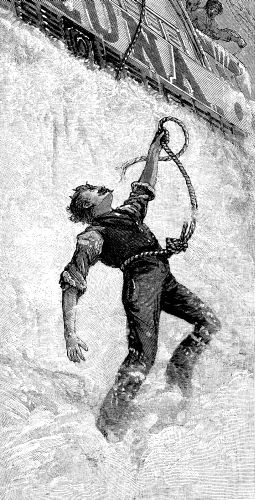
Allen casts one glance up at the overhanging mass, and then twines his arms and limbs around the "open-work" of the paddle-box with the strength of desperation. The next moment there comes a stunning shock and a deafening crash, and all is one whirl of blinding spray and seething foam, amid which nothing can be heard and nothing seen. But when the rush passes, the brave man is still there.
A shout of joy arises, but is instantly followed by a terrible cry. The safety-line around Allen's body has parted!
"Grapple him with boat-hooks, some o' ye!" roars the boatswain. "Fling him a rope!—quick! or he's lost."
But before any of the hands stretched toward the doomed man could reach him, his stiffened fingers lost their hold. For one moment he was seen balanced in mid-air, with his imploring glance cast upward at the stanch comrades who were powerless to save him, and then down he went into the roaring sea.
There was an instant rush to the life-boat; but it was barely half way to the water when a huge sea dashed it against the ship's side, crushing it like an egg-shell. This was the last chance. An arm tossing wildly through the foam of a distant wave, a faint cry borne past on the wind, and poor Allen was gone forever.
Then, amid the dismal silence, was heard, clear and strong, the firm voice of the captain:
OILING THE OUTBOARD BEARINGS.
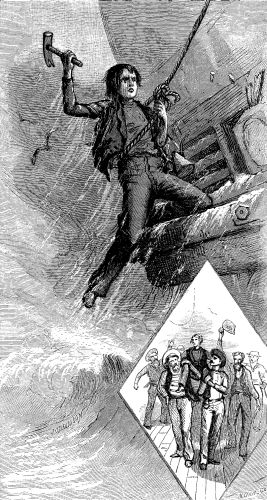
"Lads, I won't order any of you to run such a risk; but this job must be done somehow, or we shall all go to the bottom together. Fifty dollars to any man who'll volunteer!"
A dozen men sprang forward at once; but quick as they were, there was one before them—and that one was Frank Austin. Unnoticed by all, he had knotted a rope around his waist, fastened the other end to an iron stanchion, and before any one could stop him, down he slid to the perilous spot, escaping, as if by miracle, several heavy seas which came rolling in, one upon another.
For a moment the whole ship's company stood as if thunder-struck; and then one of the sailors, muttering, "Guess he'll want them, anyhow," lowered a hammer and oil-can, which Frank dexterously caught. The work was so nearly done that a few blows of the hammer sufficed to complete it; and a deafening cheer greeted the young hero as he prepared to climb up again.
"Smart, now, lad!" shouted half a dozen voices; "here's another sea comin'."
But Frank saw at once that the wave would be upon him before he could reach the deck, and that there was only one way of escape. Thrusting his slim figure between the beams of the open-work, where no full-grown man could have passed, he held on with all his strength. Crash came the great billow against the side, making the whole ship quiver from stem to stern; but Austin remained unhurt. The next moment he was safe on deck.
And now came a scene that might have served any painter for a study of Horatius among the Romans after his defense of the bridge. Frank was snatched up and carried shoulder-high to the forecastle by the cheering crew, who kept shouting the news of his exploit to all that had not seen it. His hands were shaken till they tingled, and his shoulder-blades ached with friendly slaps on the back from the sledge-hammer fists of his admirers. Every one was eager to give something to the hero of the hour. Offers of pipes, clasp-knives, tobacco, etc., rained upon him from the very men who had cuffed and kicked him like a dog but a few days before; and even his refusal of these gifts, which would formerly have been set down to conceit and "uppishness," was now taken in perfectly good part. In fact, that one deed of promptitude and courage had raised him from the last to one of the first among the whole crew. So true is it that they who succeed best are not always the bravest, or the wisest, or the strongest, but simply those who keep their wits about them, and never miss a chance of doing something.