PENCIL DRAWING, No. 2.
Reading edition
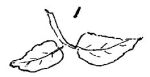
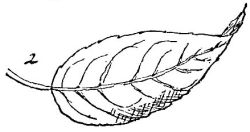
Simple as it may seem to draw leaves, there must be care, and patience, and faithful effort. After a while, the young student who succeeds will go on to flower drawing, which is more difficult, but very delightful, and will be illustrated by-and-by.
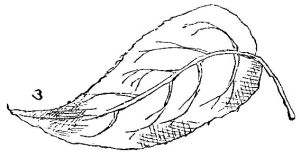
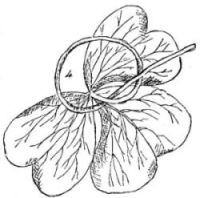
At present we must try easy leaves. I make a few illustrations, enough to begin with. Nos. 1, 2, and 3 are fuchsia leaves; No. 4, oxalis. These may be drawn again and again. A whole page of fuchsia leaves of different sizes is very pretty, and so of any leaf. By a skillful hand they may be arranged with artistic grace.
Attention to a few points will give a precision and interest to the drawing. Let the drawing be lightly rather than heavily done. Learn to draw the double lines of stems and veins with great correctness. Make a darker line on the under edge of leaves, and on one side of the stems. By turning the leaf on the wrong side the veins can be distinctly seen, and easily drawn. Do not be discouraged, but persevere. Begin to-morrow, or to-day: these beginnings may help you to become a skillful sketcher, and will give to you a delightful occupation that will grow dearer to your heart every day of your life.

This number of Harper's Young People completes the thirteen issues promised to subscribers to Harper's Weekly for 1880, and is therefore the last number to be sent out with that paper. Any one of our little friends who may thus be deprived of a weekly visit from Harper's Young People, and who wishes to continue acquaintance with us, may receive the remaining thirty-two numbers of our first volume, which will conclude with the number dated October 26, 1880, by sending One Dollar to the publishers, who will, on receipt of that amount, forward these numbers weekly, postage free, to any address in the United States or Canada. Those who wish the back numbers, as well as the remainder of the volume, should send One Dollar and Fifty Cents, the price of a year's subscription. The publishers renew their assurance that they will make every effort to please their young patrons by providing weekly an attractive and instructive variety of illustrated reading.
Lockport, Illinois.
I saw in Young People a letter from Edwin A. H., telling about his cabinet. Although I have been collecting only three years I have quite a cabinet. It contains a sea-cow, which measures fourteen inches from the tip of its tail to the nose. It is larger than any I have ever seen either in Chicago, New York, or Canada. That and a sea-horse came from Cuba. I have also some fine specimens of different corals and sponges; a box of agates and other stones from Africa; some beautiful specimens of quartz from the Rocky Mountains; a specimen from the Matanzas Cave in Cuba; a collection of Indian arrow-heads; a variety of petrifactions, among them a very large, perfect trilobite; a few very old coins, four of which, I think, are from Pompeii; a collection of foreign stamps; shells from California, Cuba, and other places; and other things I have no room to mention. Can any one tell me how I can obtain some really good specimens of minerals? And is the whale that arrived at the New York Aquarium last summer alive yet?
L. H. N.
Are any correspondents informed about the health and present condition of the whale?
Tallahassee, Florida.
I write to tell you about my collection of minerals. I am now ten years old. I commenced to collect when I was nine. My minerals are very fine, and I took the three-dollar premium for them at the fair.
William L. Betton.
Cincinnati, Ohio.
I am a little girl thirteen years old. I live in Ann Arbor, Michigan, but I am spending the winter in Cincinnati. I take Young People, and like it very much. I am collecting curiosities, but I have no Proteus.
Grace D. Hall.
Macon, Georgia.
I will write and tell you what a warm winter we have had. There were strawberries and peach blossoms in January, and now we have many kinds of flowers blooming in the gardens. I am writing St. Valentine's Day, and I and my two sisters, Bessie and Kate, have had several pretty valentines.
Laura C. Parmelee (9 years).
"Bay Cliff," Long Island.
I am a little boy ten years old, and live by the water. I have a nice little row-boat named Broadbill, with patent oars. I have a Shetland pony named Fanny. She is about three feet high, and is very kind and gentle, and I can ride or drive her. My guinea-pig is also a pet. I feed it cabbage leaves, carrots, boiled potatoes, and lettuce.
E. T. I.
Brooklyn, New York.
My most cunning pet is a guinea-pig named Tip, who creeps under my arm and goes to sleep. I put cabbage and celery in a train of cars and run across the floor; Tip gallops after and steals the leaves, stops to munch them, and then races for more.
Arthur A. Crandell.
Milwaukee, Wisconsin.
I have had experience with guinea-pigs, and I thought I would tell Mark Francis what mine eat. They like all kinds of green vegetables, such as lettuce and cabbage, but they like grass better than anything else; I can not give them enough. The only cooked food they like is Graham bread and oatmeal mush. Sometimes they eat oats and apples. My auntie has kept them for fifteen years, and she never gave them any water. She says if they want water, they are sick. They are always very sensitive to the cold.
Grace B. Peterson.
New York City.
I have been reading all the letters from little girls and boys about their pets, and I must tell them about mine. I have a little kitten named "Buttercup," and she is just as sweet and pretty as any buttercup that ever grew, and so good and so cunning. She will jump upon the bureau and watch the canary, and he will peck at her with his little bill, and she does not even look cross at him, and we know she would not ruffle a feather for all the world. I wonder if any other little girl can leave her kitten with her birds, and know she will not hurt them? And you should see her go to the mirror and look at herself—just like any lady—and she seems to think herself so pretty, I am really afraid she is vain. There are so many other things I could tell about her, but mamma says you will not print my letter if I write any more.
Ella Selwyn.
Bradley, Michigan, February 18.
I found a willow bush covered with "pussies" yesterday. The rabbits never run up to me when I whistle, like the one Laura B. wrote about. They stop and turn around and look at me, and then they just snap their eyes and scoot.
Frank C. Nourse.
I am only seven years old, and I live way out in Fort Klamath, Oregon, and I can't write a very good letter, but I like the stories in Young People, and the letters in the Post-office from little children so much. It is nice to be out here where there is so much snow to have fun with. I have a pair of snow-shoes, a little brother, and a pet dog to play with, besides lots of other things. I don't go to school, because there is no school here, but I say my lessons to mamma every day.
Sophie L. W.
Davenport, Iowa.
I am going to write this all myself. I have a pony. His name is Dick. We all love him dearly. He shakes hands. We say, "Shake hands, Dick," and he puts up his right foot. He is just as sweet as honey. He is white. We used to live on a farm, and my sister and I used to go after the cows on Dick. We carried a long whip. Some cows would lag behind, and we would say, "Bite the cow, Dick," and the dear little fellow would lay back his white ears and just bite her awful hard. We are going to have a cabinet picture taken of him.
Grace H. (9 years).
Schenectady, New York.
I am five years old. I have a blue terrier—Wax. He plays hide-and-seek. Mamma covers his eyes with her hand, and I hide. When I say, "Coop," mamma lets him go. Then he rushes all round, standing on his hind-legs to look on tables, and peeping under the couch, and looking upon chairs. When he finds me, he begins to bark loud, and tries to bite my toes, but he has very few teeth. He is old.
Roger Griswold Perkins.
Albany, New York.
I am a boy who have recently come to the city from the country. I have a young Skye-terrier, and he gives me much trouble by running away every time the hall door is opened. Then I have to run after him. As he can run the fastest, it is hard work for me, but fun for him. People must think I have two dogs, for when he goes out he is a blue dog, and when he comes back he is mud-color. When we give him a good washing, he is blue again. He likes to play, and I would be lonesome without him.
Dwight Ruggles.
Philadelphia, Pennsylvania.
I saw in the Post-office letters one from a little boy who had two Maltese cats, and one of them was very fond of pea-nuts. I had a beautiful black and white kitty, in Centennial year, that would follow me round whenever I came from the Exhibition, begging for the sugared balls of pop-corn I always brought home with me. I had another kitty afterward that was just as fond of candy. They are both dead now, and I have no pets. I am nine years old.
Florence Ozias.
C. H. Williamson.—All of Jacob Abbott's books for the young are in print. Valuable works on Long Island history have been published by the Long Island Historical Society of Brooklyn. Hitchcock's Geology and Gray's Lessons in Botany will be of service to you.
C. F. Allen.—Danger Island is in the Chagos Archipelago, on the west end of the great Chagos Bank, Indian Ocean.
Here is a very pretty experiment, sent by F. V. G., Madison, Wisconsin: "Take an ordinary water-pail. Lay across the top two pieces of stout wire, about two inches apart. Then lay a lump of ice on the wires. In about half an hour go and look at it, and you will find that the wires pass through the middle of the lump of ice, but you can not see how they came there."
The following tribute to the egg tombola is from Ella W.:
From an egg, shot, and tallow, with care, A merry tombola I soon did prepare; I brushed up his locks in a very fine way, And dressed him in garments of nice sober gray; And when he was ready all came to admire, So portly was he that I called him the Squire. I then laid him down to measure, and see Whether standing or lying the tallest he'd be; When he lifted himself with a nod and a bound, Rocked backward and forward and balanced around. The giddy tombola! he will not lie down; It's useless to urge such a funny old clown.
Madison Cooper.—The direction given to Charley D. M., in Young People No. 18, will probably apply to your fish.
Ella Fuller and Helen Thompson.—We fear there is no remedy for your unfortunate animals.
Henry B. H.—Excellent directions for the construction of a cheap telescope are given in Young People No. 1.
Charles Conner.—We can not undertake any such commissions.
J. R. Foster.—Pages of advertisements are almost always given in weekly papers. You will find them in every bound volume of Harper's Weekly, and similar publications.
"North Star."—You understand the art of making puzzles, but you must be more careful with your spelling. There is only one "e" in cathedral.
Albert Mullen.—Box-wood only is used by engravers on wood, as it has a fine grain and the requisite hardness. It can be got out in small pieces only, and these are either glued or screwed together to form large blocks. When a picture is to be engraved in haste, the block is taken apart and the pieces are given to several engravers, in order to save time. Sometimes thirty or more engravers are employed at once on a single block.
Leonard S. E.—If you send four cents in postage stamps to the publishers the number you require will be forwarded to you.
A. H. Ellard.—Your handwriting is very neat and distinct for a boy of your age. In a Numerical Charade each figure represents a letter of the solution. Supposing the answer to be "America," you could make "car" from the sixth, seventh, and fourth letters, and proceed in this way until you had used every letter of the solution.
James W. C., H. W. G., and Others.—Thanks for your kind letters, but we have decided to use no more puzzles referring in any way to ourselves. We also wish to remind some of you that enigmas must be in rhyme, otherwise they can not be printed. Do not take your own name nor the names of any of your friends to form a puzzle, because children to whom you are entire strangers could never guess it. Be careful to use new solutions in making puzzles; and when you see that we have already published one on Washington, Bonaparte, or the name of any other celebrated man, do not send us a repetition. We pay no attention to puzzles not accompanied by full answers.
Willow "pussies" are to be found now in almost all localities, judging from the many reports sent us by our youthful correspondents. Crocuses have pushed upward to the spring sunshine, and rose bushes are beginning to send out tender green shoots. "Pussies" have been reported by C. H. W., Mary M. R., Joe Ward, and many others; and Louis C. Vogt sends a twig of these pretty downy tokens of spring, which he accompanies with a very neatly printed letter. It is now time to begin to watch for violets and anemones, and other early flowers.
Answers to question by S. R. W. in Post-office Box, No. 17, are received from "North Star," W. F. Bruns, Harry V. G., Florence B., E. L. M., Freddie H., Kittie A. R., "Mystic," and others. Eight words have been sent. They are Scion, Suspicion, Coercion, Pernicion, Epinicion, Internecion, Ostracion, Cestracion; these are all to be found in Worcester's Dictionary. There is also Cion, which is synonymous with Scion. There are, besides, several obsolete words with the same ending not to be found in modern English dictionaries.
Favors are acknowledged from Charlie Markward, Willie H. McVean, Amy L. Orr, Harry C. Peck, Edward L. Haines, Percy and George, Alma Hoffmann, Rebecca Hedges, Willie C. S., Alice E. Stephenson, Lottie C. Underhill, Bessie L. Stewart, Jennie Clark, Charlie A. Mather, H. H. Pitcairn, Nellie G. Vaughn, J. D., Willie R. H., Frank Coniston, Mina L. C., Lyman C., Willie B. A., Leonie Young, Mamie Brooke, James Walker, Katie Black, Henry Koehler, G. Walter Burnham, Effie E. P., Geraldine Watson, Ray Bennett, Anabel Turner, Freddie C., Arthur B., R. L. R.
Numerous correspondents have sent new answers to our Puzzle Picture in No. 14; and although many have given nine names, but two, Florence Ozias and Mark Robbins, have found D-rill, the mischievous monkey concealed by our artist.
Correct answers to puzzles received from E. T. Smith, George H. Churchill, Mamie E. F., Herbert N. Twing, Fannie T., and Belle M., Leonard S. E., Effie K. Talboys, E. P. Walker, J. F. Sullivan, H. S. T., Gracie Flint, W. Robertson, Katie Wentz, Millie Benson, Ella W., Nellie Bartlett, Goldie Williams, W. H. Kurtz, Henry Cullyford, J. H. Crosman, Jun., Stella, Jay H. M., L. L. Lee, Marie Doyle, Gracie K. Richards.
Answer to Charade in No. 17, on page 216—Fishball.
PUZZLES FROM YOUNG CONTRIBUTORS.
No. 1.
NUMERICAL CHARADE.
I am composed of 12 letters. My 1, 3, 4 is a measure. My 6, 2, 9, 12 is a girl's name. My 11, 10, 4, 8, 3, 6, 5 is a young reptile. My 1, 7, 11 is a small animal. My whole is a South American river. Chesly B. H.
No. 2.
DOUBLE ACROSTIC.
A small rope. A scent. A question often asked. Variegated. To clasp. Water. Answer—two English poets.
M. L.
No. 3.
ENIGMA.
My first is in loss, but not in gain. My second is in France, but not in Spain. My third is in sling, but not in stung. My fourth is in old, and also in young. My fifth is in Venus, but not in Mars. My whole is composed of beautiful stars. Alfred W. S.
No. 4.
RHOMBOID.
Across—A descent; a bench; to clip; to hold. Down—In flap; a preposition; to allow; a bird; a knot; a pronoun; in flap.
N. L. Collamer.
No. 5.
WORD SQUARE.
First, manner of walking. Second, a movement of the ocean. Third, to manage a publication. Fourth, tame animals.
Nellie B.
No. 6.
DIAMOND PUZZLE.
A vowel. An animal. A well-known fruit. A man's name. A vowel.
H. N. T.