SOME ODD RELATIONS OF THE JELLY-FISH.
Reading edition
BY SARAH COOPER.
Let us now examine some odd-looking animals called hydroids, or sea-firs, which grow in the ocean, firmly rooted upon the bottom, or attached to shells and stones.
Fig. 1.—Hydroids growing on a Shell.
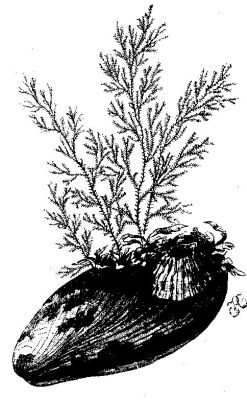
The tall branches in Fig. 1 are hydroids growing upon the shell of a dead mussel. A barnacle, too, has lived and died on this pretty shell, and little sea-weeds cluster around its remains.
We can scarcely imagine animals that are more unlike jelly-fish than these slender branches are; and yet the wonderful story I have to tell you will show them to be so closely related that we could not study the life of one without the other.
Long graceful sprays of hydroids are often thrown on shore by the tide, and as they resemble plants much more than animals, they are generally mistaken for sea-weeds. Many persons gather them for decorating brackets and hanging baskets. We frequently see bunches of them arranged in sea-shells, and offered for sale in our shops. The shop-keeper would probably not know them by any other name than sea-weed. Still, they are animals, and we can mostly recognize them by their yellow, horny appearance, and by the numerous joints on their stems.
In looking at one of these sprays with a microscope you will find each little point on the stem to be in reality a dainty cup, which when alive contained a hungry animal. Should you find a piece freshly washed up from the ocean, it would be well to place it in a glass jar filled with sea-water, and after allowing it to remain perfectly still for a while, it may perhaps show you, if it is yet alive, how it has been accustomed to pass the quiet hours in its native home.
You will find each cup occupied by a soft animal, with a mouth in the centre opening directly into the stomach. Hydroids, you see, are higher in the scale of life than sponges, for they possess mouths and stomachs. As we watch, the body of the animal will rise up in the cup, and from around the mouth will gradually creep out slender thread-like feelers, which may be extended quite a distance, or drawn up at will entirely within the body of the animal. You will, of course, wish to use the proper name for these feelers. They are called tentacles, and they evidently serve to produce currents of water toward the mouth, and to bring the required food. In this way the little animals live, day after day and year after year, patiently waving their tentacles, and waiting for the food that is sure to come.
Do you still ask what connection there is between these demure little animals and the jolly jelly-fish? We shall soon see.
The hydroids have grown by budding and branching somewhat as plants do. Occasionally pear-shaped cups much larger than those we have looked at are formed on the stem. These large cups are called spore-sacs. They contain the substances which, later, will grow into eggs; and at the proper time they fall off. After resting awhile, and throwing out cilia and tentacles, these spore-sacs swim gayly away, and, strange to relate, they are hence-forth known by the name of jelly-fish!
Fig. 2.—Hydroid magnified, showing Spore-Sacs.
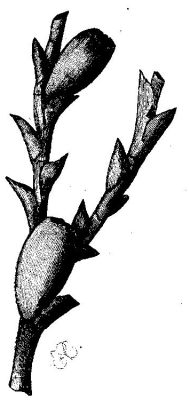
In Fig. 2 you will see a spray of hydroid magnified which shows two spore-sacs. In the species which is represented here (the Sertularia) the spore-sacs do not fall off, but they burst and discharge the eggs which they contain.
These jelly-fish now lead active lives, and as they dart and swim about in the water no one would suspect that they had any relation to the plant-like animals with which we started, yet it is supposed that most hydroids have this wonderful history.
Forgive us, jelly-fish, forgive us, hydroids, if in our ignorance we have ever cast an indifferent glance upon you. We did not know your charming secret, and we should never have guessed it, for the lives we lead are so different from yours. Now that we have learned your secret, we shall certainly tell it to the boys and girls, that they may help us enjoy it.
Jelly-fish produce eggs, from which are born little floating bodies. These after a time fasten themselves to some stick or stone, and grow by budding until they become the elegant feathery branches which we must now call hydroids. The young of nearly all animals resemble their parents, but the children of jelly-fish, you see, are very different from the jelly-fish itself. In the next generation, however, we shall find jelly-fish again.
Most of the plant-like objects which we are accustomed to see growing near the shore are in reality hydroids. Has it ever puzzled you to know the difference between plants and these low forms of animal life? One very important difference is that most plants can procure their food directly from the soil, whereas animals are obliged to feed upon living substances, or those which have at some time been alive, as vegetables and animals.
Hydroids grow in all parts of the ocean, in deep water as well as near the coast. Some of them are three feet high. One branch may contain a hundred thousand distinct animals, the only communication between them being a circulation of fluid through the hollow stems. In this way each branch constitutes a family which has sprung originally from the same little egg. Some varieties never grow tall, and as they occur in patches over rocks and shells, they resemble thick beds of moss.
Fig. 3.—Jelly-Fish (Aurelia Aurita), with Young in various Stages.
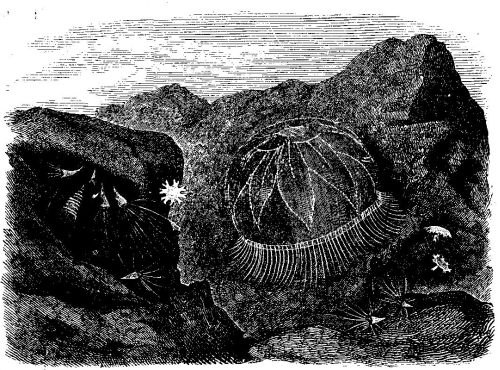
The little hydroids which we see hanging from the under side of a rock in Fig. 3 produce jelly-fish in a different manner from the one I have described, although it is equally remarkable. This hydroid has no buds or branches, but the main tube of the body divides itself into a number of rings or plates, until the whole animal looks somewhat like a pile of tiny saucers with scalloped edges. Finally the upper plate begins to twist and squirm until it loosens itself from the pile, and floats off to lead the gay and independent life of a jelly-fish. It is followed by the other plates in their turn, each making a separate animal. These new jelly-fish eat greedily and grow fast, forming some of our largest varieties.
We can form but little idea of the immense numbers of animals thus leading quiet contented lives, and drawing from the surrounding water all that is needed for their support. They can not go in search of food, and they take only such as floats toward them. Still, they seem to have some choice in the matter, as they reject from their mouths any food they are not suited with. Many of these curious animals are glowing with bright colors, and surrounded as they are with a great variety of plants, they give to the bottom of the ocean a marvellous beauty.
Does it not seem strange that the slender, delicate sprays of which we have been speaking are really animals; and more than that, the children of jelly-fish? A little girl once exclaimed, on hearing of these wonderful changes that happen in the life of hydroids, "Why, it seems almost like a fairy tale!"