EASY BOTANY.
Reading edition
JUNE.
June has many beautiful flowering trees, and many rare and remarkable plants. Some of the anemones bloom in April and May, but several wait for June. Among these the rare red anemone is found on rocky banks in Western Vermont, in Northern New York, and Pennsylvania.
Among the pines and maples of Cape Ann, at Manchester, Massachusetts, we find the laurel-magnolia, or sweet-bay, with silky leaves and buds, and deliciously fragrant cream-white flowers. This charming shrub seems to belong to the South, but has strangely strayed away, and made for itself a cozy home on the "stern and rock-bound coast" of New England. This magnolia also grows in Pennsylvania and Southern New York.
Belonging to the same fair family is the tulip-tree, with large tulip-shaped flowers tinged with yellow, orange, and green. These trees are found in rich soil in the Middle, Southern, and Western States.
Another wonderful plant of June is the large water-lily the Nelumbo luteum, or water-chinquepin. This plant apparently belongs to the East Indies, and seems to be nearly related to the pink lotus, or sacred bean of India. The American species is rare, being found at but few places; but Connecticut professes to possess it in the Connecticut River, near Lyme; and it is found in the Delaware River, near Philadelphia, at Woodstown and Swedesborough, New Jersey, and in several Western lakes. The leaves are circular, from one to two feet in diameter, and raised high above the water; the fragrant flowers are pale yellow; the seeds, sunk deeply in a receptacle, are as large as acorns.
Our own beautiful white pond-lily is well known and well beloved; and few New-Englanders are unfamiliar with the serene ponds and still waters where the lily pods make a carpet on which rest the lovely heads of these delicious favorites.
At Sandwich and Barnstable, Massachusetts, and Kennebunk, Maine, are found lilies of a fine rose-color. The common cow-lily, as it is called, though not a beauty like its relatives, is a pleasing variety, being of a rich yellow color.
Next we come to the wonderful pitcher-plants, whose chosen homes are in the black mud of peat-bogs and swamps.
The one with which we are most familiar is favored not only with a botanical name of seven syllables, but has the common names of side-saddle-flower, pitcher-plant, and hunter's-cup—all referring more or less to the curious leaves, which are hollow, and shaped like little pitchers, and are always found partly filled with water. The flower, nodding on a tall stalk, is as singular as the leaves; it is of a deep reddish-purple color, the petals arching over a little green umbrella in the centre, which covers the stamens. This striking and interesting plant may be easily found by any enterprising young botanist who is not afraid of mud and water, as it grows from Maine to Illinois and southward.
Another queer little dweller in bogs and swamps and wet meadows is the sundew, one species of which may be found in June, and others later. The leaves of this peculiar plant are covered with fine reddish-brown hairs, or glands, which furnish small drops of fluid, glittering like dew-drops.
Three species of wild oxalis, or wood-sorrel, should not be overlooked. The yellow, which is found everywhere, is so common as to be unappreciated; but the white, with petals streaked with red lines, is very pretty: it is found in deep, cold woods in Massachusetts and the Middle States. The violet wood-sorrel is, however, the beauty of the family, and rare enough to require being searched for. It springs from a bulb in shady, rocky woods in New Jersey, Pennsylvania, and New York; three or four soft purple blossoms nod on a slender stalk, and it is a lovely little plant. All the wood-sorrels are attractive and interesting from the graceful and pathetic habit which they have of folding up and drooping their delicate leaves at night-fall, opening them at the early light of morning.
The showy wild lupine comes out with long racemes of purple, pink, blue, and white blossoms, covering sandy fields with a flush of color.
The dear wild roses make the wood paths beautiful, and the indescribably delicious fragrance of the sweet-brier betrays its location on the dry banks and rocky road-sides.
The flowering raspberry, found in moist woods and shady dells, is as beautiful as the rose, and the buds, if possible, more beautiful than rose-buds. The flowers are large, of a vivid deep rose-red, and the leaves maple-shaped, and very graceful.
In June, also, come six or eight species of Cornus, or dogwood, each beautiful in its way. These shrubs, which are generally found in rich soil in rocky, open woods, are rare in New England, but abundant in the Middle States. The brilliant little bunchberry, however, which belongs to the Cornus family, delights in the deep cold woods of Maine, where it grows luxuriantly, its rich red berries charming the eye in the depths of the forest.
In the gloom of shady woods, at the roots of pine and oak trees, the young botanist may perhaps be startled to see an array of little ghosts, as it were, springing from dead leaves, and without one touch of the green of summer, but waxen-white in every part, leaves, stems, and all, sometimes having a faint shade of pink or tawny yellow. This is the Indian-pipe, with none of the healthful honesty of other plants, but stealing its existence from surrounding neighbors; and with this ghostly parasite we will close the list for June, not that it is exhausted, for hundreds stand waiting, but it would take a book to tell of them all.
FLOWERS OF JUNE.
COMMON NAME.COLOR.LOCALITY, ETC.
Alpine azaleaWh., rose-colorWhite Mts., rocky hills; N. E.
Alum-rootGreenish-purpleRocky woodlands; Conn. to Wis.
Alum-root, downyPurplish-whiteRich woods; Lancaster, Pa.
American ipecacRose-colorDeep woods; N. Y., Pa., and West.
Arrow-woodWhite, light blue berriesWet places. Common North.
Bell-shaped sullivantiaWhiteLimestone cliffs; Ohio, Wis.
Bird's-eye primrosePale lilacShores of Western lakes; Mt. Kineo, Me.
Black snakerootGreenish-yellowCopses, open glades. Common.
Black huckleberryReddish, berries blackWoodlands. Common.
Blue-tangleWhite, berries dark blueLow copses; New England.
BunchberryWhite flowers, red berriesDamp, cold, deep woods; Me.
Burning-bushDark purpleShaded woods; N. Y., Pa., South.
Bush honeysuckleHoney yellowRocks and thickets; Northward.
ButtercupsYellowBanks and fields. Common.
CassiopeWh., rose-colorWhite Mts., Adirondacks, Me. Rare.
ChervilWhiteFields and copses; Lancaster, Pa., N. J.
Chinquepin, American lotusPale yellowConn., N. J., West. lakes. Rare.
Clustered bell-flowerDeeper blueRoad-sides; Danvers, Mass.
Coffee-treeWhite racemesRiver-banks, rich soil; N. Y., Pa., West.
CollinsiaBlue and whiteMoist soil; N. Y., Pa., West.
Common elderFlowers white, berries blackBanks, rich soil. Common.
Cornel, panicledFlowers and berries whiteThickets and river-banks.
Cornel, red osierWhitish, berries whiteDamp New England pastures.
Cornel, silkyWhite, berries pale blueWet places. Common.
Cow-lilyBright yellowStill waters. Very common.
Cranberry-treeWh., red berriesLow, damp grounds; N. J.
CrowberryWhiteMountains; New England.
Cuckoo-flowerRose-color, wh.Bogs, swamps; Vt., N. J.
Dahoon hollyYellow-whiteSwamps of Virginia.
Dwarf raspberryWhiteHill-sides; N. E. to Pa. Common.
Dwarf wild roseDeep pinkDry rocky banks and fields; N. E.
Evening primrosePale yellowSandy fields; N. J. and South.
False indigoVioletRiver-banks; Pa., South, West.
FeverwortB'wnish-purpleRich woodlands. Common.
Flowering dogwoodPurplish-white, red berriesRocky woods; Conn., N. J., South.
Flowering raspberryDeep red purpleCopses, wooded banks; New Eng.
Fumitory, climbingPurplish-whiteWet woods; West.
Great-spurred violetPale violetDamp shady woods; Mass. Rare.
Great willow-herbPink-purpleLow grounds, burned pastures, and woods.
Green violetGreenish-whiteOpen woods; N. Y., Pa. Rare.
Green-weedYellowDry hills; Mass., Middle States, W.
HedysarumViolet-purpleMountains; New England, Me.
Herb-robertRed-purpleShady ravines, wet woods; N. E.
High blackberryWhiteWoods, pastures, banks. Common.
Ilex hollyGreenishMoist woodlands; sea-coast, N. J.
Indian-pipeWaxy whiteDark shady woods; New England.
InkberryWhite flowers, berries blackSandy grounds; Cape Ann.
Labrador teaWhiteCold bogs and mountain woods; New England.
Leather-flowerPurpleRich woods; N. J., N. Y., West.
Low blackberryWhiteLow woods, road-sides. Common.
Magnolia, sweet-bayWhiteCape Ann, Gloucester and Manchester woods.
Marsh five-fingerPurpleCool bogs; New England to Pa.
Marsh violetPale lilacWhite Mts., high lands N. Rare.
Meadow-sweetWhiteDamp soil, banks; N. J., West.
Mountain laurelPink and whiteRocky hills, damp soil. Common.
Mountain sandwortWhiteMountains; New England.
Nine-barkWh., rose-colorRocky river-banks; West.
One-flowered pyrolaWhite-pinkDeep cold New England woods.
Pale laurelLight purpleCold peat bogs and mountains.
Partridge-berryPurple and white, red berriesDry woods, creeping. Common.
PersimmonPale yellowWoods and old fields; R. I., N. Y.
PimpernelScarlet, blue, wh.Waste sandy fields; Mass., N. J.
Pitcher-plantDeep purplePeat-bogs and swamps; New Eng.
Poison-ivy, climbingGreenishRocky thickets, low grounds.
Poison sumacDull color, very poisonousSwamps and wet pastures.
Pond-lilyWhite, pinkPonds, pools, and still waters. Common.
Prince's-pinePale pinkDry woods. Common.
PyrolaGreenish-whiteRich woods; Conn., N. J., N. Y.
Queen of the prairiePeach-colorOpen meadows; Pa., prairies W.
Red anemoneRedRocky hills; Vt., N. Y. Rare.
Red elderFlowers white, berries redRocky woods; New England.
Round-leaved cornusWhite, berries blueRich soil, copses; Middle States.
Roxbury wax-work, climbingRed berriesThickets; N. E., Middle States.
Seneca snakerootWhiteRocky soil; N. E., West, South.
Sheep-laurelCrimsonHill-sides, pastures. Common.
Shrubby cinque-foilYellowWet grounds; N. E. Common.
Silver-weedYellowBrackish marshes and meadows; New England, West.
Small cranberryRose-colorPeat bogs; N. E., Middle States.
Spotted wintergreenPink and whiteOpen woods; Middle States.
Staghorn sumacGreenishHill-sides, dry banks. Common.
Strawberry-bushGreenish-purpleWooded banks; N. Y., Ill., South.
SundewWhiteBogs, wet pastures; New Eng.
SundropsYellowOpen fields; N. J., N. Y., Pa.
Supple-jack, climb'g.Greenish-whiteDamp meadows; Va. and South.
Swamp-honeysuckleWhite-pinkSwamps; New England sea-coast.
Swamp-rosePinkSwamps and pastures. Common.
Swamp-saxifrageGreenishBogs, wet pastures. Common.
Sweet-brierPale pinkRocky banks, road-sides; N. E.
Sweet-cicelyWhiteRich moist Northern woods.
Tall bell-flowerBright blueRich soil; N. Y., N. J., West.
Three-toothed cinque-foilWhiteBrunswick, Me., White Mts., Cape Cod. Rare.
Twin-flowerPale pinkMoist, mossy woods; Me., N. J., N. Y.
ValerianPale pinkWooded banks; Lancaster, Pa., O.
Wild elderGreenish-whiteRocky banks, thickets. Common.
Wild flaxYellowWet, boggy grounds; New England, West. Rare.
Wild honeysuckleLight yellowRocky banks; Catskill, Ohio, W.
Wild licoriceWhiteSandy shores; Western N. Y.
Wild lupinePurple, blue, pink, whiteSandy open fields; Mass., Conn.
Wild monk's-hoodBright blueRich shady hills; N. Y, N. J., S.
Wild peaPurple, whiteDry sandy soil; North and South.
Wild red raspberryWhiteThickets, road-sides; N. E., South, and West.
Wild sarsaparillaWhiteMoist woods; North and West.
Wild touch-me-notOrange, brownThickets, shades, beside streams. Common.
Wood-sorrelVioletRocky, damp woods; Orange, N. J., South. Rare.
Wood-sorrelWhite, red veinsDeep cold woods; Mass. to Pa.
Wood-sorrelYellowCopses and open fields; everywhere.
Yellow-woodShowy white flowersRich woods and hills; Middle States.
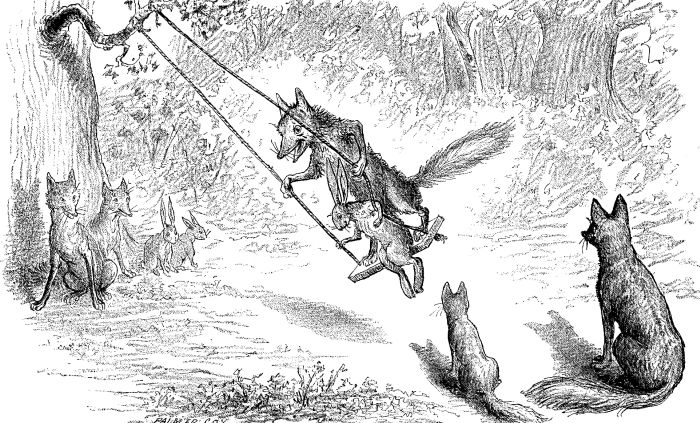
SWINGING "BRER RABBIT."—Drawn by Palmer Cox.