LAWN TENNIS.
Reading edition
BY SHERWOOD RYSE.
When I say that the game of lawn tennis was invented by an English gentleman some seven or eight years ago, I am quite prepared to hear from some of my readers, whose favorite study is history, that it is much older than that, and was known both in France and England as long ago as the reign of Henry III. And indeed the correction will have much truth in it, for tennis was known even further back than that. People who always want to get at the very beginning of everything claim that the game, or something very like it, was played in the reign of the cruel Emperor Nero, who, you will remember, fiddled while Rome was burning before his eyes. Fiddling, perhaps, was not his only amusement, and it is quite possible that in the interval between one horrible act of cruelty and another, the Emperor indulged in a game of tennis. But Nero is not at all a pleasant person to associate with such a beautiful game, so, if you please, we will leave history to the historians, and see what our modern great-great-grandchild of the old tennis is.
Those of my readers who live in or near large cities will probably know that it is an out-door game played with a racquet and a ball, but for the benefit of those who do not know it, I will give a few hints as to the laying out of the court, and the implements necessary for the game.
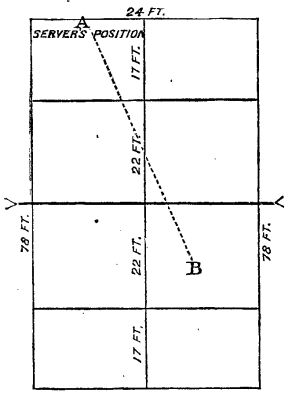
First of all, you must have a lawn; not necessarily a perfectly level piece of turf as smooth as a parlor carpet, but a fairly level plot of grass, which a scythe or a mowing-machine can soon put into order. Of course all stones and sticks must be picked up, and if you have a roller at hand, you will improve your lawn greatly by running the roller over it once or twice. When the ground is prepared, get some small pointed sticks and some string, and lay out the "court" according to the lines on the diagram on this page, stretching the string from one stick to another at the distances marked on the diagram. When this is done, get some whitewash and a brush two inches wide, and mark lines on the grass wherever the string passes over it. Then you may pull up the stakes and the string.
READY TO "SERVE."
The broad line across the middle of the diagram is where the net goes. If any one of the party knows how to make a net with a two-inch mesh, so much the better; but most of my readers will prefer to buy one, I think. The net is twenty-four feet long and four feet wide, and is fastened to posts, about five feet high, at each side of the court. The posts are supported on the outer side by "guy-ropes" fastened to stakes driven into the ground, while the strain of the net between the posts supports them on the inner side. And now that the court is marked out, and the net pitched, we have everything ready except the bats and balls.
The bat, or racquet, is a very pretty piece of workmanship, and I dare not venture to hope that the cleverest of my readers could make one, so we will assume that, even if everything else is home-made, the racquet must be bought. And so, indeed, must the balls; but a hollow India rubber ball of about two and a half inches diameter is so well known to all boys that we may dismiss it with the remark that it is as well to have at least two balls at hand in a game, to save time.
The game may be played by either two or four persons. In the latter case each pair will play as partners on each side of the net. The one who strikes the ball first (and this is decided by agreement) is called the "server." Standing with one foot outside the line at the end of the right-hand court, and the other foot inside the court (position marked A in diagram), the server strikes the ball so that it falls in the court diagonally opposite him, just over the net at B, where a player on the other side will be waiting to receive it. After the ball has bounced once, the player must strike it over the net, and it must be returned from one side of the net to the other until some one fails to do so properly. One partner plays in the inner court and the other in the outer one, and after the "service" and the first return, either of the players may return the ball to any part of their opponents' court, according as it pitches nearer to one than to the other. When a player fails to return the ball properly, it counts one for the other side, and the server begins again from his old position, except that he must serve from the left-hand court this time if he served from the right-hand court last.
Counting.—A game consists of four "points." It counts against one side, and in favor of the other,
1. When the server makes two "faults" in succession. (A "fault" is the failure of the server to send the ball into the proper court.)
2. When a player does not return the ball over the net.
3. When a player sends the ball so far that it falls outside the court.
4. When a player allows the ball to strike the ground more than once before he returns it.
When one side has made four points, a new game is begun, but the same side must not "serve" two games in succession, for there is some advantage in the "service," and it would not be fair for one side to have it oftener than the other.
It will often happen that both sides will have made three points at the same time, and when that does happen, the score is called "deuce," and either side has to make two points in succession to win the game. If the server's side makes a point when the score is "deuce," it is called "advantage in," and if the other side then makes a point, their point cancels the other, and the score is set back to "deuce" again. When the other side (not the server's) makes a point after "deuce," it is called "advantage out," and this point may be cancelled by the other side making one, as before. When one side has made two points in succession after "deuce," the game is won. The side which wins six games first wins the "set," and then the players may rest awhile, or choose fresh sides.
All the principal rules of the game are included in the description of the game given above, but if you buy a full tennis set, a little book containing the rules will be included in it.
As I have said, everything but the bats and balls can be made at home, since nothing is required but two posts, five feet high and an inch and three-quarters in thickness, four tent-pegs to fasten the guy-ropes to, and a net.
But even if it is decided to purchase a set, the cost is not very great compared with that of some other games, especially if two or three families club together. A good tennis set, consisting of four bats, four balls, a net, two posts, guy-ropes, four stakes, and a mallet for driving these last into the ground, can be bought for fifteen dollars. The bats alone of this set would cost eight dollars, and the net two dollars. The poles are rather expensive, as they are made each in two pieces so as to pack into a box, the pieces fitting together in a brass socket. Poles without a joint in the middle can easily be made, thus saving four dollars in the cost of the outfit. The guy-ropes, runners, and stakes cost seventy-five cents a set, but these can easily be made. The cost would thus be reduced to eleven dollars, namely, eight dollars for four bats, one dollar for four balls, and two dollars for a net.
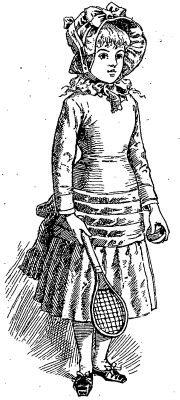
Of course players will dress lightly for the game. A flannel suit is the best thing to wear, as it is cool, and prevents the wearer from taking cold easily. Ordinary shoes can generally be worn, but most players prefer canvas shoes with rubber soles of an uneven surface to prevent slipping. For girls—and this is as much a girl's game as a boy's—short dresses of blue flannel, or some other material that is both cool and strong, are recommended; and canvas shoes with rubber soles can be bought, in girls' sizes, at almost any shoe store. English girls wear the "Jersey," shown in the cut on the preceding page, as a tennis costume, and this neat, close-fitting dress is already becoming popular in this country.
Lawn tennis is a game that requires a quick hand and eye, lively movement, and a good temper. There are two things which spoil the game, even among good players. These are lack of interest in the game, so that a player does not play his best all the time, and a show of bad temper. Angry words and solemn sulks are nowhere more out of place than on the tennis lawn.