THE PRISONER AT THE BAR.
Reading edition
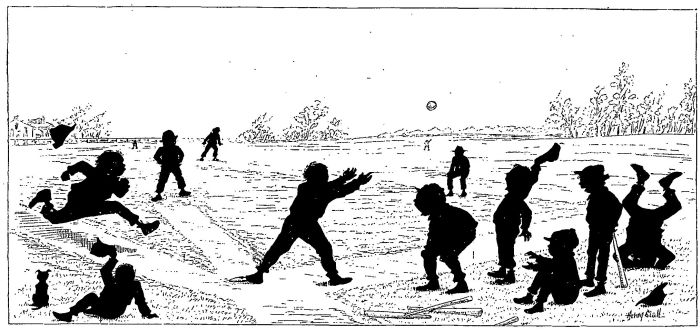
"Stand up at the bar," cried the Justice severe. "And what you can say I will patiently hear; But you have been brought here so often before That I fear it will be the old story once more. "Stop! You needn't repeat that you couldn't find work. For I know you quite well for a tramp and a shirk; You sneak round the farm-houses begging for bread, And will rob even those by whose hands you are fed. "For a stout hearty fellow like you it's a shame To take the alms due to the sick or the lame; But to steal from the kind ones who pity your case, I must punish severely a meanness so base." "Well, your Honor, I've nothing to say, for I see That nothing will change your opinion of me; I suppose you will tell me, as often before, That I must be sent to the tread-mill once more." "You take the words out of my mouth," said the Judge; "You are sentenced a month on the tread-mill to trudge; And when your tramp's over, perhaps you will feel That it's better to work at the plough than the wheel. "For good honest labor will bring its reward, While the way of the idle and vicious is hard; And 'tis better in youth to this precept to hold Than have to confess it when hardened and old."

I wonder if all the young people are as glad as I am that June has come again? You know the poet says:
"What is so rare as a day in June? Then, if ever, come perfect days. When heaven tries the earth if it be in tune, And softly above it her warm ear lays."
Some of you are studying hard in these bright hours, so that you may be ready for examination. I hope you have been so faithful all the term that you will not need what some students call cramming to make you successful now. Others of my boys and girls are busy with their roses and honeysuckles. My thanks to the dear little hands that have gathered wild flowers for me.
You must tell us about your summer pleasures, children, and if anybody meets with an adventure, remember that Our Post-office Box would like to hear about it.
New York City.
I am a little girl nearly seven years old. We have no live pets in the city, but my little sister Anna and I have fourteen dolls. I am thankful to say they are very healthy; none of them have had the mumps or cooking-cough, as my little sister calls it. In the summer we all go to Long Island. There we have a pony, two cows, one calf, two cats, a kitten, and some chickens. We have great fun bathing. I am writing this myself, and if you think it is nice enough to print, I shall be the proudest little girl in New York city.
Helen B.
Henry County, Virginia.
I've been a reader of Harper's Young People quite two years, but have seen no letter as yet from here, therefore I'll write at least one from this mountainous part of the State. My country home is in sight of the Blue Ridge, and one can get a distinct, grand view of some of its peaks a mile from our home. No one of your little girl subscribers enjoys the Post-office Box more than myself. In fact, both big and little folks here appreciate and read most of Harper's publications. I wish everybody who lives in low flat countries could at least visit our mountains, and our State's greatest, curiosity, the Natural Bridge, in Rockbridge County; it is worth a trip to Virginia just to see that wonderful work of nature. But I must not write too long a letter, for fear you'll not find space to publish it; so I'll close by stating that I'm the youngest of twelve children. With best wishes for our dear kind Postmistress,
Maggie S.
The Postmistress returns heartily the love of all the dear girls and boys who send her their pleasant messages. She has visited your lovely mountain land, Maggie, and it is her opinion that you can not praise its beauty too highly.
King George County, Virginia.
I am ten years old. I have one brother and three sisters. I have a cow and a calf. We have a play store; we make wooden dollies and many other things to sell. We have a dog and a cat. The dog's name is Trip, and the cat's Tiger. There is a little bird that comes down by the door, and we give him crumbs; he is real tame. I used to have a pet rooster, but papa sold him. He would fly up on my shoulder, and when he saw any one with a pan he would fly in it. I will tell you about a squirrel that lives in a very large hollow hickory-tree back of our house. He is so cunning! He comes out on the side of the tree and chatters at us, and the dog and cat try to catch him, but he is too sharp for that. He comes and steals walnuts from our store-house, and carries some to his tree. We have two small mules; I love to ride on their backs.
Emma F. B.
Durbin, Dakota Territory.
I am a little boy thirteen years old, and I live on my father's farm, one-half mile from Durbin, in the celebrated Red River Valley, about six miles from the world-renowned Dalrymple Farms. Our house stands on the high beautiful banks of the Maple River.
Two months ago my sister and two brothers and myself were taken sick with diphtheria. I haven't been able to walk since. My little brother Allie died. I want to tell you what the sweet little boy said when he was sick—he did not like to take his medicine; and mamma said to him, "Allie, take it to please mamma," and then he took it; and a little while after mamma heard him say, in his sleep, "I will take it to please mamma." The last time he took his wine he said to papa, "Papa, I will never take it again." He was five years old, and could read and spell, and count up to one hundred without missing, and we never tried to teach him; he learned it all himself from hearing us. I have taken Young People from the first number. I could not live without it.
Please print this, as I am unable to walk, and have little to amuse me.
Lynn C. M.
What a sweet memory you have of the dear patient little brother, who was so ready to please his mamma, even when in pain!
I hope, as the summer days bring their pleasures, you will grow strong again, and be able not only to walk, but to run and jump as boys like to.
There will be a general clapping of hands when the Cot report is read this month. Here is a letter, which everybody will enjoy, from a friend who has the Cot on her mind all the time:
I am certain a great many of our young readers, when they see the Cot acknowledgments, will exclaim, "My! how did we get so much money all at once?" I don't wonder at your surprise; I am sure I was surprised when I heard the good news. Well, that $550 which you see put down as the result of a fair is what did the work. Sometimes in reading our fund column I have wondered why so few names from New York city appeared among our contributors; the greater part of the work before has been done in the East, West, or South. But now New York city has stepped up bravely to the front, and is worthy of great praise. Four little girls living here, namely, Madeline Satterlee, Helen Manice, Gertrude Parsons, and Mamie W. Aldrich, formed a club in Lent, and worked for this fair, and earnest workers they must have been. The fair was held April 22, in the Sunday-school room of Zion Church, Thirty-eighth Street, New York, which was kindly lent for the purpose. Of course I was at the fair, and a very pretty one it was. I only wish more people could have known about it, and have been there to encourage these little girls in their good work. Very busy they all looked, waiting on the tables. They had a fish pond and a large red grab-bag, both of which took in quite a sum of money; and I am sure these little workers must have felt very proud, and well repaid for any self-denial they had practiced, when they handed in to our treasurer the large sum you see acknowledged to-day. Now don't you think it would be a good plan if all the boys and girls who are well-wishers of our Fund—and I am sure they are many—would work hard this summer, while away in the country, or at home, and try and make the amount up to $1500? That would be just half the amount needed, and how fast we could go on next winter! You would have to raise $345.56, and that is not such a large sum among a great many. Some, like these four little New York girls, could hold a fair or festival at some of the summer resorts; others could pick and sell berries. There are many ways in which the little hands and feet could earn the pennies for our fund. Do not be disheartened at small results, but remember that every effort you make, if in earnest, helps both yourselves and the Cot fund.
I wonder if some of you are not curious to know where your money goes while waiting for the rest of the $3000. If any of you have ever gone in the Sixth Avenue cars, New York, past Waverley Place, you may have observed a large building on the southwest corner, with "Greenwich Bank" upon it in large letters; our treasurer wants me to tell you that she puts your money there; and, if I am not mistaken, some of these days you will see in our acknowledgment, "Interest from Greenwich Bank," which means that the bank pays you so much money for leaving your money with it. If you will ask your papas, I am sure they will tell you that it could not be in a better place. So you see what a good treasurer we have to take care of our money.
In saying good-by I must add that I think you have all done very well so far in our good work. The year will not be up until next month, and we have passed "the place in the mountains where we can look back and see one-third of our journey accomplished."
So to our helpers, Great and small, Thanks we send For one and all.
Aunt Edna. New York, June, 1882.
St. Louis, Missouri.
As this is one of the large cities in the Union, I thought if no one else would sustain its credit I would. On the 5th of May we had a big hail-storm. In 1872 we had a hall-storm when the hail was about the size of a hazel-nut; but in this one the smallest stones I saw were that size. Most of them, however, were about the size of walnuts. I saw quite a number as large as a section of an egg, and one or two almost as large as my fist. Now I am afraid you will think that I have exaggerated, but it is true. I have heard a number of persons, including a very old lady, say that they have seen a number of stones frozen together, but never before such large single ones. The storm lasted for a full half-hour, hailing constantly. A great deal of damage was done to churches and public buildings especially. Branches of trees, bushes, and vines were cut off as smoothly as if done with a knife. One man went out to the gutter to pick up an extra large hail-stone, when another one hit him so forcibly on the back of the neck that he fell down on his hands and knees. I would have sent you one of the stones, but as such things can not be telegraphed, I could not do so.
Malcolm P.
Binghamton, New York.
I have written one letter before, and have not seen it in the paper, so I thought I would write again. I am taking Harper's Young People for the third year. I like "Toby Tyler" very much, and "Mr. Stubbs's Brother" still better. I saw some real prairie-dogs not long ago. They don't look bigger than a good-sized rat. I am nine years old, but have only been at school a year, as I have always been sick. I am in the second grade, and study arithmetic, reading, language, and spelling. Shall be promoted next term.
I have a little brother named Frankie. He is seven years old. Mamma and he and I live with grandpa, as our papa is dead. Frankie has a cat which had four kittens. They are all sorts of colors. I wish I could send you their pictures. They live in my old baby carriage. I made a little tent, not big enough to get under, that I could take down and put up as many times as I had a mind to, and to-day I broke it. Jumbo, that you have told us about, is coming here in August. I hope I shall see him. When I do, I'll write and tell you what I think of him. I just love him now. I can't think of any more. Good-by.
Eddie F.
Those little kittens are well off. Living in a baby carriage! Think of such luxury! Do they have an afghan over them when they are chilly?
It is fun to make a tent large enough to accommodate two or three boys. I think, if I were there, I could help you make one with two or three poles, and a couple of old shawls or table-covers. Suppose you ask mamma to help you do this?
Forest, Texas.
I am a little girl twelve years old, and live in the country. I have a kind uncle who sends me Young People. We have had plenty of strawberries this spring. I go to school, and am in Coins and Currency, and at play-time I have fine times playing croquet. We have a mocking-bird building in the garden. It sings all day. We had a fish-fry not long ago, and had as many fish as we wanted. It has been a very rainy season. I have a great many pretty flowers; the gladiolus is opening now. I am so glad when Harper's Young People comes. I like the story of "Talking Leaves" better than any other one.
Nina M.
We planted our gladiolus bulbs the morning that Nina's letter arrived; but the season is earlier in her Southern home than it is with us. Have you magnolia-trees and pomegranate-bushes in your garden, Nina? How charming it must be to hear the songs of the mocking-bird all day long!
Norwich, Connecticut.
I must tell you about my pet which my uncle Frank brought me from California. It was a dear little horned toad. It was very affectionate, and had a soft yellow breast and two horns, one on each side of its head. I kept it in a big box of sand, and uncle called it Cutey, it was so cute. One day it was very cold, and Cutey shivered so I covered him up in the box, and put him on the register; then I went off, and forgot my poor little toad. When I came back my toad was dead, and I cried very hard, for I felt naughty to have forgotten my pet. I have some more pets, and some time I will tell you about them; but I am afraid this is too long.
Susie.
What a pity it was, dear, that you forgot your pet! No wonder you cried. I am sure you will never again forget one of the little creatures, which are dependent on you for their comfort.
Bristol, England.
I have a very kind cousin who lives in Brooklyn, and sends me Young People. I am eight years old. I am very fond of reading the letters of children so many miles away from each other, and of hearing about their pets. I have a green parrot, but he is very spiteful. We have a gray cat, and if we stay upstairs beyond our time in the morning, she comes up and sits outside the door, and keeps mewing until I come out and speak to her. I have two sisters, one five, the other three. I have been learning to play the piano eighteen months; also my sister Lillie. We play several duets, and many pieces. I have to practice every evening, and then I have a good read from Young People. I like "The Cruise of the 'Ghost,'" "Tim and Tip," and "All-hallow Eve" very much indeed, and I am very much interested in "The Talking Leaves." My papa I have not seen in nearly four years. He is out in China. He was wrecked last July. He was chief officer of the Anne S. Hall, of Boston, which was lost in a typhoon. All hands were saved in a boat. I shall be very glad when I see him. I have been two years at school. I went to a pic-nic party to Lea Woods. We went through Nightingale Valley, and were really tired when we got to the top. The woods looked lovely with bluebells and violets. The primroses seemed to be all picked.
Percy T.
Well, Percy, I wish I were so near that I could tell whether you and your little sister keep time in your duets. You must practice very diligently, so that your music will delight your papa when he comes home again. How much you must love him, all the more fondly because he was in such peril on the ocean! I hope he will reach his children in safety.
Nightingale Valley is a beautiful name for a wood.
Brooklyn, New York.
I want to tell you about our cat, whose name is Miss Moll; my little brother named her, and he is three years old. Miss Moll trots all over the house, and when she wants to go out, she stands by the door and mews. When she wants to come in, she scratches at the door. She will lie down on her back, and play with any one's hand, although she is a middle-aged cat.
We also have a dog, but he does not amount to much, except that he is a good watch-dog, and he belonged to my brother, who is now dead.
I go to the public school, where I received a prize for writing and composition. (They don't give prizes as a general thing.) This is my first letter.
Grace I. T.
I am glad you were the fortunate little winner of a prize.
Frederick County, Maryland.
As I have seen no letter from here, I thought I would write, and maybe you would publish it. I am a little girl eleven years old. I live in the country near Frederick city. I have a dear little brother; his name is Charley. He is a little naughty sometimes, though. Charley has three dogs—their names are Sport, Jack, and Butty—and he has a very pretty Alderney calf, also ducks and chickens. He is very kind to them. My aunt Kate gave me Young People for a Christmas gift. I like it very much. I have twelve little cousins; we go to school together, and have very nice times. I send my love to you, Mrs. Postmistress, and to all the little girls and boys.
E. K. H.
Exchanges are inserted without charge, but they must be brief. First name what you have, and then state what you wish in return. Give your address plainly, and in full, town, county, and State. Please write with black ink.
C. Y. P. R. U.
The Rainbow.—When the summer shower is passing away, and while the thunder is still rolling among the hills, we have often seen the rainbow. Every one admires the beautiful arch which spans the sky. It is caused by the striking of the sun's rays upon the drops of water as they fall from the clouds. These rays are twice refracted and once reflected as they meet the transparent drops. If you look in the dictionary, you will find that refracted means bent suddenly, and reflected means thrown back. The colors of the rainbow are seven in number, and appear in the following order: red, orange, yellow, green, blue, indigo, and violet. The tints are most vivid when the background of clouds is darkest and the drops of rain fall closest. The continual falling of the rain while the sun shines produces a new rainbow every moment; and a curious thing is that as each spectator sees it from a particular point of view, strictly speaking no two persons see precisely the same rainbow. A peculiar sacredness is attached to our thoughts of the rainbow on account of the mention made of it in Genesis, when, after the deluge, Noah saw its arch in the sky. How glad he must have been to view the sun once more! Then God said, "I do set my bow in the cloud, and it shall be for a token of a covenant between me and the earth." The story of the rainbow, as the Bible tells it, is to be found in Genesis, ninth chapter, from the eighth to the seventeenth verses.
Hattie C.—You are needlessly distressed at what you call your lack of conversational powers. It is true that some people have the gift of talking with ease, and that they are not embarrassed in the presence of others. But any person of ordinary intelligence may learn to talk brightly and pleasingly by simply taking pains to learn how. In the first place, try to forget yourself. Do not fancy when you open your lips that the lady opposite you on the sofa, or your neighbor at the dinner table, is criticising or making fun of you. Well-bred and kindly mannered people never do so. Have, in the second place, an idea of what you wish to say. In the third and last place, be sure to tell your story or give your opinion in the simplest language you can command. Never use slang. To be a good listener is as great an accomplishment as to be a bright talker. A young lady who listens intelligently, and with sympathy in her looks, giving now and then a brief reply or a turn to the talk, but not trying to lead it, or to be at all conspicuous, is sure of being popular. Find out what your friends are interested in, and help them to talk on their special subjects. Do not worry about the impression you are making when in society, but let your great aim be to make the place where you are as cheerful as possible.
We would call the attention of the C. Y. P. R. U. this week to Mr. Charles Barnard's article, "Wave and Sand," and to "The Boyhood of William Chambers." The girls will be pleased with Mrs. Dewing's pretty and artistic design for "A Kettle-Holder."
YOUNG PEOPLE'S COT.
Contributions received for Young People's Cot, in Holy Innocent's Ward, St. Mary's Free Hospital for Children, 407 West Thirty-fourth Street:
Henry and John Goeltz, $2; Kerfoot W. Daly, Gibsonton, $1; Mamie Tilton, Fort Riley, Kan., $1; Easter gifts from Charles Frederick Fletcher, $1, Theodora Carter, $1, Maud Metcalf, 75c., Ruth Metcalf, 75c., and Mary Aiken Metcalf, 50c., Auburndale, Mass., total, $4; Dora's Easter Offering, New York, $1; Lucy, Frank, and Willie Green, Upper Alton, Ill., 25c.; "Little Margaret," June 4, In Memoriam, $100; Teddie and Willie McVickar, New York, $20; Ethel Hurst, New York, 75c.; Virgie McLain, Nassau, N. P., $1.25; Annie and Edith Van Kuran, Clinton, Iowa, 50c.; Lena Matthews, Olean, N. Y., $1; Oliver T. Clough, Junction, Iowa, $1; In Memoriam, Herbert Stockwell Day, $50; Ethel Ransom, 25c.; Elise Hurst, New York, 25c.; Teddie McVickar, New York, 25c.; Lulu Lyon, $1; Frank M. Hartshorn, in memory of two little brothers, $1; Emily Chauncey, 30c.; Isabelle Lacey, $10; Teddie McVickar, New York, 50c.; proceeds of a fair held in Zion Church Chapel, Madison Avenue, New York, April 22, the Lenten work of a club of four little girls—Helen Manice, Madeline Satterlee, Gertrude Parsons, and Mamie W. Aldrich—New York, $550; total, $747.30; previously acknowledged, $406.84; grand total, May 15, 1882, $1154.14.
E. Augusta Fanshawe, Treasurer, 43 New St.
Clinton, Iowa.
We saved fifty cents out of our pocket-money for the Cot, and we hope it will help a little toward the support of some poor child.
Annie and Edith Van Kuran.
I have saved these two dollars with my brother. My brother saved fifty cents, and I saved one dollar and fifty cents. My brother is seven years old, and I am fourteen. I sent these few pictures because I think they will please the little ones. My brother and I will try to send two more dollars.
Henry and John Goeltz.
I send you $1 I earned myself feeding chickens and getting up early in the morning. Mamma said I might do whatever I chose with it. I am not a very big boy.
Kerfoot W. Daly.
Upper Alton, Illinois.
I have been intending to write to Young People for some time. We all like it so very much. I am so glad Mr. Otis has begun another story about Toby Tyler. I know it will be splendid. My brother Frank and I send twenty cents for Young People's Cot, and hope the Cot will prosper. I am so sorry the trailing arbutus does not grow here. I have never seen it. But we do have lots of other lovely wild flowers. We have white, blue, and yellow violets and bluebells all growing in our yard. I wish I could see the boys and girls that write to Our Post-office Box. I wish I was able to give some of our flowers to the poor sick children in the hospitals.
Lucy L. Green.
P. S.—My brother Willie adds a nickel to our contribution.
L. L. G.
Nassau, New Providence, Bahamas.
Inclosed you will find $1.25 for Young People's Cot. Once before I sent you 35 cents. I had a beautiful parrot which died, and to console me papa gave me $5, so I now send $1.25 out of it.
Virgie McLain.
Schuyler, Nebraska.
We have taken Harper's Young People for only a month, but papa sent and got us all from the January number down. We felt sorry for the homeless little children, and so we sent them some papers. We have been saving them up from 1879. There are five of us children, and I am the next to the oldest. We live in Schuyler, Colfax County, Nebraska. We have a good many pets, but I will have to wait until next time to tell you about them. I will have to close now, as it is about time for school. Good-by.
Mattie Clarkson.
Olean, New York.
I am a little girl nine years old. I send you a dollar for Young People's Cot, which I earned by helping my mamma. The only pet I have is a little baby brother. I have got the mumps on both sides. I go to school, and study geography, grammar, spelling, reading, writing, drawing, and arithmetic. I must close. Good-by. From
Lena Matthews.
PUZZLES FROM YOUNG CONTRIBUTORS.
No. 1.
BEHEADINGS.
1. Here is a group of boys. Behead the name of No. 1, and you have an ancient vessel; of No. 2, and you have something unpleasant; of No. 3, and you have a nickname; of No. 4, and you see a vehicle; of No. 5, and you have a useful article of furniture; of No. 6, and you have an organ of the human body; of No. 7, a beautiful bird; of No. 8, a disfigurement.
2. Here are four pretty girls, with very sweet names. Behead the first name, and you have what the robin did to the cherries; the second, and you have the name of the earliest martyr; the third, and you have what bees and butterflies are in summer; the fourth, and you have an exciting chase.
Sam Weller, Jun.
No. 2.
ENIGMA.
My first is in apple, but not in prune.
My second in May, but not in June.
My third in seek, but not in find.
My fourth in cross, but not in kind.
My fifth in mice, but not in rat.
My sixth in cape, and also in cap.
My seventh in chair, but not in stool.
My whole is a country you'll learn of in school.
A Boy of Ten.
No. 3.
TWO DIAMONDS.
1.—1. A letter. 2. A domestic pet. 3. A city in France. 4. A metal. 5. A letter.
2.—1. A letter. 2. A nickname. 3. A heavenly wanderer. 4. Human beings. 5. A letter.
Eureka.
No. 4.
NUMERICAL ENIGMA.
My whole is a noted battle-field, and I contain 11 letters.
My 1, 2, 6, 4 means to speak familiarly.
My 7, 3, 10 is a horse.
My 1, 8, 9, 5 is a water-fowl.
My 11, 2, 6 is an exclamation.
Empire City.
ANSWERS TO PUZZLES IN No. 133.
No. 1.
LUNARRASP
USAGEACME
NASALSMUT
AGATEPETS
RELET
FIGVAN
ICEACE
GETNET
No. 2.
FirinG
IodidE
CheruB
HawaiI
EndinG
LoungE
No. 3.
S
DICED
DUEIDEASART
DUCKSSCEPTICDROOP
EKEEATERTOE
SSIRP
C
TBE
TIPTEAEND
TIGERBETSYENDOW
PETASPDOT
RYW
No. 4.
Excelsior.
Answer to Enigma on page 134—Handcuff.
Correct answers to puzzles have been sent by "Eureka," Annetta D. Jackson, Pansy V. R., "I. Scycle," Harold S. Chambers, Florence, Mabel, and Annie Knight, Douglas Fay, Alex Ketchum, John B. Todd, Alice Bolton, Emma Grace, Fanny and Fleda Cary, Viola, S. T. C.
[For Exchanges, see 2d and 3d pages of cover.]
THE YOUNG GENIUS.
GAS BALLOONS.
Small gas balloons are made of thin sheet India rubber, or gutta percha, or tissue-paper; larger ones are made of oiled silk. Cut gores of the material to be used, sufficient in number when fastened together, the sides of each gore overlapping the gore fastened to it, to form a globe of the desired size, with pear-shaped ends. Join the gores together so as to make them completely air-tight. When the heavier materials are used, they should be sewn together, and then covered with glue or thin varnish. At the lower end of the balloon insert a tube, and tie all the narrow tips of the gores firmly round it. Cover all with a solution made of India rubber dissolved in naphtha and turpentine, and over the balloon place a net bag that has been previously made of the proper size and shape.
The gas with which the balloon is to be filled is made in the following manner: Put a pound of granulated zinc or iron filings into two quarts of water in a stone jar, and add gradually a pint of sulphuric acid. Have a tube of glass or metal run through the bung with which the jar is corked, and after taking the materials out-of-doors, fill the balloon by connecting this tube with the tube already placed at its mouth. When the balloon is filled, tie its neck very tightly, and it will rise into the air. Common coal gas may be used when it can be obtained. A small car made of some light material may be attached to the netting which goes over the balloon.
A BALLOON ADVENTURE.
An exciting balloon adventure was that of Mr. Pendarves Vivian, an English member of Parliament. With two skilled aeronauts he recently made an ascent from Southwest London, the start being delayed by unfavorable weather until 10 p.m.
They found themselves in a strong current, which in ten minutes had placed them over North London, the lights below presenting a fairy scene of indescribable beauty. Though over 1000 feet high, street cries were distinctly audible. Ascending rapidly to 8000 feet, in an hour they found themselves passing at a tremendous rate over a flat country suitable for descending, and they resolved to come down. Gas was let out, and grappling-irons dropped, when there was a sharp check and violent jerks, and suddenly they commenced soaring upward at a frightful pace.
The rope of the grappling-irons had broken. The danger of so helpless a position, especially at night, was instantly apparent, and shortly afterward a renewed descent was made, hoping to run the balloon against some branches of trees. When this was done, one got out, and the two, relieved of his weight, were carried upward with extreme velocity to a height of three miles.
Half stunned by the shock, some time elapsed before the adventurous occupants of the balloon again attempted to descend, when, to their horror, they heard the roaring of the sea immediately below them. Fortunately they landed upon the beach, and not in the water. They were eventually rescued unhurt; but Mr. Vivian's experience convinces him that ballooning can never be of practical utility as a means of travelling.
MAGICAL MUSIC.
This is a game in which music is made to take a prominent part. On one of the company volunteering to leave the room, some particular article agreed upon is hidden. On being recalled, the person, ignorant of the hiding-place, must commence a diligent search, taking the piano as his guide. The loud tones will mean that he is very near the object of his search, and the soft tones that he is far from it. Another method of playing the same game is for the person who has been out of the room to try to discover on his return what the remainder of the company desire him to do. It may be to pick up something from the floor, to take off his coat, to look at himself in the glass, or anything else as absurd. The only clew afforded him of solving the riddle must be the loud or soft tones of the music.
THE BASE-BALL SEASON—THE "HOME RUN."