Chapter I
Reading edition
If you don't know Aunt Ruth, I can scarcely expect you to understand just how lovely she is: the most unselfish, good-humored of women. She is not very tall, but there seems to me something queen-like in her manner. She is very pretty, but the charm of her face is its sweetness. When she smiles, her eyes grow very tender; when she is serious, a look comes into them of a peace I can not describe.
Aunt Ruth lives in a big old-fashioned house in the country, at which her many nieces and nephews are always welcome, and all the country people adore her. Though there is so much of what papa calls personality about her, yet she never seems to be thinking of herself, i and one day when the girls and I were clustering about her in her own sitting-room, I exclaimed: "Aunt Ruth, do you ever think about yourself for one moment? You seem just made for other people."
Now a sudden strange look came into Aunt Ruth's face. It was not pain exactly, but of some recollection that seemed to grieve her for a moment even as she smiled. I know Aunt Ruth thinks me rather the spoiled child of her little circle of nieces, and when she looked at me and smiled, and said, "Why, Kitty dear, we can make ourselves what we like, with help," I felt a little conscience-stricken. I supposed I was lazy and selfish; but how could Aunt Ruth know what it was to take care of three little brothers and sisters; get up early in the morning to study; stay in-doors, lovely June weather, sewing and patching and mending? Everything came easily to Aunt Ruth that was for other people. Perhaps she read my thoughts in my face. Her own brightened, and she said, pleasantly: "Girls, I wonder if you would like to hear a story—a chapter out of my own experience. I have often thought of telling it to you."
Aunt Ruth's story-telling is as famous as her gentle charity; and we were soon in comfortable attitudes, listening. The story had a peculiar charm, because it was about her early girlhood, and as she is only our aunt by marriage, we knew less of her young days than of the older life so happily associated with our own.
Now, to begin with (said Aunt Ruth), you know that my father was a country doctor. We lived in C——, a pretty town not far from Albany, and when I was nine years old my mother died. There were three children younger than I—one a mere baby—and we were all left to the care of my step-sister Winifred. You know her now, girls; and can you fancy what she was at fourteen, when she assumed the charge of our sad little household? A sweet, motherly little body, with so many loving, gentle ways that it seemed strange she was only our step-sister. But we never thought of her as such. Gradually she stepped into the mother place left vacant, and by the time I was nearly fourteen, and Winny in her nineteenth year, it had come to seem natural that she should direct and govern, pet and humor, us all, as if she was really our mother. But admirable as was Winny's household management, her care for us all, her orderly ways, and tenderness for our wants, there was one mistake in her system: she completely spoiled me, and from being inclined to indolence, I grew selfish and exacting. It seemed to me in those days perfectly right that Winny should have the work and I the play; that if a new material was bought for Winny's dress, and I liked it, it should be made up for me; that I should go away for change of air now and then, while Winny staid at home; that I should go out to tea as often as I was invited, and Winny have to hesitate over every invitation. In fact, it never seemed to occur to me to question my right in all sorts of things of which my selfishness deprived her. Winny loved me so devotedly, that if she saw my faults she tried to cover them up. Mrs. Judson, the minister's wife—your grandmother, Fanny—used to come over to our house a great deal, and I remember hearing her scold Winny for spoiling me. "Never mind, Mrs. Judson," Winny would say, with her sweet little laugh, "Ruth will be a big girl one of these days, and then she'll take her share of disciplining."
One fall, soon after my fourteenth birthday, I remember that papa began to talk about Winny's looking pale and thin. She certainly did not look well, but she maintained that she felt quite herself. It was a warm autumn, and Winny said that the cold weather would do her good. Papa, like the rest of us, I think, always took what Winny said without analyzing it; and so, when Mrs. Judson came over to see if Winny could go down to her mother's for a few days' change of air, I recall his saying, "Oh, it's all right, Mrs. Judson; I've given her some quinine, and she says she is very well."
It was two or three days after this that, at tea-time, papa came in with a letter in his hand, which he read aloud. It was from a cousin of ours in New York, a Mrs. Ludlow, and she wrote to invite either Winny or me to spend a fortnight with her. There was to be a wedding anniversary party; several young people were to be in the house, and she said she knew it would be a pleasant gathering. Now I am ashamed to say that it never for an instant occurred to me that I should not be the one to go. Papa read the letter, and then looked at Winny, who was sitting at the tea table, I recollect, with a small brother on either side of her. I can see the home picture now: our comfortable tea table; the pretty, cheerful room; the window at Winny's back, showing our bit of lawn and cedar-trees; the cozy gleams of fire-light; and Winny's face, just a trifle paler and thinner than its wont, but the dark eyes as lovingly watchful of us all as ever.
"Well, lassie," papa said, looking at her fondly, "you'll have to go, I think. Just what you need. Dear me!"—and he looked again at the letter—"so it's Mary Ludlow's twentieth wedding-day. They have a fine house down there. You'll see something of New York society."
Winny's face glowed. "Oh, thank you, papa," she exclaimed; "I shall be so glad," and then her eyes fell upon me. I know just how I must have looked—vexed, disappointed, and chagrined; indeed, the tears were nearly in my eyes.
"It will be a good chance for Ruth to learn housekeeping," papa went on. "Let us see if you can do as well as the lassie," he added. He had a fashion of calling Winny that, because of her Scotch ancestry. He laughed, and went away without noticing either my down-hearted look, or the change that had come into Winny's face. Singular though it may seem, it never occurred to me that it was Winny's right to go, and my duty to help her. I had grown accustomed to receiving all and giving nothing. Winny said nothing more about the visit just then. We passed our usual hour in the parlor before the children's bed-time rather quietly. It was Winny's custom to go up every night to the nursery, see the children undressed, hear their prayers, and perhaps talk to them a little before they went to sleep. Sometimes—when I felt like it, that is—I assisted at this little tender office, but I usually did so when I had some of my own concerns to discuss with Winny.
To-night I followed her up to the nursery, and sat down in the window, looking very haughty and self-restrained, while Winny put Joe to bed, talked Annie into a peaceful frame of mind, and made sleep less repulsive to Dick, whose theory was that beds were wicked tortures invented by grown people expressly to aggravate boys. While Winny went from one tiny bed to another, I sat thinking what a fine thing it would be to tell the girls at school I was going to the Ludlows'. I should certainly have a new dress, and perhaps my hat retrimmed. There was to be a party, so I must take my white muslin and kid slippers. Gradually my mind was not only absorbed by these delights, but by the feeling that Winifred would actually be robbing me of my own were she to accept Cousin Mary's invitation.
The children were at last in bed. Dick, in spite of his theories, was snoring loudly; Joe was declaring from the depths of the clothes that he never, never meant to be good again, because the cook had taken away his marbles; Annie was asleep in her little cot, a picture of pretty dimpled babyhood; and Winny was looking, if a little tired, at least glad that in spite of naughtiness, not one had gone to bed without kissing and hugging her fondly. Even Joe supplemented his terrible resolve with, "I'll just be good sometimes for you, Winny, but I'll always be bad all the rest of the time." His voice reached a kind of a wail. It was a sepulchral voice for a little boy. "I'll be bad—very bad—and perhaps I'll be hung—"
WINNY AND RUTH—Drawn by E. A. Abbey.
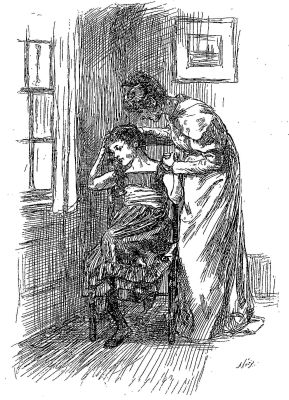
Winny was down on her knees at Joe's side.
"Yes, I will," he persisted, in a louder but more melancholy key. "I will go off where there are wild beasts, pottermusses, and lizards—I will."
"Winny," I exclaimed, sharply, "how can you put up with that naughty boy? Joe," I continued, looking at him severely, "let Winny alone, and go to sleep this minute. I want to talk to her."
"Oh, you do, miss, do you?" Joseph returned, with round eyes fixed on me over the sheet. "I'll never be good for you, Miss Greedy, I can tell you that."
But in a few moments Joe's curly head had drooped, and he was fast asleep. Winny turned to me the gentle sisterly look I knew so well.
"Ruth dear," she said, sitting down, "I've been thinking it over, and it seems to me"—Winny's eyebrows drew together, she clasped her hands closely—"you had better go to Cousin Mary's. I don't think I can: leave home just now"—Winny was a little flurried—"so we will get you ready nicely, and you shall go."
I was ready enough then to hug Winny, and tell her she was a darling, but during the days that followed I forgot the sacrifice she had made. She easily made papa see that it was I who should go. "Joe is not well," she pleaded, "and he never does anything for Ruth; he must be taken care of." One such excuse after another was made, greatly to my delight, and the only drawback to my satisfaction was Mrs. Judson's disapproving air. She came over more than usual, and several times remarked upon the injustice of this arrangement. "Why, Winny is quite a young lady," she said once to me, "and really ought to see something." But it was always Winny who silenced her, and prevented papa's discussing the question further.