THE THIRSTY FLOWERS.
Reading edition
BY MRS. SOPHIE B. HERRICK.
Fill a glass with water, and let a piece of common tape or a strip of muslin hang so that its lower end shall dip into the water, and then notice it: the liquid creeps slowly but surely up the strip. If the end which you have in your hand is dropped on the table beside the glass, the goblet may be entirely emptied, the water running up over the edge of the glass before it runs down again. This behavior of water would seem very queer if we had not noticed something of the kind all our lives. It is caused by what is called capillary attraction. Whenever one part of a material full of fine openings which lead through it is dipped into a liquid, the fluid runs through the whole stuff, even if it has to run upward. Try a lump of sugar: put one corner into your cup of tea or hot milk, and watch it soak the lump through. The burning of a lamp is upon the same principle. The wick serves to carry the oil from the globe of the lamp to feed the flame. As soon as the oil gives out, the light fades and dies away.
Fig. 1.—Cells. A, Leaf of Geranium Flower; B, Leaf of Sorrel.
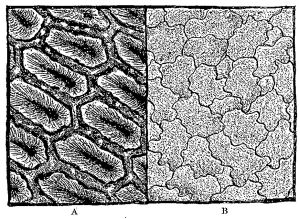
Every part of a plant needs water: it must be close around every little cell. These cells are the tiny queer-shaped bags full of liquid that are packed close together, and make up the leaves, stems, and flowers of plants. In Fig. 1 you see the cells of a leaf of geranium flower, and one of sorrel or sour grass, which, if you are like the children I know, you have many a time eaten to get the pleasant sour taste. Well, every one of these tiny cells must be kept wet all the time, or the plant will die. The only way we can think of that water could get up into the leaves and flowers from the earth is by capillary attraction, as it runs up the slip of muslin. And if it were not for this singular behavior of water, the only plants in the world would be those that grow in the seas and rivers and lakes. The land would be as barren as the desert of Sahara.
Now try to think of some plant with all the earth away—a tree, for instance—and you will see that it is a sort of double growth; that there is an upside-down tree in the ground, with its trunk and branches and twigs, as well as one above the ground. The under-ground twigs do not bear leaves, but each one of them wears on its head a little cap or helmet to protect the tender growing part from being injured as it pushes its way through the hard earth. The most important parts of a tree are those that seem of least consequence, the rootlets and the leaves. These are to the tree what our mouths and stomachs and our lungs are to us: the roots are the feeders and the leaves the breathing apparatus of plants.
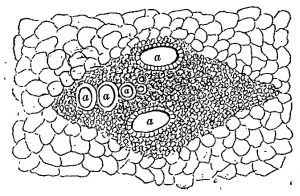
Fig. 2.—Corn Stalk cut across.
As the under-ground tree grows, the tender little roots push their way down into the darkness and cold of the deep soil; they find their way around stones and through great clods of earth, anywhere and everywhere, until they get their little noses into water or damp earth, and then they begin to suck. Sometimes it is only pure water that they take up from the earth, but generally it is a sort of broth—water with plant food dissolved in it.
The roots and stems and leaves are all full of little passageways running upward and branching and dividing until they reach the leaves. Fig. 2 shows a corn stalk cut across. You see some roundish holes, marked a; these are the ends of tubes that run through the stalk. When the corn begins to grow, take a stalk about two feet high, and cut it across; you will see little white spots all over the cut place. This figure is one of those white dots magnified.
Fig. 3.—Plant Mouths. A, Corn Leaf: B, Bean Leaf, with Mouth: C, Mouth seen Sidewise.
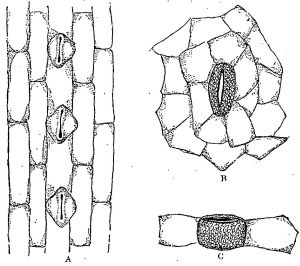
When these tubes come into the leaves, they open into little spaces just under the outside skin of the leaf. These spaces are like the hollow of a mouth, and each one has generally two lips, that are sometimes open and sometimes shut. Through these tiny mouths (Fig. 3) the plant breathes. It draws in air, and it sends out, as you do, a mixture of air and water. If you want to know how much water there is in your own breath, try holding a piece of cold glass before your mouth.
Plants are not wasteful of the water so necessary to their lives. What they do not use they give back to the air from which it was received, as we make our thank-offerings to God of what He has given us. The roots suck up the water, and each little cell takes a drink as the water passes it, and hands on the rest to the cell just above it. And so the water takes its course, supplying each thirsty cell with drink as it passes, spreading through every part of the plant until it reaches the little mouths. And there all that is left is breathed out in a fine steam which you can not see until it touches some cold substances, and is turned into water again.
Some one who wanted to know exactly how much water was given back to the air by growing plants carefully examined a number of them, and found that a single sunflower gave off in twelve hours a pound and a quarter—enough to fill nearly to the brim three common table goblets. Another plant, the wild cornel, was found to breathe but more than twice its own weight of water in a day and a night.
Fig. 4.—Water-carrying Plants.
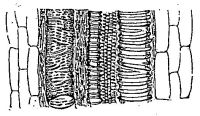
In order to find out what parts of the flowers were the principal water-carriers, a deutzia, one of our most delicate and beautiful spring flowers, which you probably know by sight if not by name, was put into some very blue water, colored with a mixture of what is called aniline, and in a little while every vein of the flower was a beautiful dark blue. The poor little blossom was, however, poisoned with its dose, and wilted away in a few minutes (Fig. 4).
The quantity of water that plants breathe off is so great that it makes an entire change in the climate when forests are cut down. Plants, like grasses and small weeds that grow on the surface, of course do not make the same difference, for their roots only go down a little way. But trees are very important: unless the air is kept damp by the sea or some large body of water, it depends very much upon trees for its moisture. Where there are no trees, the rain that does fall sinks into the earth, and runs away in little under-ground currents, and is lost. There are no deep roots to stop this waste, to suck up the water, and restore a large part of it to the air.
Fig. 5.—Cactus.
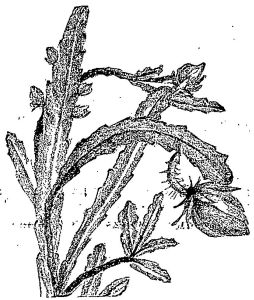
In places where the rain-fall is frequent, and the air is always kept soft, plants may be as lavish of their water as we are in the great cities where the supply never fails. Plants growing in such places very often keep their mouths open all the time. If this were the habit of those which grow in very dry places, they would soon perish of thirst. On the high Western plains beyond the Mississippi only a few things are able to live. Among these are some kinds of cactus plants, which you have probably seen in greenhouses or as window plants (Fig. 5). The reason why they manage to grow such bulgy leaves and fat stems where there is so little moisture, is because this plant is so very stingy of its water. It hoards it up as the travellers over the great African deserts do, knowing how hard it will be to get more. The roots of the cactus suck up every drop of water they can find, and the leaves keep their millions of little mouths tight shut so as to hold it all. Only such plants can grow on these plains as are able to do with very little water, or else are wise enough to hoard up all they can get. This water we have been talking about is not sap—that is the blood of the plant—but it is like the water we drink, and which not only helps to make the blood, but keeps all of the parts soft and moist so that it may live. The largest part of every living thing is water. It is not without good reason that the Bible so often speaks of the Water of Life, for without water no life could exist for a single hour.