THE LITTLE GRANDMOTHER.
Reading edition
BY MARY A. LATHBURY.
It had been an eventful morning in the attic. There were six of us—three of the Guernsey cousins and three of ourselves. Fanny Guernsey and our Ned had been reading Robinson Crusoe and the Swiss Family Robinson, and so we had all suffered a most horrible shipwreck, and had finally been cast upon a desert island. The ship was an ancient cradle, into which we were packed like sardines, and which, owing to Ned's vigorous efforts at "the wheel," lurched around the attic in a fearful way, and finally tumbled us all out in a heap upon an old-fashioned braided rug in a corner. We found ourselves too dense a population for "the island," and so Jamie Guernsey and I paddled off to the wreck, and got aboard. Then all at once a change passed over the wreck, and we (Jem and I) were Mr. and Mrs. Noah, urging our sons and daughters to hurry into the ark, and be saved. They at once saw that they were huddled upon the highest peak of a mountain, and must soon be drowned, so in they clambered, bringing two dolls with them to make out eight souls, and again we went sailing over the floods. It was Ned who first thought of our little oversight in forgetting to take animals into the ark.
"What on earth are we to do?" he cried.
"There isn't any earth. It's all water," said Fanny.
"Well, when we do get on earth, what are we to do for meat and milk and wool—and—and—"
"Oh, it's all up, and we might as well stop being Noah and his wife," said Jem to me, impatiently. "What's an ark without the animals? And there isn't room for a mouse."
"Oh, Jem, you and the girls get on the chest," said the fertile Ned, "and we'll be pirates, and swoop down on you."
"I don't want to be swooped down upon," said Jem, unreconciled.
"Oh, it's fun. Come on, Phil!" And upon that we were tumbled out, and Ned and Phil leaped into the cr—cruiser with such a piratical mien, and turned so fiercely upon us, that we were glad—Fanny and Jessie and I—to clamber up on the old chest for refuge. Then the cruiser, with a black neck-tie flying from a cane mast, bore down upon us so hotly that Jem was forced to come to our defense, and manfully he fought, too. Poor Jessie shrank into a little heap, and screamed. Fanny, her eyes flashing, and her tumbled, shining hair full of dried thoroughwort leaves from a great bunch hanging close above her, was struggling desperately with Ned, who, instead of carrying her off in his arms, as a true pirate should do, was pulling her aboard his cruiser by one foot, while with a crutch that used to be our grandfather's I was pushing her off—not Fanny, but the cruiser, I mean—into deep water. I was succeeding finely, when Phil kicked the foot of the crutch aside as I was throwing my whole weight upon the top, and in a trice I had rolled into the hold of the pirate ship.
This was too much for Jamie, who seized the mast of the cruiser, with a cry of "Down with the black flag!" and dealt Phil a blow upon the back that added another voice to the general chorus of shrieks.
In the midst of the uproar we heard a soft voice from the extreme end of the attic, calling,
"Children! children!"
One by one we ceased our outcries, and listened.
"Children"—what a soft thread of a voice it was that came out of the darkness!—"children—Ned, Fanny, Phil, Jessie, Bessie, Jem—come here."
We all looked at each other, until Ned rose bravely and started for the voice, the rest of us creeping after him. Midway we stopped, and the voice called,
"Come, children, come."
There was no mistake now; it was the portrait. We huddled together, but drew nearer and nearer, for there was enchantment in the voice, and as it grew upon us in the dim light there was enchantment in the face and figure also.
"LITTLE GRANDMOTHER."
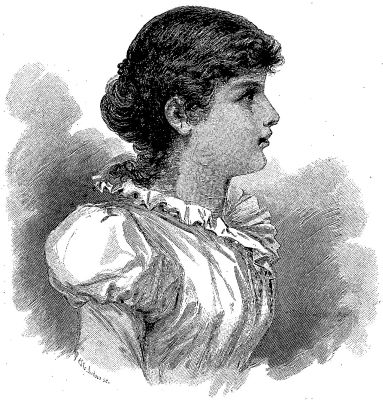
It was the portrait we were all familiar with, and which we called the "Little Grandmother." It was the portrait of our mother's grandmother, taken at the age of sixteen, and which had always hung in the library until the last holidays, when Phil had by mischance let a missile from his new toy gun fly in the direction of the portrait. It made an ugly hole in the canvas among the dark curls of our pretty Little Grandmother. It was considered a family calamity, but until it could be sent to a reliable restorer of pictures, it was set up on an old dresser at the end of the attic. It had had a piece of green baize thrown over it, which was removed, and now lay on the dresser beside it. Had she taken off the veil herself?
"Children," she continued, looking right on up among the rafters, as if she were talking to herself instead of to us, "you never heard me speak before, and you will never hear me speak again; so open your ears. Phil"—Phil started and began to quake—"I am sure I hold no personal grudge against you for that unlucky shot that mutilated my poor head in this way, but your general conduct is a distress to me. A boy of twelve should begin to show his knightly qualities, if ever he hopes to bear the grand old name of gentleman. Gentleman, indeed! to shoot his great-grandmother, with scarcely a pang of regret, and trip his girl cousin, and witness her fall with a laugh! Gentleman, indeed! And, Ned, you are scarcely a whit behind. You are brave, in a sense, but the bravery that attacks weakness, and shouts over its own triumphs, is a spurious bravery. A fine Sir Galahad or Sir Philip Sidney you would make! There is as crying need of brave and courtly men now as in the days of Arthur and his Knights of the Round Table, but where are they? The dear maidens must hope in vain for protection from evil men and evil beasts if 'the boy is father to the man.' Jamie, you are not as strong and as full of action as Ned and Phil, but you are a true knight, and perhaps one of these days you can say,
"'My strength is as the strength of ten Because my heart is pure.'
"You have nothing to fear, Sir Jamie."
By this time Fanny, Jessie, and I had sunk in a little heap on the floor. How pretty she looked, this girl grandmother! Her dark curls clung so daintily around her olive face, and the dark eyes shone out from the shaded brow with such a clear, honest light. We fancied we could see the red lips move, and the creamy white dress, with its bit of a waist and short puffy sleeves, tremble with the beating of her heart. Our own almost ceased to beat when she resumed.
"Fanny, Bessie, Jessie, you are dear girls, though I fear you are going to lack nobility and dignity of character; but what can be expected of girls that are taught French instead of their catechism, and the waltz in place of the minuet! Really, girls, I never screamed in my life—not even when a shell from a man-of-war burst in front of our house; and I must say I never witnessed such a romp as this among boys and girls in all the eighty-five years that I lived."
Eighty-five years! We looked from our Little Grandmother to each other in astonishment, and then the voice went on:
"But girls are not as they used to be, and perhaps they can not be. The world is growing weaker and wiser, and you have more already in your little noddles than I ever learned from books. I did not mean to scold you, my dears, but I have often wished to give you a bit of advice, and I have never had so fine an opportunity as this. If the great-grandsons of Mary Angela Bascombe are knightly men, brave, tender, and true, and her great-granddaughters are ladies, indeed, gracious, gentle, loyal, and loving, she will be grateful for the happy misfortune that sent her to the attic."
There was a long silence. Then Fanny drew a long breath, and each one of us immediately did the same. Ned, always the leader, stepped forward a little, and said, "Little Grandmother, we mean, you know, to be all right—but—but—"
"And we'll do our best after this; indeed we will," added Jamie.
"That's so," put in Phil, rather awkwardly.
"We love, you, Little Grandmother!" burst out Fanny—clasping her hands—in a little ecstasy, while Jessie and I murmured something in chorus about wishing to be like her; but there was no response from the portrait to anything that we said.
We had not noticed that the dim light was fading from the attic, and the portrait losing its outlines, until the sound of a bell below recalled us to outward things. Then, clutching each other as we went, we passed down the attic stairs and through the halls, and gathered in a very quiet knot in the tea-room. One by one the family gathered there also, and the seats around the long table were quietly filled.
"What is the matter with you youngsters?" said my father, scanning our faces keenly. "You are as mute as mice, and look as if you had seen your grandmother's ghost."
"We—we have," said Fanny, with a hysterical laugh, that ended in a sob; and at that Jessie and I put our napkins to our faces and began to sob too, while the boys looked at each other and smiled in a sickly sort of way.
"What does this mean, Ned?" said my father, laying down his napkin; and my mother nearly shivered a cup and saucer, she set it down so suddenly.
"Why, the—the portrait, you know, up in the attic—the Little Grandmother—has been talking to us, and we don't just know what it means," said Ned, making a strong effort to overcome his tremor.
"Talking to you! What did it say?" my father demanded again.
Here Phil came to the rescue, and said, sturdily, if not defiantly, "She said we were no gentlemen, sir."
"Gentlemen, indeed!" echoed Cousin Rob, in a sweet falsetto voice, from the end of the table; whereupon Ned, Phil, and Jamie rose in their seats, nearly overturning their chairs. Fanny and Jessie caught each other around the neck, and sobbed a short sob, with a little shriek at the end of it, and I fled crying to my mother.
It was a very trying scene. My father lost all patience, and my mother was in real distress, and as five or six were talking at the same moment, the matter became more and more hopeless, until Ned, who had gone over to speak to Rob at the end of the table, set up a clear, ringing, healthy laugh that silenced us all, and turned the force of my father's wrath full in that direction.
"Ned, we want no more of this nonsense. If this is one of your offensive practical jokes, explain at once."
"It's not mine—it's Rob's," cried Ned.
"Well, Robert?" said my father, trying to control himself.
"I beg your pardon, Uncle James," said Robert. "I am wholly to blame, but I did not anticipate such a scene as this. Aunt Fanny sent me to the store-room at the end of the attic about an hour ago for some corn for the children to pop after tea. I went up by the back attic stairs. There was fun, I can assure you, in the main attic. I never heard such a Babel. I went to the little open window that was made to let light through from the store-room into the main attic, and saw that you had set the portrait on the old dresser on the other side, and so covered the window; but through that ugly hole that Phil made in the Little Grandmother's head I could see that Ned and Phil were making terrible havoc with the girls, while Jamie was trying to defend them. When I saw poor Bessie go under, I thought it time to interfere, and began calling to them. Then the funny fact of talking through the Little Grandmother's head grew upon me, and I assumed the falsetto voice that you heard a few minutes ago. I was the falsetto in the college quintette club, and so became an expert in the use of it. I found that the youngsters really thought the Little Grandmother was calling them, and so I improved the golden opportunity. I'm afraid I didn't lecture in character. I beg the Little Grandmother's pardon if I did not, but I think I managed to make a few timely suggestions to Ned and Phil; and I saw and heard one thing that I shall never, never forget. It was Fanny, when she clasped her hands like this; and gushed: 'I love you, Little Grandmother.'"
Here all the children, who had returned to their normal state of mind, fell into fits of laughter, and were joined by the mollified father and relieved mother.
All the children, except Fanny. She cried with vexation, and did not promise to forgive "Brother Rob" until he had promised to forget.
And this is the story of the Little Grandmother.