OLD TIMES IN THE COLONIES.
Reading edition
BY CHARLES CARLETON COFFIN.
No. II.
CHAMPLAIN AND THE IROQUOIS.
It was a long while ago, in 1535, that Jacques Cartier, of France, discovered the St. Lawrence River. He sailed up the mighty stream to the Indian village of Hochelaga—a cluster of wigwams at the foot of a hill which he named Mount Royal, but which time has changed to Montreal. Seventy-four years rolled away before any other white man visited the spot. In 1609, Samuel Champlain, an officer in the French navy, sailed up the great river. He was a brave adventurer, who was ever taking long looks ahead, and dreaming of what might be in the future—how the unexplored wilderness of America might become a New France. He had built houses at Quebec, and was on his way to discover what might be beyond.
He treated the Indians kindly, gave them presents, and made them his friends. There were many tribes, but all the Indians east of the Mississippi, and between Lake Superior and the Ohio, were divided into two great families, the Algonquins and the Iroquois. The Indians along the St. Lawrence, the Ottawa, and Lake Huron were Algonquins. The Iroquois lived in New York. They were the Mohawks, Onondagas, Oneidas, Senecas, and Cayugas. They called themselves the Five Nations. They had corn fields, and lived in towns. Their language was different from that of the Algonquins, with whom they were ever at war.
The wild flowers were in bloom in June, 1609, when Samuel Champlain sailed up the St. Lawrence to join a war party against the Iroquois. He had resolved to make the Algonquins his allies, and through them, and with the aid of the Jesuit priests, he would lay the foundations of the empire of New France.
The war party sailed up the Richelieu, or the St. John, carried their canoes past the rapids, launched them once more, and came out into the lake which bears the name of the intrepid explorer. Two Frenchmen accompanied Champlain, and there were twenty-four canoes, carrying sixty warriors, who had put on their feathers, and filled their quivers with arrows.
The woods were full of game, and the lake was swarming with fish, so that there was no lack of provisions. At daybreak they hauled their canoes up on the beach, and secreted themselves, so that no Iroquois might discern them; but when the sun went down they launched their canoes, and stole on in silence over the peaceful waters.
It was ten o'clock in the evening. They were near Crown Point, when they heard the dip of other paddles, and beheld a fleet of Iroquois canoes moving northward. A whoop wilder than the howling of a pack of wolves rent the air, and the Iroquois pulled for the shore to prepare for battle. They hacked down trees with their stone hatchets, and built a barricade.
Both parties danced, sang, howled, and yelled through the night, boasting of what they would do.
"We will fight you at daybreak," came from one side.
"You are cowards, and don't dare to fight," was the answer.
The morning sunlight streamed up the eastern sky, revealing the outline of the Green Mountains, and driving the darkness from the wilderness. The air was calm and peaceful as the Algonquins and Iroquois ranged themselves for battle. Many times had they met, and the great world had been no better—nor perhaps any worse—for their fighting; but this was to be a momentous conflict, affecting the welfare of the people of America through all succeeding ages.
Champlain put on a steel breastplate, and an iron casque to protect his head, with a plume waving from the burnished metal, buckled on his sword, loaded his arquebuse, or gun with a bell-shaped muzzle, putting in four balls. The other two Frenchmen put on their breastplates and loaded their guns, but all three kept themselves concealed from the Iroquois.
The Iroquois had shields of hide stretched on hoop for defensive armor. Like the Algonquins, they had bows, arrows, and tomahawks.
The Algonquins were only sixty-four, while the Iroquois were more than two hundred. In splendid order, which was the admiration of Champlain, the Iroquois advanced to wipe out the Algonquins at a blow.
The Algonquins opened their ranks, and the Iroquois beheld Champlain—a being in human form, with the sunlight gleaming from his breast. They were transfixed with astonishment at the apparition. They see him pointing something at them. There is a lightning flash—a cloud—a roar. A chief falls dead, and one of the warriors is wounded.
The Iroquois are astounded. For a moment the air is filled with their arrows. Another lightning flash, a third, and they flee in terror, running swifter than the deer, to escape from beings which fight with lightning flashes and hurl invisible thunder-bolts! They were shots which are still echoing down the ages.
A BATTLE THAT LASTED BUT A MINUTE.
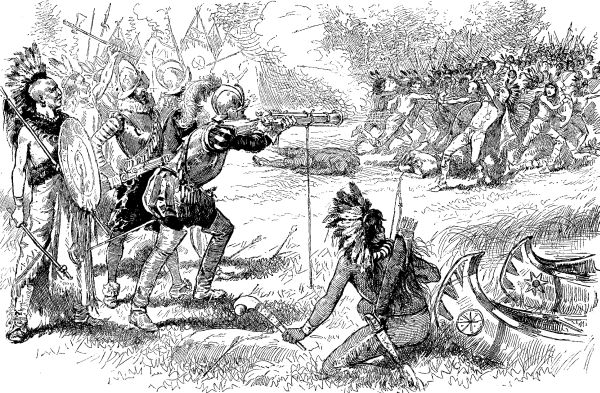
The battle has lasted a minute, but the Iroquois never will forget it. More intense their hate of the Algonquins; and it is the beginning of their implacable enmity to the French: an enmity which is to increase as time goes on, and which will make them the allies of the English through the great struggle which is to take place between France and England—between two races, two languages, two religions, and two civilizations—for supremacy upon this continent.
Seven years passed. Champlain had been back to France, and had returned. He was still thinking of the great empire France would one day control in the Western World. He made his way with a dozen Frenchmen up the Ottawa, past Lake Nippising, to Lake Huron, then turned south to Lake Ontario, sailed along the eastern shore with a great war party of Hurons, to attack their old enemies—the Senecas, tribe of the Iroquois.
It was October. The woods were bright with crimson and magenta hues. The Iroquois had planted corn and pumpkins, and were gathering the harvest when the Hurons burst upon them. They fled to their fortified town on the shore of Lake Canandaigua. It was inclosed by trunks of trees thirty feet high set in the ground. There was a gallery on which they could stand and fire or throw stones upon their assailants.
The Iroquois were the terror of every tribe east of the Mississippi. If Champlain could but conquer them, he would make the power of France felt to the Gulf of Mexico.
All night long the Hurons worked, building a tower of timber upon which the Frenchmen could stand, and pick off with their guns those inside the walls.
Two hundred warriors, with shouts and yells, amid a volley of arrows, drag the tower into position. The Iroquois swarm upon the walls, and the fight begins—the Frenchmen firing from the top of the tower, the Iroquois sending back arrows.
The Hurons light torches, and run up to the palisade with armfuls of dry sticks, and set them on fire; but the Iroquois run with calabashes of water, mount the gallery, and extinguish the flames. Each warrior yells at the top of his voice. They are crazed with excitement. For every whoop of the Hurons, the Iroquois give an angry yell of defiance. Arrows and stones fly. The Iroquois drop one by one before the unseen thunder-bolts from the men in the tower, but seventeen warriors go down before the arrows of the Iroquois. An arrow wounds Champlain in one knee, another pierces his leg. For three hours the fight goes on, when the Hurons, crest-fallen and disheartened, retreat to their camp. They linger five days, and then retire to their canoes, carrying Champlain on a litter all the way to Lake Ontario. The Iroquois steal upon them in their retreat, letting fly volleys of arrows, and yelling like hyenas over the defeat of the Hurons. They have discovered that the white men with their guns, after all, are not invincible.