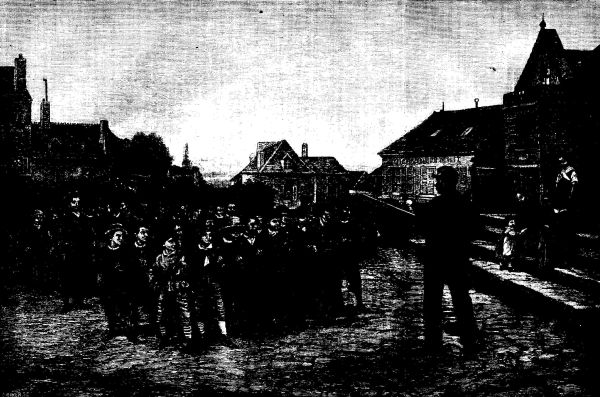
WAS THE DAY A FAILURE?
Reading edition
BY KATE R. McDOWELL.
Had you known the Oliver family, many things would have shown you that Fourth of July was near at hand. Especially did the Oliver wood-shed herald its approach. That heap of tin cans in the corner had accumulated by Maggie the cook's promising the boys that she would open all winter the vegetables, soups, and fruits with greatest care, and see that not one of the cans found its way into the ash-barrel.
"We can't have too many," said Hugh, taking one from the pile; "for you know we all agreed that sending them up was the most fun of all last year. How we did keep them whizzing!"
In another corner stood a good-sized hand-cart.
"Halloo!" exclaimed Hugh; "you've got that on hand in good season. Now are you sure of the place, Dug? If we go so very early, it may be rather dark, you know."
"Oh, I can find it. I was there with Eugene the day before he went away. It's where a basket shop used to be, and the chips are in piles, some of them three feet high. We couldn't ask anything better—ash, too, regular blazers. They'll make a glorious bonfire."
"And as we are going in to Boston in the evening to see the fire-works, why, we must have it early as we can in the morning," remarked Hugh.
The next morning, as Douglas fancied himself on the point of lighting a huge fire-cracker that was to send up an enormous can with a picture of thirty-eight tomatoes on it, Hugh substituted a sound shaking for the expected explosion.
"Hush," said he, in answer to Douglas's remonstrances. "It's been raining."
"Raining!" repeated Douglas, in a tone as though rain on the Fourth of July were an impossible occurrence, and as unseasonable as a snow-storm. "Raining!"
Five minutes later, Hugh and Douglas were out of sight and hearing, as, each with a hand on the cart, they ran lightly down the hill, and turned off at the first side road, walking and running by turns until Douglas announced, "Here we are!"
"And so evidently is somebody else," added Hugh, as two little figures were noticed by the chip pile, rapidly filling a large basket.
"They've come!" the boy had just whispered to his sister.
"Halloo!" cried Douglas. "Goin' to celebrate?"
"No, sir," in a girl's voice; "we uses 'em, sir."
Whether the announcement that any one could be gathering chips without intention of celebrating was a revelation to Douglas, or whether the "sir" pleased him, is uncertain, but something had the effect of making him ignore Hugh's "Do come ahead, Dug, and help fill," as, suiting action to word, his brother threw an armful of the light wood into the cart.
"You don't get up so early as this every morning?" queried Douglas, with surprise.
"Only since the day we heard you and another talk of coming here to get wood for to-day. Since then we've worked pretty steady," said the girl, with a weary smile.
"Hear this, Hugh, will you!" cried Douglas. "They overheard Eugene and me planning to come here, and we're taking their wood."
"Oh no, you're not," said the girl, quickly. "It's nobody's but those as gets it."
"Of course, Dug," frowned Hugh, impatiently. "Don't stand talking there. Come on and fill, can't you. They've probably their wood-house crammed by this time, anyway."
"Oh no," said the girl, turning to Hugh. "It's so far, sir. We can't lug more nor ten baskets a day."
"Far!—where?" still questioned Douglas, as Hugh went to work again.
"You'll see when the fog lifts. The red cottage by the brook."
"What! not 'way down by the mill?"
"Yes, sir," said the girl, as she shook the basket, and piled some more chips on top. "Come, Dick, this is your side," and off they started in the light rain that was beginning to fall.
"Poor little things," said Douglas, "I haven't the heart to take their wood," and he threw some chips indifferently into the cart. "Oh, Hugh, I've a plan," and his face lit up. "Let's give 'em a lift—this cartful; will you?"
Hugh deliberated. It was raining. The bonfire might as well be given up. As the cart was filled, the mill children might as well have it. He only wished it had been his plan instead of Douglas's.
It seemed but an instant later that the chips were shaking merrily in the cart, as the boys started to overtake the little laborers; and they were not entirely quieted when both children were carefully lifted to a seat and told to hold on firmly.
"Ain't it splendid!" whispered Dick Ransom, loudly, to his sister. "Now I can play on me bones and hunt fire-crackers all day; can't I, Jinny?" almost losing his hold in delight at thought of a holiday. "Oh, ain't it splendid! We're 'goin' as fast as Dr. Phisterer, ain't we, sis?"
Jenny smiled. "Won't granny be pleased?" was all she said, while the chips seemed to dance again at her thought.
As you may have guessed, more than one load found its way to the red cottage that morning. Three times did the Oliver boys heap the cart, and three times did little Dick Ransom fancy he was Dr. Phisterer as he sat perched up on the chips, having the best Fourth of July he had ever known.
As the Oliver family was breakfasting it commenced to rain hard.
"The day is going to be a perfect fizzle," announced Hugh. "It'll be no fun staying out; besides, nothing will go off. Imagine being cooped in the house all day!"
The twins looked disconsolate.
"Cheer up," said Douglas. "We can put off some torpedoes in the attic if it comes to the worst; and, best of all, we'll be back with the two Wills in less than no time, and they always think up something."
The boys were at the station soon after, Hugh keeping two bombshells in readiness to be fired the moment the two Wills got off the train.
"I'll signal," said Douglas, his eyes on the off-coming passengers; but he had no need, for there was no Will Edson and no Will Hammond aboard.
"Missed the train," decided Douglas, a shadow on his usually happy face. "Let's see if there's a telegram. Good! there is," as the operator handed him an envelope.
Both read it, and each looked blankly at the other.
"Well, I never thought of their not coming."
"A perfect fizzle," said Hugh, pocketing the bombshells with a frown of disappointment. "The whole day—just as I told you."
"We may as well go home"—in Douglas's voice, but without its usual ring, as they slowly left the waiting-room.
"We mustn't let the weather get the best of us," said Douglas, as they reached home. "We can at least give the others a good time."
So they went up stairs, and played nine-pins with the boys, and were targets for their torpedoes, until the attic rang with merry shouts.
"The little ones are having quite a day, after all," thought Mrs. Oliver, a pleased smile on her face, "and Bridget at last has that long-promised morning out."
Another disappointment came with dinner—a dispatch from Mr. Oliver, stating that he was called on urgent business out of Boston, and preferred the boys did not come into town alone.
"That caps the climax," said Hugh, abruptly leaving the table. "And it's clearing up, too. I should think papa might take one holiday in the year for a change."
The boys had their heads together after dinner. Hugh had made up his mind to accept the situation; indeed, he had done more than that in going on with the train of thought that Douglas's unselfish suggestions of the morning had opened to him.
"Why, it's a splendid idea, Hugh," Douglas was saying. "Maggie will get us cloths and water, and we'll lock the library doors."
"They're fixin' the magic lantern," said the twins, as the children stood three or four deep outside the door.
"P'r'aps tabberlows," ventured little Edith, remembering her success at the Child's Hospital benefit, and determining to stay within call all afternoon.
"Listen," advised the twins.
"Shakspeare here," they heard in Hugh's voice, "and Dickens there. That's just exactly as they were."
"It's tabberlows," sobbed tired Edith on nurse's shoulder, as they all went up for an afternoon nap.
"Yes," said the twins, as they toiled up the stairs after her. "We remember that very one."
It was about four o'clock when Mrs. Oliver came to the door. "What is going on?" she inquired. "Can not you let me in? I've some news for you."
"We're just about through," they called, and a moment later opened the door.
The mother's face expressed just the surprise and pleasure the boys had looked for.
"If you knew how I had been dreading it," said Mrs. Oliver, after they had talked it all over, "I could give you some idea of the relief I feel. I'd been thinking that I must send for Mrs. Sanleitner, and give a day right up to it, have every book taken out, the shelves dusted, and—But you've done it all," her eyes again on the boys' work of a few hours past; "and now that the children are asleep, Bridget can come in with her chamois, and polish the doors."
"Yes, do have her," urged the boys, "and give papa a thorough-going surprise."
"To match the one I have for you," said Mrs. Oliver. "Dr. Phisterer has been here, and asked if I had two boys that would answer to his description, and I had to confess I had. He then went on to say that he and Freddy were going into town at half past four, and asked if he might take charge of my boys as well."
"You don't mean it! Hurrah!" they cried, waving their dusters. "Hope he'll take the bays; they're awfully fast."
"I don't care what he takes, so long as we get in town in time for the fire-works. Dr. Phisterer evidently thinks it is going to clear."
"Clear!" exclaimed Mrs. Oliver, throwing open the blinds. "You're so shut up in here, you don't know the state of the weather."
The sun had come out.
"I wonder if we'll have time— But there he is this minute;" and Douglas rushed out on the piazza, calling, "Dick! Dick!"
The boy approached slowly, his hands behind him. "It's one as has been used," he said, producing a fire-cracker he had picked up in the yard.
"I didn't call you for that," said Douglas, hurriedly. "Didn't know you had it. Here are some good ones—wait; these too. Give some to—"
But two bare feet were flying in the air. The putting into Dick Ransom's hand of three unopened packs of crackers had deadened his sense of anything else. He gave a sort of a whoop as he darted down the mill road, which had the effect of rousing the neighborhood, and of making scores of flying feet the principal things to be seen.
The Oliver boys talked in something of this strain when they got back from town that night:
"Didn't those horses fly!"
"Isn't Dr. Phisterer splendid!"
"I never knew Fred was so nice a fellow."
"Will you ever forget the surprise of the two Wills as we dashed by the Edson's?"
"'Twas rich; and then our meeting father before we'd gone a mile."
"And with Colonel Yale! I thought of the library right away."
"So did I; and you heard how delighted papa was; said he'd been thinking all the way out if he'd only attended to having those books straightened; for Colonel Yale has one of the finest collections, you know."
"Oh yes; but do you know," interrupted Douglas, "that we haven't yet touched upon the best thing of all?"
"What do you mean?" asked Hugh.
"Why, when they put off that big piece of 'General Washington on his Horse,'and the crowd were all 'Ohs' and 'Ahs' over it, I thought, 'If mamma could only be here!' for 'twas so much grander than I expected; and then to look up, and see not only her, but papa and Colonel Yale, each holding up one of the twins, why, I just joined in the hip-hip-hurrah with all my might."
"The twins' verdict of the day wasn't bad?"
"What was it?"
"That they didn't believe anybody could ever have a better Fourth o' Ju' New-Years."
GRANDPA'S DRUM.—Drawn by J. E. Kelly.
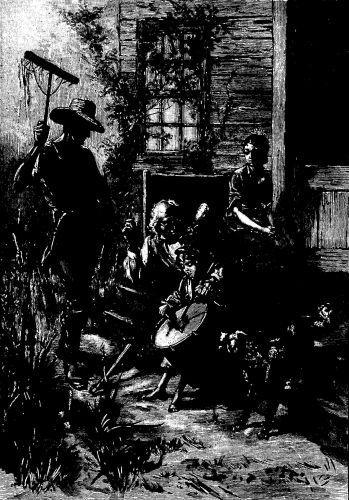
YOUNG SOLDIERS.—"CHARGE BAYONETS!"