THE PEREGRINATING ORCHESTRA.
Reading edition
BY F. E. FRYATT.
That the Popolo family were musical was beyond all question, seeing that every member, from Pietro padre, down to Pepita, the baby, either sung or played on some musical instrument.
Pietro was an aristocrat in his profession, for he had risen from the rank of organ-grinder to the proud eminence of possessor of and performer on six musical instruments; and what is most wonderful, he could play on all six at the same time, to the infinite delight of astonished audiences.
Pietro and his pretty wife Teresa were born in Italy, the land of music. They were poor but ambitious, and having heard that in our country gold was so plenty that one might almost pick it up in the streets, they desired nothing so much as to come here; so they counted their florins, bade their people farewell, and crossed the blue ocean.
Like many other young couples who had come before them, they soon found that the gold was not scattered in the streets, but must be gained only by persistent and patient industry.
Teresa had an old uncle named Luigi Nicolai, who had, by "hook and crook" literally, amassed a snug little fortune. After considerable hunting they found him in lofty but rather dingy rooms in Crosby Street, a quarter Of New York which might well be called New Italy, so many of these people live there.
The meeting between the three was affectionate and lively; and dear me! their tongues travelled so nimbly for the next three hours that I will not attempt to tell you half they said, especially as it was all in Italian; but this I know, they went to ask Luigi's advice, and he gave it.
The result was, the Popolos bought a hand-organ and a tambourine, and commenced business the next morning.
From the very beginning the young people prospered, Teresa's bright eyes and gay bodice, no less than the merry jigs and pathetic wailings of the instrument, serving as so many magnets to attract the coppers from the people's pockets, in spite of the "hard times" of which they were always complaining.
Again it was summer. "Week in and week out" Pietro and his faithful wife had trudged forth in sunshine and storm, and now they had a modest little sum lying by in the savings-bank. And they had something infinitely more precious than silver or gold—little Pepita, a perfect cherub of a babe, with bright black eyes and rings of silken soft hair.
Teresa lost no time in preparing Signorita Pepita for her coming vocation. Was she not prettier and more mischievous than a monkey? hadn't she a voice sweeter than an angel's?
"Carissima mia," she would cry, "will not de monees pour into dese little brown hand as one riv-are?"
And so it proved. Little Pepita, in her mob-cap, was fondled and patted by the women, and run after by the children, who were delighted to leave their pennies in her chubby fist, so that Teresa's tin cup was filled to overflowing; and one day Pietro sold his old barrel-organ, and bought a brand-new one.
To say there was contentment in the Popolo apartments that evening would but faintly express it. Uncle Luigi and some neighbors were invited to participate in the rejoicing. It lessened not the pleasure of the party one whit that the rooms smelled strongly of fried fish and garlic; on the contrary, it increased it by anticipation, for Teresa was famous for her cookery.
Supper, however, was a secondary consideration. The new organ must be looked at first, and Teresa lighted an extra lamp for the occasion, and was made very happy by the praises bestowed upon the new instrument.
Now that Teresa had baby to carry, her tambourine lay idle. This and their prosperity set her to thinking, and the result was a letter to her cousins Andrea and Luisa Felippo, which bade them "come to America, where the people were so fond of music that one might fairly whistle the money out of their pockets."
The Felippos came, Andrea bringing with him his flageolet, and Luisa a small sum of money with which to set up housekeeping in the New World. Nor were they an unwelcome or undesirable addition to the little troupe of musicians. Andrea, with his gold ear-rings, conical hat, and velvet trousers, and Luisa, with her picturesque peasant dress, became paying attractions. They were not announced by flaming handbills, nor were they trumpeted forth in the newspapers like Ole Bull or Wilhelmj, or Patti or Nilsson, but they soon acquired a wide-spread fame of their own on the east side—a fame some day to be increased fourfold by an event, the realization of a secret hope in the breasts of Pietro and Teresa Popolo.
In a certain side street of the city was a curious old shop, in which was stored all sorts of second-hand musical instruments. Now Pietro was of an inventive turn, and possessed considerable mechanical skill.
No one knew but the good wife Teresa where he spent so many evenings, while she sat at home singing and rocking the cradle.
Andrea and Luisa would drop in for a chat. Neighbor Giuseppe frequently inquired for her husband, and to all she would say, smilingly, "Wait; you not know dis night."
Meantime the object of their solicitude was busy with his awl and his knife, and a lot of buckles and straps, preparing the wonderful invention that was to delight the people, and pour in money for the little Pepita's dowry.
Toward the last Teresa was obliged to go with him one or two evenings to help him with the straps and buckles, and to test the working powers of the great— But I must not go ahead of my story. It was still a secret to Andrea and Luisa, but they went to look at It the evening before Pietro decided to exhibit it on the street.
Now, children, guess what It was, if you are able.
THE PEREGRINATING ORCHESTRA AT WORK.
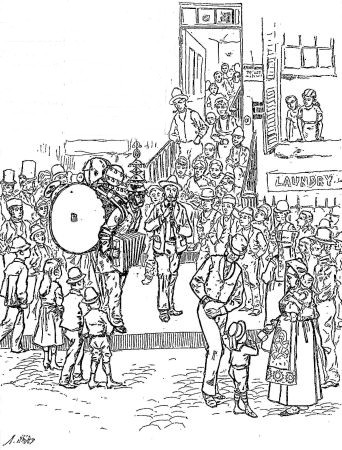
Look at the picture of Pietro, and you will find It on his back and his head, in his hands, and at his feet.
It is the peregrinating orchestra, that is, the travelling or wandering orchestra.
Do you wonder that the women have left their wash-tubs to gaze from the laundry windows, that the tenement-house is emptying its population to look at and listen to this wonderful man and his musical family?
Here you may count six different musical instruments or contrivances, connected with each other by an ingenious set of straps, so that the movement of one sets all the others going in proper time.
Just fancy Pietro is playing the "Star-spangled Banner." He touches D, B, G, the first notes of the air, on the accordion. Up fly the drumsticks; it's time they were busy. "Rub-a-dub," says the snare-drum; "boom, boom, boom," growls the bass-drum; "crash, crash," shriek the cymbals; "chink-a-chink, chink-a-chink," rattles the tambourine; "jingle, jingle," ring the bells from the little tower on his head; while the poor accordion puffs and wails laboriously.
Nor is this all; for Andrea is piping away steadily on his flageolet, Luisa is shaking her tambourine, and Pepita is flourishing her ivory rattle with the silver bells, as pleased with the whole affair as any member of the crowd.
Pietro has indeed reached the top of his profession; for what more could one man be expected to do in the way of music than he is already doing?
Andrea has certainly a good example to follow. He has only to bear in mind, as Pietro did, good old Nicolai's motto, "Poco a poco"—little by little—and he too may prosper.
As for little Pepita, her history is only just begun; but I shouldn't wonder, from the present promising state of affairs, if we should hear of her as the lovely and admired heiress Signorita Pepita Popolo, daughter of the famous Pietro Popolo, the performer, or rather professor, of the peregrinating orchestra.