ABOUT CROTCHETS AND QUAVERS.
Reading edition
BY MRS. JOHN LILLIE.
I well remember the first morning I ever spent in a foreign Conservatory of Music. I arrived just as the Harmony Class had assembled. Beside me sat a slim little girl, with a very pretty pale face and a tired, anxious look. When we had all opened our books, she whispered to me, "May I look over you?"
The expression in her eyes was so piteous that it went to my heart to answer, "You may if you like, dear; only it won't help you. I don't know much of anything myself."
I never shall forget her look as she burst into a silent fit of crying, which for ten minutes stopped the lesson.
Often since I have thought of my little worried companion, who struggled on through the winter, always declaring she could not learn because she could not like it, and I have wondered if there were not a great many young students who feel in the same way.
It is so stupid to hear of semibreves and crotchets and quavers and minims and scales and clefs and scores, and all sorts of terms like "allegro" and "andante" and "con moto" and "adagio," and, indeed, whole Italian sentences, that used to look to me when I was a child like impertinent intrusions into English music.
But have you ever thought whether this system of music which we have to-day may not have had a story—a far-off story almost as entrancing as a fairy tale?
I think had some one told my little friend the story of the system she was toiling to understand, it would all have looked very different, and the study would have been tinged with a real delight.
Now what I propose to tell you is the history of the notes we use. This is really an introduction to the study of thorough-bass, or harmony; and if you make yourself complete master of the first simple rules or ideas, you will find later that many seemingly difficult things come almost instinctively.
You know, of course, how music is written to-day—the five lines; the division of bars; the arrangement of time; the value of notes. Of course you can easily understand that such a perfect system did not come without years of trial of various methods, and centuries of experiment, and a very crude sort of music.
Away back in early Oriental times there was music at festivities, triumphs, or times of mourning, and from the Greeks came the first ideas of harmony. You see, directly music came to be written down, it was evident that some sort of a system had to be established.
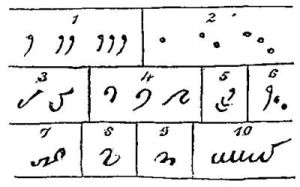
Fig. 1.—The Neumæ.
In very early ages musical sounds were represented by the letters of the alphabet. These were the days when good St. Gregory had singing-schools in ancient Rome. The singers chanted psalms and other church music, which must have been very solemn and beautiful.
This system came to an end, however, and was replaced by the use of a series of characters. These were called neumæ, and each character had a different name. The first was known as the virga, and it was a long single note; the bivirga represented two notes; the trivirga, three; the punctus was a short note, etc.
Now I have culled out of an old volume some illustrations showing how music was written in ancient times, and I want you to study them, and see how curious the methods were which preceded our present perfect system.
Fig. 2.
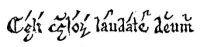
Fig. 1 shows the neumæ. There are ten here, but authorities differ as to the number that were really in use. These neumæ were placed over the words, as shown in Fig. 2. We are not quite certain what melody they here represent, but the solution given underneath is the probable one:

The first idea of making lines occurred in the year 900. But for a long time only one red line was used, and on this the F note was written; the grave sounds were placed below this line, the acute ones above it. How this music looked when written you will see in Fig. 3.
Fig. 3.
Probable Solution.

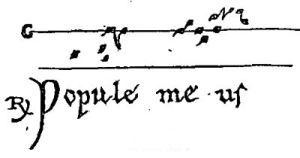
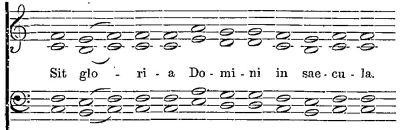
Early in the tenth century a monk in Flanders named Hucbaldus introduced a stave, as we call it, consisting of a great number of lines. At first these lines were not occupied by notes, but by the syllables to be sung, as shown in Fig. 4. In order to show whether the voice was to proceed by a tone or a semi-tone, the letters T and S were introduced. One advantage attending this system was that it could be applied to a scale of any extent, and even used for a number of voices singing at the same time.
Fig. 4.
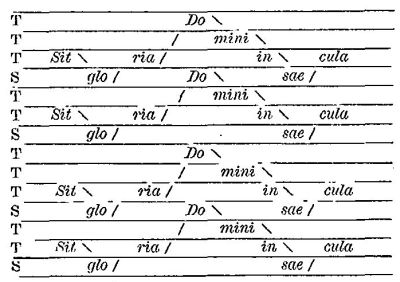
Solution.
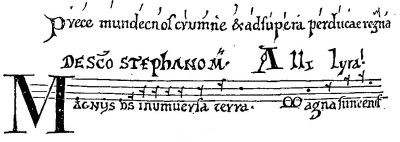
In the Bodleian Library at Oxford, England, is a very precious old book, once used in the cathedral at Winchester. It is MS., of course, and is believed to have been written during the reign of King Ethelred II., who died in 1016. In it we find music written in two different fashions, as shown in Fig. 5. This, then, was the period of change. We have the simple neumæ above the words, and we have actually a four-line stave with notes instead of words.
Fig. 5.
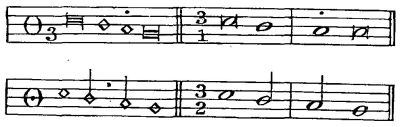
But up to this time all the notes were the same; no difference in length was indicated, and no one who had not heard the melody could sing it from them. Presently the breve, semibreve, and dot, as shown in Fig. 6, began to appear, and thus, little by little, our own system of notation was approached. In 1600 an Italian named Franco de Colonia established a system of time, and in or about 1600 the first idea of a score originated.
Fig. 6.
Do you know what a score is? I was at a concert rehearsal in Paris one day, when a very knowing-looking young person of about fourteen, with a great deal of fur and velvet on, and a large roll of music, came in with her governess, and sat down near me. The orchestra were going to give part of Faust, with some singing, and this pert young lady turned to her governess, saying,
"Don't you want the score, Miss ——," and forthwith she handed her the programme.
Now I think it would have been much wiser for this small person to have first been sure what a score was before she talked of it. The origin of the score was in 1600. A composer named Peri published his Euridice, and he put the instrumental accompaniment below the vocal part. Then he scored bars through the stave, connecting the words and music. Hence we call the music and words together the score of the work.
As music began to progress—as oratorios, masses, and operas were written—it became necessary to establish a definite system of time. It was done gradually; but at last, in Bach's day, it was a carefully arranged science; so many beats to the bar, so much value to each note.
Here we have finally a whole well-disciplined little army of crotchets and quavers and minims and semibreves, and all the big and little notes.
A grand science has come from those first queer little attempts at written music, which we find it so hard to understand to-day, and yet how grateful we ought to be to the patient people of the seventh and tenth centuries who tried to record some of their musical feelings!
When you sit down to your first harmony lesson, try to remember what a wonderful story those little black notes could tell. It is not dull or colorless work. Listen to the word "allegro," which comes in your first piece, I am sure. What does it make you think of? Some long-ago Christmas-tide, when all music was written to glorify God, when out upon the night in the dim cathedral aisles were poured forth the praises of the Infant Lord.
FLOWN.