THE WHITE BEAR OF THE ARCTIC REGIONS.
Reading edition
The polar bear, the nannook of the Esquimaux, has its home in the desolate and icy wastes which border the northern seas. It has many characteristics in common with its brothers which live in warmer countries. It is very sagacious and cunning, sometimes playful, but is not a very savage beast, and will rarely attack a hunter unless in self-defense, or when driven by hunger to fall upon everything which comes in its way. Dr. Kane, the great arctic traveller, says he has himself shot as many as a dozen bears near at hand, and never but once received a charge in return. The hair of the polar bear is very coarse and thick, and white like the snow-banks among which it lives. Its favorite food is the seal, which abounds in the northern regions; it will also eat walrus, but as that animal is very strong, and possesses a pair of formidable tusks, bears are sometimes beaten in their attempts to capture it. Wonderful stories are told of bears mounting to the top of high cliffs and pushing heavy stones down upon the head of some unwary walrus sleeping or sunning himself at the foot, and then rushing down to dispatch the stunned and bruised animal, but arctic travellers disagree upon this point. A very hungry bear will sometimes attack a walrus in the water, for the polar bear is a powerful swimmer; but in his peculiar element—and he is never far from it—the walrus is the best fighter, and his tough hide serves as an almost impenetrable armor.
As seal hunter the polar bear displays much cunning. It will watch patiently for hours in the vicinity of a seal hole in the ice, and the instant its prey comes out to bask in the sun, the sly bear crouches, with its fore-paws doubled up under its body, while with its hind-legs it slowly and noiselessly pushes and hitches itself along toward the desired game. Does the seal raise its head to look around, the bear remains motionless, its color making it hardly distinguishable, until the unsuspecting seal takes another nap. When the bear is near enough, with a sudden movement it seizes the innocent and defenseless victim, and makes a fat feast. Unless it is very hungry, it eats little besides the blubber, leaving the rest for the foxes. It is said that arctic foxes often follow in the path of bears, and gain their entire living from the refuse of the bear's feast.
The nest of the she-bear is a wonderful illustration of instinct, and a proof of the fact that a thick wall of snow is an excellent protection against cold. Toward the month of December the bear selects a spot at the foot of some cliff, where she burrows in the snow, and, remaining quiet, allows the heavy snow-storms to cover her with drifts. The warmth of her body enlarges the hole so that she can move herself, and her breath always keeps a small passage open in the roof of her den. Before retiring to these winter-quarters she eats voraciously, and becomes enormously fat, so that she is able to exist a long time without food. In this snuggery the bear remains until some time in March, when she breaks down the walls of her palace, and comes out to renew her wandering life, with some little white baby bears for her companions, which have been born during her long seclusion.
Many funny and exciting stories are told by arctic travellers of encounters with bears. During Dr. Kane's expedition a scouting party who were away from the ship, and sleeping in a tent on the ice, were awakened by a scratching in the snow outside. On looking out they saw a huge bear reconnoitring the circuit of the tent. Their fire-arms were stacked on the sledge a short distance off, as had they been kept inside the tent, the frost from the men's breath would have clogged them and rendered them useless. There was nothing to be done but to keep quiet, and hope his bearship would go away. But the bear was bent on discovery, and his big head soon appeared through the fold of the tent. Volleys of lucifer matches and burning newspapers which were thrown at him did not disturb him in the least, and he quietly proceeded to make his supper upon the carcass of a seal. One of the men then cut a hole in the rear of the tent, and crawling cautiously out, was able to reach the guns, and soon sent a bullet through the body of the huge beast.
SLAIN IN DEFENSE OF HER YOUNG.
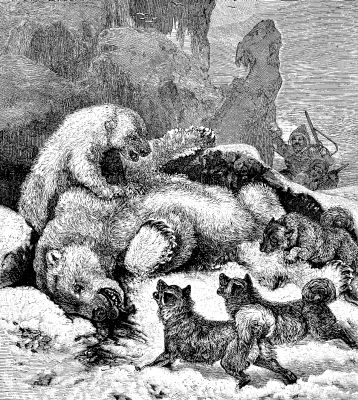
The mother bear's affection for her little ones is so strong that she will lose her life defending them. Two arctic huntsmen once saw a bear taking a promenade on an ice island with two little cubs. Chase was given at once, but the bear did not perceive the hunters until they were within five hundred yards of her. She then stood up on her hind-legs like a dancing bear, gave one good look at her pursuers, and started to run at full speed over the smooth ice, her cubs close at her heels. She had the advantage of the hunters, as the feet of the polar bear are thickly covered with long hair—nature's wise provision to keep the animal from slipping; but the ice soon broke up into a vast expanse of slush, and here the little cubs stuck fast. The faithful mother seized first one and then the other, but proceeded with so much difficulty that the hunters were soon near enough to fire at her. The little ones clung to their mother's dead body, and it was with great difficulty that the hunters succeeded in dragging them to the camp, where they stoutly resisted all friendly advances, and bit and struggled, and roared as loud as they could.
Bears often annoy arctic travellers by breaking open the caches, or store-houses, left along the line of march for return supplies. Dr. Kane relates that he found one of his caches, which had been built with heavy rocks laid together with extreme care, entirely destroyed, the bears apparently having had a grand frolic, rolling about the bread barrels, playing foot-ball with the heavy iron cases of pemmican, and even gnawing to shreds the American flag which surmounted the cache.
Roast bear meat is very palatable and welcome food to travellers in the dreary frozen arctic regions, and at the cry of "Nannook! nannook!" ("A bear! a bear!") from the Esquimaux guides, both men and dogs start in eager pursuit. The bear being white like the snow, it often escapes detection, and Dr. Kane mentions approaching what he thought was a heap of somewhat dingy snow, when he was startled by a "menagerie roar," which sent him running toward the ship, throwing back his mittens, one at a time, to divert the bear's attention.
Polar bears are sometimes found upon floating ice-cakes a hundred miles from land, having been caught during some sudden break up of the vast ice-fields of arctic seas, and every year a dozen or more come drifting down to the northern shores of Iceland, where, ravenous after their long voyage, they fall furiously upon the herds. Their life on shore, however, is very brief, as the inhabitants rise in arms and speedily dispatch them.