THE LITTLE DOLLS' DRESSMAKER.
Reading edition
ADAPTED FROM CHARLES DICKENS.
BY MRS. ZADEL B. GUSTAFSON.
Near the small town of Millbank, and just outside the great city of London, there is a little street called Church Street, and a little square called Smith Square, and where this street and square come together there is a row of houses, rented very cheap, and in one of them lived the little girl whose story I shall try to tell you.
She was about fourteen years old at the time I speak of, and her real name was Fanny Cleaver; but her back was so weak, one of her short legs being shorter than the other, and she was so very little—not having grown any since she was seven years old—that she had given herself the name of Jenny Wren, and by this name every one knew her. The queer little figure, as it hopped about, and the queer but not ugly little face, with its bright gray eyes, made her seem wonderfully like the cheerful, quick, tiny brown bird whose name she had chosen.
Jenny's mother was dead, and Jenny's father was a drunkard. If you do not know what misery comes into a home, whether it is a rich or humble one, when the father has the evil habit of drink, then you can hardly understand what a great trouble little Jenny had to bear, and all alone, too, for her bright mind, her true heart, and her skillful little hands were all the friends Jenny had. What could such a little creature do? She printed the words "Room to Let" with a stubbed pen on a piece of white card-board, and hung it in the window; and it had not hung there many hours before there came a knock at the door. The door flew open by a spring which had been touched inside. Across the narrow entry the parlor door stood open, and showed Jenny Wren sitting in a low, old-fashioned arm-chair, which had a kind of work-bench before it. Jenny looked at the handsome young lady standing on the door-step.
"I can't get up," said she, "because my back's bad and my legs are queer, but I'm the person of the house, miss, and won't you come in?"
"You have a room to let?" said the young lady. "My name is Lizzie Hexam, and I want to hire a room."
"Um-m," said Jenny; she was pressing bits of card-board between her teeth. "Take a seat—but would you please to shut the door first? I can't do it very well myself, because my back's so bad and my legs are so queer."
Lizzie Hexam closed the door, and sat down. She looked kindly at the very little creature, who went on with her work a few moments in silence, gumming together with a camel's-hair brush pieces of card-board and thin wood, which had first been cut out in different shapes. There were scissors and small sharp knives, and bright scraps of velvet, silks, and ribbon, lying on the bench.
"You can't tell me the name of my trade, I'll be bound," said the little creature, with a quick bird-like glance at her visitor.
"You make pincushions?"
Jenny nodded. "What else do I make, miss?"
"Pen-wipers?"
"Ha! ha! What else? Oh, you'll never guess," laughed Jenny.
"You do something with straw, but I don't know what," said Lizzie, pointing to one corner of the bench.
"Well done!" cried Jenny. "Now I'll tell you. I only make pincushions and pen-wipers to use up my waste, but my straw really does belong to my business. Try again. What do I make with my straw?"
"Bonnets?" said Lizzie, after thinking a moment.
"Yes. Fine ladies' bonnets," Jenny said, with a proud nod. "Dolls. I'm a dolls' dressmaker." She put her tiny hand in a very small apron pocket and drew out a card. "There," said she, "read that."
Lizzie took the card, which looked like this:
Miss Jenny Wren,
Dolls' Dressmaker.
Dolls attended at their own residences.
"I hope it's a good business," said Lizzie, smiling at the little creature.
"No. Poorly paid," said Jenny. "And I'm often pressed for time. I had a doll married last week, and was obliged to work all night to get her ready in time, and it's not good for me, on account of my back being so bad and my legs so queer. And they don't take care of their clothes, and they want new fashions every month. One doll I work for has three daughters. Bless you! she's enough to ruin her husband."
Here Jenny laughed, and gave such a sharp look at Lizzie, and hitched her little chin, as if her eyes and chin worked together by the pulling of a wire.
"Are you always so busy?" Lizzie asked, looking with wonder at the small fingers cutting, gumming, and stitching so fast.
"Oh, busier," said Jenny, tossing her head. "I'm slack just now. I finished a large order for mourning clothes the day before yesterday. The doll I worked for had lost a canary-bird, and she wanted very deep mourning." She laid down her work, and reached for a crutch that leaned against the bench. "Come," said she, "I'll show you the room. It's not large, but it's nice, and very cheap."
They went up a small and narrow staircase, and Jenny threw open a small door, and with one step down they were in a little box of a room, but it was neat as wax, and had one white-curtained window just over the front door. Lizzie hired the room at once, and then followed her queer little landlady down into the parlor again.
"Are you alone all day?" said Lizzie. "Don't any of the children in this street—"
"Oh, don't!" said Jenny, with a little cry, as if the word had pricked her. "Don't talk to me of children! I can't bear children! Oh, I know their tricks and their manners!" She said this with an angry shake of her tiny right fist close before her eyes. "Always running about and screeching, they are; always playing and fighting; always skip-skip-skipping on the walk, and chalking it for their games. And that's not all"—shaking her little fist as before. "They go a-calling names through a person's key-hole, and imitating a person's back and legs. Oh, I'll tell you what I'd do to punish 'em if I could. There's doors under the church in the square, black doors leading into dark vaults. I'd like to open one of those doors, and cram 'em all in; and then I'd lock the door, and blow in pepper through the key-hole."
The little creature stopped, quite out of breath.
"Blow in pepper!" said Lizzie. "Why should you do that?"
"To set 'em snee-ee-eezing, and make their eyes water; and then I'd mock 'em through the key-hole, just as they mock a person through a person's key-hole. No; no children for me. Give me grown-ups."
From all this the little dressmaker's new lodger could very well understand that the children of the street, who were strong and well, and could romp and play merrily all day, had not been as thoughtful and kind as they might have been to little Jenny Wren, whose life was so unlike and so much braver than theirs.
In a few days the two girls had become warm friends. Lizzie, who was eighteen years old, earned her living by working in a seamen's outfitter; that is, a shop where sailors' clothes are made. During the daytime Lizzie was away at her work, and Jenny sat at her little work-bench at home, except when she had to peg away on her little crutch to the milliners', or the doll shops, or to the house of some customer for whom she had dressed a doll. At night-fall, when her work was done, the dolls' dressmaker would lean back in her little low arm-chair, with her arms crossed, and sing in a sweet, thoughtful voice, and wait for Lizzie, who at about the same time would come out of her shop in Millbank, and hurry along in the sunset by the river-side until she came to Church Street, and the small house, and the small housekeeper who loved her so much.
"Well, Lizzie-Mizzie-Wizzie," Jenny would say, breaking off in her song, "what's the news out-of-doors?"
"SOMETIMES A VISITOR WOULD DROP IN."
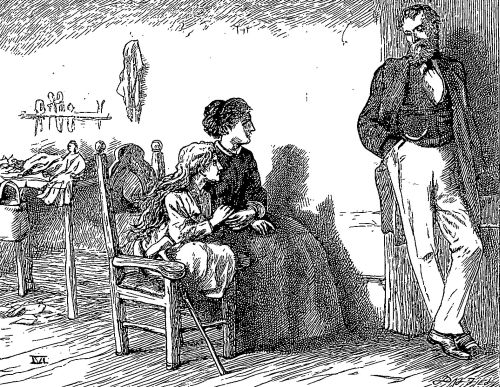
"And what's the news in-doors?" Lizzie would answer, laying her gentle hand on the bright hair, which grew very long and thick and wavy on the head of the little dolls' dressmaker. Then they would have tea together, Lizzie spreading the cloth on the low work-bench, because Jenny could sit at that more easily than at the table, and while they ate they would talk over the day and its work. After supper, Lizzie would move Jenny, chair and all, so that she could look out over the square and into the evening sky, and then sit down beside her. Sometimes a visitor would drop in, perhaps one of Jenny's patrons who took an interest in her, or who had an order to give the little dressmaker.
"This is what I call the best time of the whole day," said Jenny one night, when they were sitting in the pleasant twilight; and then she continued, in a soft, low tone, "I wonder, Lizzie, how it happens that sometimes when I am working here, all alone, in the summer-time, I smell flowers. It isn't a flowery place, you know—it's anything but that. And yet as I sit at work I smell miles of flowers. I smell roses until I think I see them in great heaps—bushels of them around me on the floor—and I put down my hand and expect to make them rustle. I smell the white and the pink May in the hedges, and all sorts of flowers that I never was among, for I've seen very few flowers indeed in my life, my Lizzie-Mizzie-Wizzie."
"You must find it very pleasant, my dear Jenny."
"So I think when it comes. And the birds I hear! Oh!" cried the little creature, holding out her hand and looking up, "how they sing!"
As Jenny talked in this way, with her hand raised, and her eyes wide and bright, she looked quite beautiful, Lizzie thought. They sat silent for some moments, until they heard a shaky, shuffling step on the sidewalk.
Then Jenny spoke in such a different voice. "That's my child coming home, and my child's a bad, troublesome child."
Jenny was speaking of her drunken father. She always called him her child. It seemed as if the little creature felt that the name "father" would in some way be wronged and spoiled in her own thoughts if she gave it to the poor wretch who stumbled over the door-sill where they sat. The name "child" seemed to give her a sort of patience to bear her trouble.
"I would rather you didn't see my child," Jenny said; and Lizzie rose and went up stairs.
[to be continued.]

Little correspondents the wide world round have sent the missives which greet our young readers this week. Some of the letters have been a long while in reaching their destination, and others are from friends not far away. We are sure that every letter will be eagerly read, not excepting the doleful one from a new contributor, which bright eyes will discover tucked snugly in among epistles from more fortunate writers.
Rocklands, Rockhampton, Queensland.
I live in Central Queensland, and have never seen a letter in Harper's Young People from this colony. Our home is in the bush; the trees about here are gum, box, and ironbark. They give hardly any shade, as the leaves hang straight down. There is a lagoon in front of our house. My brother and I want to make a canoe, but we can not procure back numbers of Young People here? If any young reader would send us a copy of No. 26, Vol. I., we would in return send some native seeds or colonial stamps.
It is very hot here, and we hardly ever see frost. Our orange-trees are now loaded with blossoms. We have several hundred pine-apples. I have a little garden of my own, and raise pumpkins, cabbages, rock-melons, beans, and lettuces. My brother is ten, and I am eight and a half years old. We recite lessons to mamma.
We often go riding, and we call our ponies Pip and King Pippin. We have been building a suspension-bridge over a little dam, of saplings and fencing wire. It gave us hard work for several weeks, and papa says it developed our muscles finely.
Bertie Wilkinson.
Alexandria County, Virginia.
I wish to tell all the little folks, like myself, who read Young People, of our home near the capital of the United States. From the heights near our house we have a beautiful view of the cities of Georgetown and Washington; and when the day is fair we can see Sugarloaf Mountain, away up the Potomac River, and down the river to Alexandria and Mount Vernon, the former home of our great General Washington.
We have a beautiful oak grove just back of our house, and a dear little owl lived there for several years. When we children played in the grove, laughing and shouting, he would come out of the hole in the side of the old oak-tree, and listen as if he were wondering what all the noise was about. When we moved back here last spring, the little owl was gone. A family of pretty little red squirrels had taken his place, and I guess they drove him out to seek a home somewhere else. The little usurpers seem very happy in their new home. We often see them playing and skipping about, and as we never molest them, they have grown quite tame, but we all wish the little owl would come back too. He used to do some funny things.
One night mamma went into the parlor, and was very much surprised to find all her beautiful ferns pulled out of the vase. As none of the children had done it, she didn't know what to think. She re-arranged them all nicely in the vase, but on going into the parlor in the morning, found them all scattered over the floor again. She was more surprised than ever, when, on looking up, there sat the little owl on one of the picture-frames, looking as wise as possible out of his great big eyes. He had come down the chimney, mamma thinks. She took him down, and after giving him a good talking to for his badness, carried him out to the grove, and letting him go, away he flew up to his nice warm nest in the old oak-tree again.
I am eleven years old, and have four sisters and two brothers, so you see "we are seven." We have a nice school near by, and last month my teacher gave me the highest number (100) on the roll of honor for deportment and perfect lessons.
I will be so much obliged if you publish my true story of the little owl, for I think it will please those who live in the large cities, and never have a chance of seeing the beautiful country, and the great oak-trees.
Elizabeth T. S.
Heidelberg, Germany.
I have been in Europe for a year and a half. I have been in England and Holland much of the time. I can speak German, and often I play with German children. When I was in Paris I often played with Mr. De Lesseps's children, and I think the picture of them which appeared in Young People is very good. Heidelberg is a very pretty little town surrounded by mountains. I went up the Rhine in a steamboat. It is a beautiful river, and has mountains on both sides, and on these mountains I counted more than sixty castles. I do not like Paris so well as I do New York city, which is my home. The best treat I have every week is the coming of my Young People. For my birthday, I got from mamma a lovely paint-box with eighteen paints and black and white chalk. I am very busy making my Christmas presents. I hope this will be printed, for I wrote once before, and the letter was not published. Now I must say good-by, wishing you a Merry Christmas and Happy New Year.
Mary M.
Pittsburgh, Pennsylvania.
I am a little girl six years old. My name is Susie. Papa read to me Etta M.'s letter, and I think a nice name for her doll would be Pansy. I have three dollies; one is named Nellie and one Julia and one Alice. I like Harper's Young People very much, and my sister Mary, who is eight years old, reads it to Bessie and me. Bessie is four years old. I like "Toby Tyler" best. I got papa to write this for me.
Susie L.
You all remember the letter from Lydia Hargreaves and Lulu Ruckstuhl, which appeared in Our Post-office Box No. 111. Here is an acknowledgment of your answer to that appeal:
Dear "Young People,"—We know you are all anxiously waiting to hear about the Christmas tree at the Home for the Innocents, so we will try and write a nice long letter, and thank you for the many gifts that we have received—for we did receive a great many gifts; we had no idea when we wrote that there were so many kind little boys and girls who read the paper. Monday morning we went out early to the Home, and found some kind ladies, and together with them we dressed the tree with the ornaments you had sent; then around under it we placed the dolls and toys and books. The tree was beautiful, and although the room was small, it showed off very well. In the afternoon the children came marching in, singing "Onward, Christian soldiers." They have two or three little boys that sing so sweetly. But they could hardly finish their song, so eager were they in watching the tree. After a short prayer, the children were each asked, "Now, what will you have?"
After the children were supplied—and there was an abundance, as you were all so liberal; even the little ones in their nurses' arms had their arms full of dolls—Sister Emily, who is the matron, and has another small school where she teaches poor children—took some of the toys, and fixed a tree for them. These poor little children were dumb when they saw the tree. One little girl, when they handed her a doll, said, "Oh, dolly! dolly!" and she did not look at anything else the whole evening but her doll. I wonder if you were all as happy on Christmas as that little girl. I hope so.
Little Bertha R. always calls the paper Harper's Young Family. We think you are the nicest family we ever heard of. If some little boy or girl does not find his or her name below, please don't feel slighted, for we have tried to put all the names down, and you may be sure your package was received and appreciated by some poor child.
Wishing you a Happy New Year, we are yours lovingly,
Lulu G. and Lydia B. Louisville, Kentucky.
Packages were received from Harper & Brothers; Susie Benedict; Fred and Arthur D.; Alice Paige; Maud Duling; Grace Stephens; Fanny Young; Maggie Buch; Annie Lewis; Morril Dunn; Eva Cunningham; Rose Ella Carhart; W. and A. Burke; John and Daisy Cunningham; Lottie, Warren, and Alice Lockwood; Rona R. and "Little Gertrude"; Justin, Tommy, and Isaac Andersen; Jennie and Annie Petman; Willie H. Hazard; Helen McCoy; "Aunt Edna"; Kenneth Murdock; Dolly; May and Tom Barron: Mollie, Effie, and Myrtle Bakewell; Josie Ulmer; L. V. H.; Maud and Lillie Hench; L. H. S. and T. B. S.; Carrie; Nora and Bell; Nellie Portis; Jessie Whitehurst; Daisy; Mortimer Hambem; Louisa L. Tatten; Willie Needham; Mrs. Annie J. Post and Charlie J. Post; Louis Bryant, a check for $1; an unknown friend, $1; Winnifred and Mac Allen; Mrs. T. A. C.; Murray Boyer; Charlie and Willie Patrick; and a package from Canada.
Nukhonuyo.
The readers of Young People would like to hear of my pets. I am five years old, and have two birds (linnets), Tommy and Mrs. Tommy, a white rabbit called Snowball, which is very cunning, and my gray kitty is named Baby Rose. My dollies are a great delight to me. Their names are Daisy, Rosa Posa, and Bessy Bright-Eyes, who is married to Boy Blue, and has a family of five children.
Ethel McP.
Fort Omaha, Nebraska.
I have a little antelope, which my cousin sent to me from Wyoming when it was two weeks old. We had to feed him from a bottle for a long time. He would drink only when the milk was in the bottle. But one day I did not give him anything to drink till night; then I brought out a pan of milk for him, and he tried to drink, but he did not know how, though he soon found out, and it was funny to see him. He would put his nose in and try to eat it, but it couldn't be eaten. He is now a large antelope, and when you touch him he will turn and run after you, and if you don't get on the fence or behind a tree, he will butt you. Sometimes the dogs come in and get after him, and then he will run up to the window and make a noise, so that we will come out and drive the dogs away. When we are at dinner he will come up to the window and lick it and ask to be fed. His tongue is black, and his horns are two inches long, but they hurt when they hit you. His color is a grayish-brown. He sheds his hair every year, and it gets thicker, so that he will be warm for winter.
Frank C. S.
Winsted, Connecticut.
I am a little girl eleven years old. I go to school, but it rains so hard that I could not go to-day. I think Miss Augusta would change her mind about hating cats if she could see mine. He is a large gray one, and weighs ten and one-half pounds. He is very gentle, and I can handle him as I would a baby. When I take him up, he puts both fore-paws each side of my face, and feels it very gently, and he never sticks in his claws. I know he loves me dearly. I have a little sister eight years old. Her name is Gertie. My cousin lives with us, and his name is Wheaton. I take Our Little Ones, and my sister takes the Nursery, and my cousin takes Harper's Young People.
I forgot to tell you all about my cat. When he is hungry, he does not mew, like most cats, but lies down and rolls over, and if we do not notice him, he lies on his back, and waits for us to see him.
Alice E. D.
Jericho, Long Island.
I am a little girl, and I live in the country. I wish to inform Henry F., who is so sorry for the country boys and girls, that his pity is thrown away, for when we go to the city—and I know of none in these parts who have never been there—and return to see the green grass, and fields bedecked with flowers, we think this is far superior to the noisy elevated railroads of the city. We have a great deal of fun here in winter. There is quite a high hill, to which we take our sleds, and ride clear down to the bottom, and then across a pond. Sometimes three or four get on a sled at a time. I go to school, and study reading, spelling, mental and practical arithmetic, geography, grammar, and history. I like history best. I think Harper's Young People is the nicest paper I have ever read. I like the Post-office very much.
Maggie J. L.
Washington, D. C.
I am eleven years old. My mother and little brother have gone down to Florida, so papa and myself are alone at home. A few days ago papa and I went up on top of the Washington Monument. We did not walk up, but rode up on the elevator. It took about five minutes for it to reach the top. On the elevator was a large granite rock weighing over three tons. It went up with us. We saw memorial stones inside of the Monument sent from all parts of the world. When we got to the top we had a very fine view. It was better than the view from the top of the Capitol. They have a net around the top, so if persons should fall, it would not hurt them, as the netting would catch them. Sometimes during the noon hour the men get out on the netting, and smoke just as if they were in a hammock. What a terrible fall they would have if the netting should break! It was about 240 feet high when we were up there. It was so windy that day that you could not stand up on one side of the Monument without holding on to something. At one time the wind shifted, and there were some boards lying out on the net, and a man was walking along on the side where they were. When the wind shifted, it sent the boards flying, and every one of them came down on the man's head, but it did not hurt him, for as soon as they began to tumble on his head, he lay flat down on the wall, so as to keep from being blown away. It made quite an excitement. At first the man would halloo and laugh, and shout, "Joe, Joe, come up here; quick! quick!"
Some men came running up from the inside of the Monument, thinking something dreadful was the matter. We staid up there about an hour. Papa and I walked all around the walls, which were seven feet thick at the top and fifteen at the bottom. Then at the foot of the Monument, in a little house, we saw many more memorial stones. One of the best of them was one that came from Nevada, with the word "Nevada" let into the stone in solid silver, and a motto let into the stone in solid gold. Both the gold and silver came from the mines of Nevada. We enjoyed the trip very much, and I thought some of the readers of Young People might like to have a description of it.
K. B. A. M.
The Nursery, Roseville, Arcadia.
I am a poor little thing. I used to be a beauty and a pet and a darling. But now I am a martyr, and am fading away by degrees. I haven't had a kiss or a kind word from my mamma since Christmas. It's more'n a week since I had my dress off or had on my night-gown at night; and you know it's very unrefreshful to have to wear the same clothes night and day. Still, 's long as I had a bed to sleep in, I didn't complain. But now for three nights I've slept under the sofa, with a lion and a tiger out of Bobby's Noah's ark by my side, and my poor little arms lying out on the floor. Mr. Philip, mamma's big brother, stepped on my thumb last night, and it gives me scruciating pain. Puss carried me all round in her mouth yesterday, and Peg, the terrier, shook me as if I had been a rat and 'most shook away my senses. And I heard Nurse and Norah the waitress talking, and Nurse said, "Oh, Norah, do throw the horrid-looking creature in the ash barrel; it isn't wanted in the nursery now."
Please can not somebody go to my mamma, and ask her to save me from my cruel fate. If she'll never love me any more, won't she give me to somebody who hasn't so many other new favorites? For I think my heart will break.
Florrie's Old Doll.
Grand Rapids, Michigan.
I have been wanting to write to you for a long time. I have a doll. I have a nice brother; his name is Joe. I have a good dog. I have a kitty, and I like her. I have a work-box. I have a basket. I have a money purse. I was happy Christmas morning. I can read in a book. I am a pretty big girl. I hope you will print this letter.
Nan P.
It is a very nice letter, Nan, and we wish we could give you a kiss for it. We hope the little work-box is in good order, that the money purse will never have a hole in it, and that you will be ever so much bigger and just as happy when Christmas shall come again.
One of our little boy readers wants to know why he must always take off his hat when he speaks to a lady. It is a very old custom, and a mark of respect that gentlemen like to show their lady friends. The following little story shows what King George III. of England thought about the matter:
Nearly seven hundred years ago, Philip II. of France summoned King John of England either to trial or to combat for the murder of Prince Arthur. As the latter cared for neither, a gallant soldier named De Courcy, then languishing in prison, was set free that he might undertake the combat not for his King's, but for his country's sake. The fight, however, never took place, for Philip's champion, afraid of the gigantic De Courcy, preferred to sacrifice his honor to risking his life. Being urged by John and Philip, who had come to witness the expected encounter, to give them an exhibition of his strength, De Courcy placed his helmet upon a post, and cleaving it with terrific force, drove his sword so firmly into the wood that none but the striker could withdraw it. "Never," said King John—"never unveil thy bonnet, man, again, before King or subject." Thus the privilege of wearing the hat in presence of the sovereign came to be enjoyed solely by the De Courcys, Earls of Kinsale. They asserted their privilege by wearing their hat for a moment and then uncovering, but the De Courcy of George III.'s reign, not thinking this assertion sufficient, on one occasion wore his court hat all the time he was in the presence of the King. But the third George crushed the display of pride by remarking, "The gentleman has a right to be covered before me; but even King John could give him no right to be covered before ladies."
William T. W.—There seems to be a prevailing opinion that the "shadow" is the best canoe for sailing and paddling. The best-known builders of "shadows" are Everson, of Brooklyn (489 First Street), and the "Racine Canoe-Building Company," of Racine, Wisconsin. The American travelling canoe is an admirable paddling canoe and a fast sailer. One of the best rigs is the "Lord Ross," a modified lateen rig. Two sails are always to be preferred to one large sail.
May G. Hamblin recites perfectly the list of the sovereigns of England, as her mother testifies. George F. and Hattie L. Leet have repeated the same list in its order, with the date of each coronation, and also the five lines and five houses, with the names of the sovereigns included in each.
We wish there were room in the Post-office box to print the nine bright letters kindly sent to us by the principal of a school in Geneva, New York. They were selected by her from a number of letters to Harper's Young People submitted by her pupils as the regular weekly exercise in composition. Their merit is so nearly equal that we do not think it would be fair to choose one for publication and omit the others. So, with cordial thanks to Mrs. L. and to the little correspondents who like the paper so well, we simply print their names, and hope to hear from them again: Neva K., May E. B., Maggie M., Mabel S., Lizzie B., Philip B. R., Georgia H., May R., Carrie E. S.
C. Y. P. R. U.
Thoughts for the Commonplace-Book.—No, Jessie and Mary, I have not forgotten my promise to give you pretty poems and quaint passages now and then for you to copy in your commonplace-book. I have had so many questions to answer that my column has not been long enough for choice extracts, but here to-day are three, which you may take pains to write out in a fair hand, as the old writing-masters used to say. The first quotation I make for you to-day is from Friedrich Ruckert, a great German lyric poet, who was born at Schweinfurt, Bavaria, in 1788, and died at Coburg in 1866. The little poem contains a thought for every member of the C. Y. P. R. U.—a thought worth taking for a life motto:
SOLOMON AND THE SOWER.
In open field King Solomon Beneath the sky sets up his throne; He sees a sower walking, sowing, On every side the seed-corn throwing. "What dost thou there?" exclaimed the King. "The ground can here no harvest bring; Break off from such unwise beginning, Thou'lt get no crop that's worth the winning." The sower hears; his arm he sinks. And, doubtful he stands still and thinks; Then goes he forward, strong and steady, For the wise King this answer ready: "I've nothing else but this one field; I've watched it, labored it, and tilled; What further use of pausing, guessing?— The corn from me, from God the blessing." Translated by N. L. Frothingham.
The next thought is from the Green Book of Mrs. Maria Hare:
"The praises of others may be of use in teaching us not what we are, but what we ought to be."
And now for the last hint for which I can spare space. It is from John Ruskin, and is intended as a reproof for an affectation of modesty. Modesty is always beautiful, but affectation, like other forms of insincerity, is the sign of a defect in character:
"If young ladies really do not want to be seen, they should take care not to let their eyes flash when they dislike what people say; and more than that, it is all nonsense, from beginning to end, about not wanting to be seen. I don't know any more tiresome flower in the borders than your especially 'modest' snow-drop, which one always has to stoop down and take all sorts of tiresome trouble with, and nearly break its poor little head off, before you can see it; and then, half of it is not worth seeing. Girls should be like daisies, nice and white, with an edge of red if you look close; making the ground bright wherever they are; knowing simply and quietly that they do it, and are meant to do it, and that it would be very wrong if they didn't do it. Not want to be seen, indeed!"
May.—Caoutchouc is obtained from plants which afford a milky juice, white as it flows from the plant, but darkening with exposure to the weather. It is commonly called India rubber, and is so useful and convenient an article that civilized people could hardly get along comfortably without it. It forms an important article of commerce. Mexico, Central and South America, and the East Indies are the principal places from which India rubber comes. The East India rubber is the juice of a species of fig-tree. The South American product is taken from the syringe-tree, which is sometimes as high as an eight-story house. To erase pencil marks is one of the uses of India rubber which will occur to you first, and then you will think of water-proof cloaks and shoes, without which we could not go out comfortably in stormy weather. But these only begin to be the list of articles which this obliging gum aids in constructing. Tubes, fire hose, elastic bands, mats, belts for machinery, door springs, etc., are made of it. Combined with sulphur, it forms combs, canes, buttons, picture-frames, brush backs, and surgical instruments, and combined with sulphur and coal tar, and polished like jet, it is used to make beautiful ornamental jewelry.
Lois T.—Yes, when I was a little girl I liked to go to parties; but our parties, dear, always began about three o'clock in the afternoon, and were over at eight, when we were sent for by our mothers, and went home to sleep well and have happy dreams. Such a thing as an evening party, with full dress, was considered too great a dissipation for little folks when I was young.
The boy members of the C. Y. P. R. U. will find in this issue an inspiring sketch, entitled "The Boyhood of Daniel Webster," by Mr. George Cary Eggleston, showing what an "idle boy" could do in the way of astonishing his teacher by his industry; and a pleasant article by Sherwood Ryse, entitled "On Skates," which gives both information and practical suggestions regarding one of our pleasantest winter pastimes. The girl members can not fail to be interested in "The Life of a Little Girl in 1782," by Mrs. Margaret E. Sangster, while they will heartily congratulate themselves on the changes in the way of training children that a century has brought about.
PUZZLES PROM YOUNG CONTRIBUTORS.
No. 1.
ENIGMA.
'Tis black and brown, 'tis blue and gray, 'Tis changeful as an April day; And yet, no matter what they say, 'Tis not without attraction. It has a language all its own. Though mortal never heard its tone; It tells the sufferer's moan, It tells of satisfaction. Inclosed within a narrow cell, It moves on hinge invisible. Securely kept, and guarded well From all approaching danger. It often speaks, yet never talks; It freely runs, but never walks; And every passing thing remarks— In fact, is quite a ranger. It swims, and yet arms has it none; And dances out of very fun Without a leg to stand upon, Or foot to follow after. It has a brother—twin, they say— And when cross-purposes they play, They look the very oddest way; To some they're cause for laughter. As shining crystal it is bright. 'Tis dark or dull as winter night, Its very nature, too, is light, For all were dark without it. It forms the poet's constant theme, It haunts the lover in his dream, And really paramount would seem, So much is said about it. Rip Van Winkle.
No. 2.
TWO EASY DIAMONDS.
1.—1. A letter. 2. A personal pronoun. 3. A word implying command. 4. A tree. 5. A letter.
2.—1. A letter. 2. To decay. 3. Sunny. 4. A vegetable product. 5. A letter.
Fill Buster.
No. 3.
DOUBLE ENIGMA.
In acorn, not in nut.
In depot, not in hut.
In building, not in inn.
In copper, not in tin.
In shark, not in eel.
The whole two reptiles dreaded
Wherever they are seen.
Will A. Mette.
No. 4.
DOUBLE ACROSTIC.
1. Undisturbed. 2. A lovely wild flower. 3. A bed. 4. A large building. 5. A preparation of opium. 6. A domestic animal. 7. A lazy person. 8. Plentifully. 9. A small rodent. 10. A river in South America. 11. A measure. 12. A large bird prized for its feathers. 13. A bird that sings at night. 14. An article of dessert. 15. A covering for the head. 16. To terrify. Finals and primals form the names of two choice flowers.
M. E. N. (11 years old).
ANSWERS TO PUZZLES IN No. 113.
No. 1.
Snow-bird. Sparrow.
No. 2.
1. Chicago. 2. Hartford. 3. Rappahannock. 4. Idaho. 5. Savannah. 6. Tallahassee. 7. Maine. 8. Austin. 9. Susquehanna. Christmas.
No. 3.
H
BET
HELIX
TIN
X
Correct answers to puzzles have been received from Harry D. Lockman, Bessie Eaton, Roy Dempster, Robert Andrews, Jun., William C. Hyatt, "Fill Buster," John Janemich, Harry Graff, Olin A. McAdams, Florence T. Cox, L. E. C., "Lodestar," H. L. Pruyn, Sadie A. Sedgewick, Clare B. Bird, J. C. Krautz.
The answer to the Enigma on page 160 of No. 114 is Drab—Bard.