MY FAMILY OF ORIOLES.
Reading edition
BY W. O. AYRES.
We were down in the country last summer, Fred and I, at Blackberry Farm. Fred is a bright, lively boy, nine years old, and everything there was novelty to him, for he had never been out of the city before, excepting once, when he was too young to notice and remember what he saw. Perhaps no boy who left New York in July enjoyed his vacation more than Fred did his two months at Blackberry Farm.
Among the residents at the farm-house was one Tiglath-Pileser, commonly called Tig for short, though Fred almost always gave him at least one of his two names in full in speaking either to him or of him. Tig was a very handsome Maltese cat, to whom his little mistress, who was very fond of him and very proud of him, had given this name of the old King of Assyria. Now Tig was a very industrious cat; he not only caught mice about the house and barn, but birds also out in the orchard, and once I saw him come in dragging a garter-snake much longer than himself.
One morning Fred came hurrying to the veranda, where I was sitting, closely followed by Tig, both of them in a state of great excitement.
"Oh, Uncle William, Tiglath has killed such a beautiful, beautiful bird! Only see! I made him give it up, though he tried hard to keep it."
And in fact Tig was at that very moment manifesting great dissatisfaction with the condition of things, and a decided determination to recover his property.
"Did you ever see such a beautiful bird, Uncle William? Tiglath-Pileser, keep your foot down. His head is so black and his breast is such a bright orange."
"Yes, Fred, there are few birds of more brilliant plumage which come so far north as New England. It is a Baltimore oriole, though if you should ask any one of the people about here, you would probably be told that it was a hang-bird, or perhaps a fire hang-bird—a name which they give it from the nest which it builds, and from its very bright colors. There are various species of orioles in other countries, but this and the orchard oriole are the only ones which are ever seen in New England."
"But why is he the Baltimore oriole if he comes here to Connecticut to live?"
"Who was the first Governor of the colony of Maryland, Fred?"
"Cecil Calvert, known as Lord Baltimore," replied Fred, in regular school-boy style.
"Yes; and when Lord Baltimore came to America his servants wore a livery of orange with black trimmings; and so this bird, which is very common in Maryland, was called the 'Baltimore oriole' from the colors of his coat. And it is very true of him, as it doubtless was of the servants just mentioned, that his wife and children are much more plainly dressed. The female bird and the young ones wear no such gay colors; you would scarcely suspect that they were part of his family. The people of Baltimore always speak of the oriole as 'our bird,' and if you had kept watch of the papers, Fred, you would have seen that last year in October, when they wanted to have a great festival to celebrate the completion of their splendid water-supply system, they called it 'The Baltimore Oriole Celebration.' Everywhere in the decorations, and in the dresses of the ladies, and in the scarfs and neckties of the gentlemen appeared the black and brilliant gold of the oriole."
"What does he live on, Uncle William? His bill is very smooth, and comes to a round, sharp point. It does not look as though he could bite anything hard."
"Ah! that bill, Fred, is a wonder. And it is not merely for eating that he uses it. You remember I told you the people called him hang-bird, because of the sort of nest he builds. Now that nest he never could build unless he had this curious bill. I must tell you a story about his mode of using his bill; but before I do it we will start out for a walk, and find one of their nests, if possible, even an old one of last year will do. We will put this dead bird away, so that we can examine him again. So, Tig, if you want a bird for your breakfast, you must go and catch another."
"Yes, Tiglath, we can not spare him, even though he does really belong to you. But you can go with us." So away we three went across the fields, Tig, however, soon wandering off in search of a mouse or something.
We had not gone very far before I espied an oriole's nest. It was on the extreme end of the branch of an apple-tree. Fred climbed it, and presently we had the nest in our hands. It was hung where a branch divided into two smaller twigs, and I showed Fred very easily how the bird had begun by fastening an end of a very long soft piece of grass to one of the twigs, and then fastening the other end to the other twig, so that the middle of the grass hung down in a long loop as much as five inches deep. Then it had made another loop, which hung across the first, and of the same depth, but this time the loop was made of a piece of bark. Then there was another loop—actually a string which the bird had found; and so it went on until there were seven or eight loops hanging.
"Now look at these other fibres, Fred, which run across and around the loops, and make a real basket of it. Do you see they go over one loop and under another, and so on? How do you suppose they were put there? There is where that shape of the bill which you noticed comes into play. Come, let us go back to the house, where you can have the bird and the nest together, and I will tell you the story, and you shall see for yourself."
We were soon quietly seated on the veranda, Fred all eagerness for a lesson in ornithology.
"The story is about a family of young orioles, three of them, which I took from their nest just before they were large enough to fly away. Perhaps it was cruel to take them, on their mother's account, but she seemed to care very little about it, and in a few days they would have left her anyway. I carried them to my room, and put them in a large open cage, where I thought they would be as comfortable as possible.
"Knowing that their mother fed them on berries and insects, I gave them plenty of both; but they would not touch them, and all that day they ate nothing. Next morning I tried them again, but it was of no use, and fearing they would starve, I was about to carry them back to the old nest, hoping their mother could do better with them than I could, when an accident showed me how to manage them.
"I was at that time making a collection of birds, and on my working-table lay the body of a robin, whose skin I had just prepared and stuffed. I had one of the little orioles sitting on my finger, when he hopped off on the table, and seeing a piece of the flesh of the robin, he swallowed it on the instant. As he seemed to like that sort of food, I cut him another piece, and down it went like a flash, and I continued to feed him until he could eat no more, and then I brought out his brother and sister and fed them in the same manner.
"After that I had no trouble in keeping them supplied with food, and they grew rapidly. They never ate anything but the flesh of the birds which I was skinning daily. I had no suspicion that such birds would eat meat at all, nor do I think that it is generally known. Neither Mr. Audubon nor any other writer mentions any such habit as belonging to them; but these little fellows were very fond of it, and they certainly throve well on it.
"Of course they were soon strong enough to fly, and I left the door of their cage open for them to come and go as they pleased. They grew very tame, and soon learned to come to the table and get food themselves. They always slept in the cage, but during the day they were everywhere about the room. They grew so much attached to me, that the instant I entered the room every bird with a loud chirrup would start for me with his utmost speed, lighting on the top of my head, on my shoulders, on my finger when I held it out to them—anywhere that they could find a place.
"If a stranger came with me, they were doubtful; would let him take them, and possibly sit a minute on his finger, but nothing more. It was when one of them was sitting on my finger that I first learned that curious use of his bill in nest-building of which I spoke before we went out.
"I had brought him up to my face, when, to my great surprise, he put the point of his bill between my lips, and tried to pry them open. I tried him again, and he did it the second time. I lifted one of the others, the female, and she used her bill in the same manner. It occurred to me at once that that was the way in which they built their nests. I watched them constantly, and became perfectly certain that I was right. They would try to pry open my fingers; if I separated my lips, they would try to part my teeth. They often went up to books, and put in the point of the bill to pry apart the leaves, opening the bill each time with all their strength."
"And is that the way, Uncle William, he has done with this nest? Sure enough, I can see. Look!—look here! that piece of grass has gone under this loop, and then it comes over, and here it goes under again."
"That is just what the bird did, Fred. At first it was all open work, and easy; but as the nest was getting nearly finished, the bill was shoved in under that loop and opened widely, and the grass passed through, and so on one after the other. And the nest could not have been made as you see it now except for that singular way of using the bill.
"But I must tell you more of their doings. They soon learned that their food came from birds, and that it was because I skinned the birds, and they learned just how I did it. If a bird lay on the table, they gave no attention to him till I sat down ready for work. Then every oriole flew immediately to the table; but each one looked around carelessly, as though he had come there by accident, and had nothing particular on his mind. They would walk about, and try to pry open books and whatever else came in their way, and very often I waited some time, just to try them and see what they would do. I would profess to read something, as though skinning a bird was not in my thoughts at all.
"But no; they knew better; one would look up at me, and then another, and then they would run about again, but all the while keeping a sly and cunning watch of me; they knew they would get the better of me in a few minutes. For the instant I took up the bird, turned him on his back, and raised my knife, a rush was made, and there they stood watching for the first bite.
"It was a most comical sight, and time and time again I used to laugh to see them. I parted the bird's feathers with two fingers of my left hand, almost always with an oriole on each finger, while three little heads were thrust close down, and as I cut through the skin; in went three bills digging and tearing for a mouthful each."
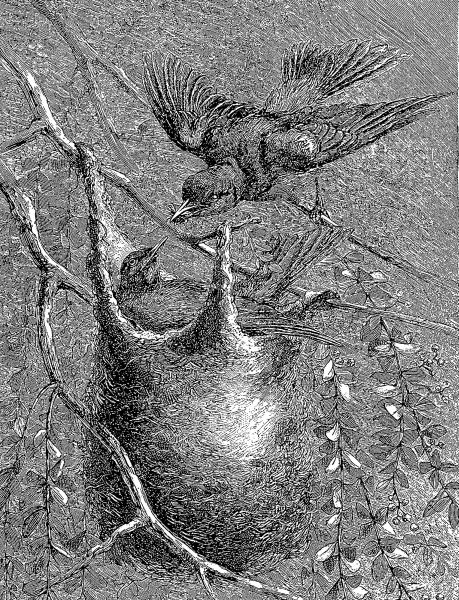
AN ORIOLE FEEDING HIS MATE.
"Oh, Uncle William, what a strange thing! Do tell me what ever became of the little orioles! What did you do with them in the winter, when there were no birds for them to eat?"
"Two of them, the female and one of the males, died very shortly after they were fully grown. The other used to fly in and out of the window as he pleased, into the orchard, and across to the woods. The first time he went out he seemed quite uncomfortable, and called very loudly for me to come and bring him back again, and when I climbed up the apple tree to him, he hopped on my finger, and settled himself down in a contented way that showed he was very glad to be at home again. But after a number of excursions he learned to prefer living out-of-doors, and doubtless went to the South in the autumn with the others of his kind."
"THAT FAIRY HOPE, OH! SHE AWAKED SUCH HAPPY DREAMS."—Drawn by Mrs. Jessie Shepherd.