EMBROIDERY FOR GIRLS.
Reading edition
BY SUSAN HAYES WARD.
No. IV.
gentleman who has done more beautiful art work than any other I have ever known once told me that his principle was first to know the rules of art, and then to do as he saw fit. The one rule of the embroiderer's art that I would specially emphasize for you is that whatever is worth doing at all is worth doing as well as you know how. You do not wish to fill your homes with worthless work. It is vastly better to do but little, and to make that as choice and dainty as possible, for the first charm of embroidery is its nicety.
Fig. 14.
Having thus put you on your guard, let me tell you how the New England stitch may be modified and rendered more simple. This modified stitch is only for those who are so painstaking that they can be trusted never to slight their work except judiciously, for no lazy needle-woman could resist the fascination of this easiest of embroidery stitches. She would never use another. If you can not trust yourself, skip this article.
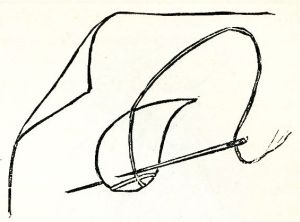
Take your first stitch as in Fig. 10, then, instead of reversing the stitch and pushing the needle from you, point the needle toward you as shown in Fig. 14.
Of course when each stitch is taken naturally with the needle pointing toward you, the work reels off wonderfully fast, but the stitch loses in effect, for instead of the pretty double twist, you now have the needle cross the thread but once, making a single twist not nearly so pretty when examined closely. (For work that is only to have its little day, like a tidy or a bureau-cover, I should surely use this modified form of the stitch. Life is too short to spend time in pushing your needle backward, when pushing it forward will do as well. For nice work, for hangings before choice little cabinets, or for a bed-spread that may last a century, take the stitch the old way; but for work that is not meant to last a lifetime, use the easiest stitch possible.)
Fig. 15.

Fig. 15 is meant to be repeated for the ends of a table-scarf or bureau-cover, with the border in two shades; another line can be added a half-inch below 2 to give weight to the border.
The lines 1 and 2 are to be worked in stem stitch, the space a filled with a darker and b with a lighter shade; c is not filled in. The design (Fig. 16) can be colored to suit your room or the shade of the stuff on which it is worked, though old gold, soft yellows, pinks, and blues would be pretty for the flowers, the border being in old golds or blues.
Fig. 16.
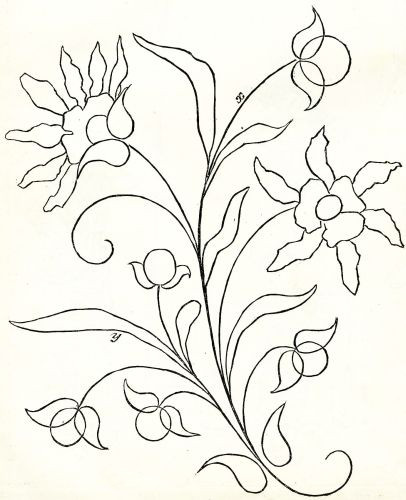
This design would do well scattered, or, to use the technical word, powdered, over a small curtain, alternating it with small sprays from the design like x or y, or for the corners of a small table-cover.