THE NEWSBOYS' HOME,
Reading edition
AND HOW IT HELPED JOE.
BY F. E. FRYATT.
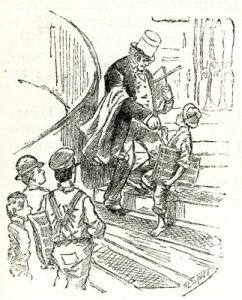
"Here's yer five o'clock e-dishun, Post, Express, an' Commercial—full account of Gen-er-ull Garfield on the tow-path!" shouted three urchins, planting themselves directly before a portly old gentleman who was slowly puffing up stairs to the elevated railway.
"Clear out, you little scamps!" grumbled the besieged, adding, more amiably, as he caught sight of the youngest of the three, "give me a Post, sonny, and change this quarter."
"Thankee, sur," said Joe Brown, the lucky competitor, diving into the deepest of pockets for the needful coppers, then dashing pell-mell after his comrades in pursuit of a probable customer.
"Post, Express, an' Commercial—full account of Gen-er-ull Garfield!" still rang the cry an hour later, while in and out, up and down and across the streets, darted the lithe, eager little fellows, until the crowd began to thin out, the papers were nearly all sold, and a distant bell reminded them that if they wanted their six-cent supper, it was high time to be off for the Lodging-House.
Let us follow them as they hasten to the lofty brick building which stands on the triangle formed by the meeting of New Chambers, Duane, and North William streets. The great doors are wide open; we pass in with Joe, his two comrades, and half a score of bustling, laughing lads, mount two long flights of stone steps, and enter the large lecture or school room on the second story, with its rows of desks and benches, and the convenient lockers or closets against the walls.
BEING REGISTERED.
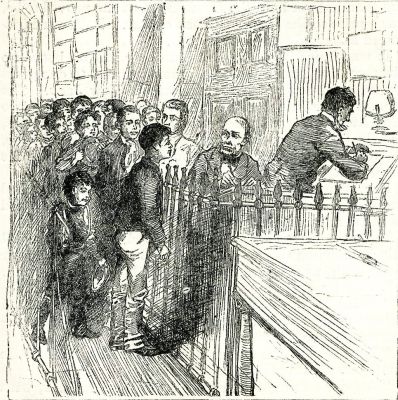
One by one, in orderly fashion, the boys step within the iron railing, state their names, ages, and parentage to the clerk, receive numbered keys to their lockers, and pass on.
Here a lad locks up his bundle of unsold papers until after supper, another his blacking-box and brushes, a third his hat and jacket; then away for the lavatory, with its long ranges of foot and plunge baths, and its shining basins under the bright copper faucets.
Business must be unusually brisk, or the demands of the "inner man" unusually lively, if one may judge by the celerity with which the boys appear, brushed and combed and ruddy-faced, for supper.
"Hurry up, Bill, and get yer ticket," cried Joe, passing up to the desk, and depositing twelve cents for bed and supper, then taking his place at the end of the line that was already on the move.
"Sixty, sixty-one, two, three, four," calls the Superintendent as the boys file past, and the tramp of descending feet comes to us through the open doorway.
AT SUPPER.
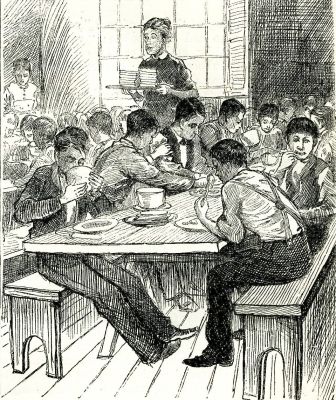
By the time we reach the dining-room, with its expanse of polished floors and high column-supported ceiling, seventy or eighty boys are seated at long tables, which present an inviting appearance with their white enamelled cloths, platters piled high with bread, and rows of capacious bowls steaming with fragrant tea.
What a busy scene it is for the time! the bread mountains diminish like snow before the sun, the tea fountains vanish like rain on thirsty soil, and the young women attendants, in their neat dresses and aprons, pass to and fro continually with their renewing bread trays and flagons of tea and syrup.
The majority of the boys laugh and chatter like magpies, but here and there sits a silent little news merchant, whose mind, absorbed with visions of "extras," hurries him on to the wished-for future.
See, there they go, half a dozen of them, with quick steps and anxious faces; they will notify the watchmen that they must keep late hours, and pay the required trifle for retaining their locker keys beyond time. Up to midnight their shrill cries will ring through the gas-lighted thoroughfares of the great city, while many—or, indeed, most—of the young readers of this paper are dreaming happy dreams in bed.
It is now nearly eight o'clock, supper is over, and the boys disperse for the short evening left them before bed-time; for all must be within-doors at half past nine, or pay a fine.
THE GYMNASIUM.
Some of the boys go out for a walk, others, I am sorry to say, to spend their earnings at the cheap theatres and shows of the city; but the sensible ones drop their spare pennies or silver coins into the odd-looking savings-bank near the door, and hasten up stairs to the reading-room or the gymnasium. Let us follow some of them to the latter.
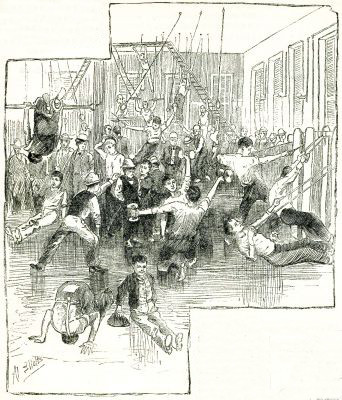
What a jolly place it is! One could have no end of fun with its horizontal and parallel bars, its rings, ladders, and flying trapeze: it is better than a circus.
There's a race for you already on that long ladder rising from one side of the room, crossing over, and coming down on the other slantwise. Johnnie Wilson has started at the north end, Billy Jones at the south end. There they go, hand over hand! Now they meet overhead in the middle. I declare, Billy's feet touch the floor first: he has beaten by three rounds.
"Hurrah for Billy! three cheers for Billy Jones!" shout the boys who are watching them.
Yonder three lads are trying their strength lifting iron weights in the corner. Tough work they find it, and soon leave to take a look at a comrade who hangs by his feet from a horizontal bar.
Now he swings back and forth before the little group, who are eager to risk their necks in the wonderful experiment.
See! he lets go, and with a dexterous swing catches by his hands, and drops safe and sound before his admirers.
This is nothing to what is going on yonder, where two boys are performing prodigious feats on the flying trapeze, squirming and twisting, and turning somersaults, hanging by their chins, then by their toes, and then by each other, until the looker-on trembles and grows dizzy.
Let us look for wee Joe Brown; he is not here, neither is he in the reading-room below-stairs, where a dozen or more youngsters are amusing themselves quietly, some reading story-books and illustrated papers, others playing checkers or dominos.
I'll tell you where Joe is. He is one of the early birds. Since four o'clock in the morning, when he went out for his daily papers, only when he ate his simple meals, his busy little feet have paddled about the great city, his childish voice has shrilled forth the familiar cry, "Sun, Herald, an' Tri-bune, Post, 'Xpress, an' Commercial," until, too sleepy to read, too weary for even the fascination of watching the flying "trapezeists," he sought the solid comfort of the dormitory.
THE DORMITORY.
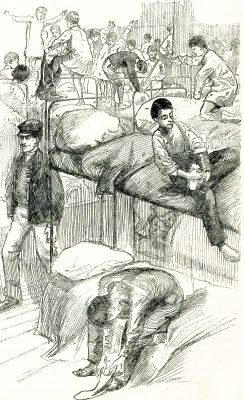
Look in at the long tiers of beds one above another, like berths in a steam-boat. In number 69 you will find Joe sleeping the sleep of the innocent and weary.
Would not the young people like to hear how Joe happens to be in the Newsboys' Home? I'll tell you. It all came about through Lenny Williams, who is a "call-boy" at one of the small theatres up town, and lives at the Duane Street Lodging-House.
Very late one stormy night in midwinter, as he was coming home from his work, he fancied he heard a child sobbing, and stopping, he discovered by the feeble flickering light of a gas lamp a small figure crouching in the low doorway of one of the old-fashioned shops of that quarter.
His heart gave a great bound of pity and sympathy for the poor homeless little creature so tattered and forlorn. His own jacket was wet without, but within it was dry and warm. To pull it off and place it around the shoulders of the shivering child was but the work of an instant.
"Get up on your pins, little 'un, an' come along with me," said Lenny, assisting him, and buttoning the jacket close under his throat.
With difficulty the poor child, whom you must have guessed before this was Joe Brown, rose and limped along, for he was stiff with cold and weak with hunger.
Before they reached the Lodging-House, Lenny won from him his pitiful story—how, driven from home by the cruelty of his drunken father and step-mother, he had wandered the streets from day to day, managing by dint of begging and running errands, and sleeping in dark corners known only to the wretched and homeless, to keep soul and body together while the fine weather lasted.
A kind old apple woman only yesterday had given him a basket, and some matches to sell; but then came the cold, pitiless rain, and nobody wanted to buy anything; so he had strayed from street to street, until he had lost his way in the dark, and sat down, utterly worn out and famished, where Lenny found him.
"Yes, chicken," said Lenny, as he finished his sad story, "you'd hev froze to death as sure as a gun. But cheer up; here we're home at last."
Never will Joe forget the glow and warmth of the "drying-room" into which he was led. There were three other boys there hanging up their wet clothes to dry.
And wasn't the bath warm and delightful into which they plunged him!
For a long time Joe could not understand why there should be a clean, whole shirt, a jacket and trousers, socks and shoes, all ready for such a poor miserable little stranger.
And the bowl of hot bread and milk, what a luxury it was!—surely he must be in heaven, the place where all good, unhappy boys go when they die. Perhaps he had really died, out in that pitiless storm, and was there? He rubbed his eyes, and expected to see wings, and was disappointed at not finding them.
The books of the institution tell how the seven-year-old child, deserted by his inhuman parents, was taken within the sheltering doors of the Lodging-House; but in another book the recording angel has written how a simple "call-boy" on that dark night did the will of his heavenly Master.
That night Joe had a blessed sleep in his little bed with its nice sheets and downy "comfortables," so that when he woke the next morning he was a new little man; but after breakfast he was happier than a king, for the Superintendent loaned him a small sum of money to buy some newspapers.
Two or three of the boys volunteered to teach him "lots" about selling them; and they did, for before night he had sold two sets of morning and evening papers.
A prouder, more independent little fellow than Joe can not be found anywhere, because he not only earns his meals and lodging, and helps a comrade occasionally, but every night drops pennies or nickels into savings-box No. 90.
This he has been doing for some months; at the end of each he receives ten per cent. interest.
Joe, being studious and ambitious, faithfully attends the evening schools; he does not mean to grow up to be an ignorant, useless man; besides, he must make the most of his time, for he indulges in the dream of a happy home in the country, and though he hasn't told me, I am sure he is saving up that money to buy a good stock of books to take with him.