DECORATIONS FOR CHRISTMAS.
Reading edition
BY A. W. ROBERTS.
Fig. 1.
A great variety of material abounds in our woods that can be utilized for Christmas decorations.
All trees, shrubs, mosses, and lichens that are evergreen during the winter months, such as holly, ink-berry, laurels, hemlocks, cedars, spruces, arbor vitæ, are used at Christmas-time for in-door ornamentation. Then come the club-mosses (Lycopodiums), particularly the one known as "bouquet-green," and ground-pine, which are useful for the more delicate and smaller designs. Again, we have the wood mosses and wood lichens, pressed native ferns and autumn leaves; and, if the woods are not accessible, from our own gardens many cultivated evergreens can be obtained, such as box, arbor vitæ, rhododendron, ivy, juniper, etc.
Where it is desirable to use bright colors to lighten up the sombreness of some of the greens, our native berries can be used to great advantage. In the woods are to be found the partridge-berries, bitter-sweet, rose-berries, black alder, holly-berries, cedar-berries, cranberries, and sumac. Dried grasses and everlasting-flowers can be pressed into service. For very brilliant effects gold-leaf, gold paper, and frosting (obtainable at paint stores) are used.
Fig. 2.
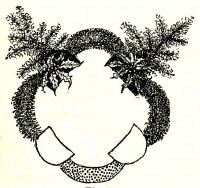
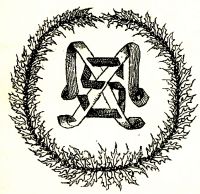
Fig. 1 represents a simple wreath of holly leaves and berries, sewn on to a circular piece of pasteboard, which was first coated with calcimine of a delicate light blue, on which, before the glue contained in the calcimine dried, a coating of white frosting was dusted. The monogram XMS is drawn on drawing-paper highly illuminated with gold-leaf and brilliant colors, after which it is cut out, and fastened in position.
Fig. 2 consists of a foundation of pasteboard, shaped as shown in the illustration. The four outside curves are perforated with a darning-needle. These perforations are desirable when the bouquet-green is to be fastened on in raised compact masses. The four crescent-shaped pieces of board are colored white, and coated with white frosting. On the crescents are sewn sprays of ivy and bunches of bright red berries. From the outer edge of the crescents radiate branches of hemlock or fronds of dried ferns. For the legend in the centre the monogram I.H.S.,[2] or "A merry Christmas to all," cut out in gold paper, looks well.
Fig. 3.
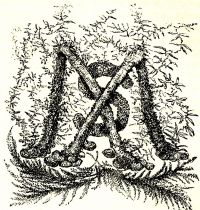
Fig. 3 consists of a combination of branches of apple wood, or other wood of rich colors and texture, neatly joined together so as to form the letters M and X. (In selecting the wood always choose that which has the heaviest growth of lichens and mosses.)
For the ornamentation of the rustic monogram I use wood and rock lichens, fungi, Spanish moss, and pressed climbing fern. Holes are bored into the rustic letters, into which are inserted small branches of holly in full berry. By trimming the monogram on both sides it looks very effective when hung between the folding-doors of a parlor, where the climbing fern may be trained out (on fine wires or green threads) in all directions, so as to form a triumphal archway. By using large fungi for the feet of the letters M and X (as shown in the illustration), the monogram can be used as a mantel-piece ornament, training fern and ivy from it and over picture-frames. The letter S in the monogram is composed of immortelles.
Fig. 4.
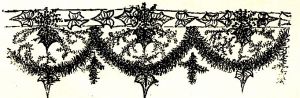
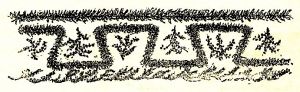
Fig. 4 consists of a narrow strip of white muslin, on which is first drawn with a pencil in outline the design to be worked in evergreens. For this purpose only the finer and lighter evergreens can be used, as the intention of this design is to form a bordering for the angle formed by the wall and ceiling. This wall drapery is heavily trimmed with berries, to cause it to hang close to the wall, and at the same time to obtain richer effects of color. The evergreens and berries are fastened to the muslin with thread and needle.
Fig. 5 is composed of a strip of card-board covered with gold paper on which the evergreens are sewed. This style of ornamentation is used for covering the frames of pictures.
Fig. 5.
Natural flowers formed into groups can be made to produce very beautiful effects for the mantel-piece and corner brackets of a room. The pots should be hidden by covering them with evergreens, or the wood moss that grows on the trunks of trees. For mounting berries fine wire will be found very useful. I have always used, and with good effect, the rich brown cones of evergreens and birches for Christmas decorations.
Very rich and heavy effects of color can be produced by using dry colors for backgrounds in the following manner. On the face of the pasteboard on which you intend to work the evergreen design lay a thin coating of hot glue; before the glue dries or chills dust on dry ultramarine blue, or any of the lakes, or chrome greens. As soon as the glue has set, blow off the remaining loose color, and the result will be a field of rich "dead" color. To make the effect still more brilliant, touch up the blues and lakes with slashings of gold-leaf ("Dutch metal" will answer every purpose), fastening the gold-leaf with glue. Don't plaster it down, but put it on loose, so that it stands out from the field of color.