OUR POST-OFFICE BOX.
Reading edition
We have very great pleasure in publishing a letter from the kind lady who has charge of the ward in which our Young People's Cot will be placed when sufficient money shall have been contributed to endow it. We think that perhaps after reading this letter, with its touching description of the ward, and suggestive account of the manner in which the little sick children play at nursing their dolls, some of you who have not yet done so may like to give a Christmas offering to aid this good work. When we shall be so happy as to hear that the cot is really ours, we will take a special interest in the little ones who may occupy it.
St. Mary's Free Hospital for Children, 407 West Thirty-fourth Street, New York, November, 1881.
My dear Young People,—It has been suggested to me that you would like to hear something of the "Holy Innocents' Ward" from one who knows all about it. Now I certainly "know all about it," for I see it at almost every hour of the day, and very often at different hours of the night. But whether I can say what will be of interest to you is to me a very doubtful question. You have already been told who furnished the ward; but I wonder how many have really seen it, and know just what it is like? I am sure that some of you have, but for the benefit of those who live far away, I will give a little description; and when We come to tell of your own cot, you will have perhaps a better understanding as to its place in the ward, etc., etc.
The "Holy Innocents' Ward," then, is a long room, with two large windows at either end reaching almost from the ceiling to the floor. Outside of these windows are piazzas, where in warm weather the little ones can sit in their tiny rocking or arm chairs, and listen to the "moosic man" or shake hands with a favorite monkey who climbs up on the outside of the house, and to whom they always give a few pennies, and a drink from one of their own mugs.
In cold weather the children—those who are able to be up, of course—can sit close to the windows inside, and see all that is taking place in the street. On either side of the ward are rows of blue cribs with brass knobs on the corners, and hanging over each crib is a little blue frame holding a card, on which is written the name of the child who sleeps in the cot. Between each crib is a small square table with a shelf underneath. The shelves of these tables are for toys, and the tops are used for a great many different purposes. Sometimes you would find on one of them a tiny red tray holding a cup of milk-punch, on another a glass of flowers, or at times a queer-looking deep tray, in which are kept lint, bandages, plaster, etc. In addition to the tables beside the beds, each crib has a little table that stands on it—something like a butler's tray, with four legs, only the little ledge is around three sides instead of four. These "bed-tables," as they are called, can be put close up to the children, and were intended to hold the toys, scrap-books, and the blocks out of which are built most marvellous houses, that come down with a terrible "bang"—the louder the better, (Occasionally a small child has been discovered sitting on one of these little tables; but that, of course, is "out of order," although it may be a good symptom of returning health.)
There is still another table, that stands on the floor, and around which several children can sit and play together; sometimes—in fact, often-times—the favorite play is "Hospital"; and I have often seen very sick dolls, who are treated in the most skillful manner. They are probed and bandaged, have their pulses and temperatures taken, are given "mick-punce" and "q'nine," have weights tied to their feet, and poultices on their chests. The ward also contains a small organ and a large music-box, and around the walls are several pretty pictures. Now can you see it all?—the long room; the blue cribs with brass knobs; the little ones in bed with bright red jackets on; those able to be up sitting in the tiny chairs, and wearing gray wrappers bound with red, and fastened with red buttons; the sun shining through the long windows on the little ones sitting near or at the "play table," and perhaps just lighting up "Young People's Cot"; the little organ, the music-box, and the pictures? I hope so; and when I write again, I will tell you just where your own cot is.
S.
Terra Ceia Island.
I am a little girl from New York who came to this beautiful island a year ago in October with mamma for her health. The climate is lovely, and has benefited mamma very much, for which I feel repaid, and am willing to be away from other children for her sake. There are only two little children besides myself on the island, and sometimes weeks pass and I do not see a child's face. We live in the midst of a beautiful orange grove, and have one of the largest and handsomest-looking orange-trees in the State. Last year it bore 4200 oranges; this year not as many. Others of our trees are bearing from 800 to 2000 each. We have fine bananas, figs in their season, guavas, plums, lemons, and other fruits of which we are very fond. The ivory-billed woodpecker steals our figs, and the pretty, naughty redbirds pick all the fruits and vegetables. Meat is scarce here sometimes, and my uncle has to shoot the quails or the pink curlews, with their beautiful spoon-bills, and the blue herons, with their lovely large human-looking eyes. We must sometimes have them to take the place of fresh meat, but not often, as uncle dislikes killing the beautiful birds, which never do any one any harm. The redbirds sing sweetly. The little phœbe-birds call "Phœbe" all day long. The mocking-birds are the first to sing in the morning, and the last at night. In the summer the quails say, "Bob White," "Bob White." The beautiful gray mourning doves come around a little later, and at night a bird that takes the place of the Northern whip-poor-will calls out, "Whip the widow," in the same strain as the whip-poor-will. I am very fond of my island home. There is a beautiful bay that our grove and house front on, called Terra Ceia Bay, about five miles long, and in some places nearly two miles wide. I have a small row-boat that I go out in with mamma, and sometimes I stand in the stern of the boat, with a long pole, and pole the boat in shallow water. The beautiful sunsets we see on the water sometimes make me wish other children could enjoy natural scenery and the wonders of the sky as I see them here. We have very fine fish called mullet that are caught with a cast net, besides other kinds, clams, and oysters.
I have four cats, named Punch and Judy (because I thought those names different to others in general) and Beauty and Topsy, and a dog named Jip. One day Jip was barking furiously, and we went to see what was the matter, and for the first time he saw himself in the looking-glass. We had a hearty laugh.
Another day he made a great deal of noise when a praying mantis, shaped similar to our large Southern grasshoppers, but with a waist similar to a wasp, instead of its being on all four legs, was standing up straight, with its fore-legs raised in an attitude of devotion, looking right at the dog. When we came, it turned around with its head, just like a Shaker woman, and looked first at one of us and then at the other, without moving its body.
I was so interested in "Toby Tyler," and knowing that Mr. Otis must like children, and as you say he is now through our State travelling in his little steam-yacht, please give him an invitation to call on us and eat some of our fine oranges, as we will have them until April. Aunt and uncle and mamma join in the invitation. He—that is, Mr. Otis—can sail from Key West or Cedar Keys into the Gulf of Mexico, then into Tampa Bay, into the mouth of Manatee River, through the cut-off into our Terra Ceia Bay. Or he could keep in the Manatee River to Palma Sola, at the Warner Mill, and they could show him through the small cut-off into our bay. We are very hospitable, and have wanted to see him ever since he wrote "Toby Tyler," and about his pet bird.
I was afraid Jimmy Brown was on a long vacation. So long as he has to be in so much trouble, please ask him to tell his tales of woe oftener, and relieve his mind.
Sometimes I go over to Manatee after my paper with my uncle. We go in a sail-boat, and I enjoy sailing so much! I wanted to have a little vegetable garden of my own, so uncle let me have a patch, and I set out fifty tomato plants, just to see what a little girl could do; they are growing finely, and putting on blossoms now—not all, but part of them.
Mamma teaches me, as there is no school near us short of six miles, and I would have to go in a sail-boat to attend school. I have most of my time taken up, as mamma teaches me to be industrious, and wishes me to try to grow up a smart girl, as it would have pleased papa so much, had God permitted him to live and know his little girl was trying to do right.
Florence M. Brewster, P. O. Braidentown, Manatee Co., Fla.
The verses which follow were sent by a little reader:
THE CHRYSANTHEMUM'S SONG TO THE MOON.
I stand in a little box At a lowly cottage door; I grow and grow and grow and grow Till I can grow no more. My leaves are the brightest green, My flowers the purest white, Of any flowers you've ever seen, O Moon, so large and bright. O Moon up there so high, As you nightly roll along, Please don't forget me in my box As I sing my little song. Annie L. C.
Milford, Connecticut.
I wrote a letter once before, but it wasn't published. I know you can not publish all the letters that are sent you. I thought I would try again. My brother has two pet owls. He feeds them on raw meat. They are very pretty. At some times they look very small, and at other times they stick their feathers out and look like a ball of feathers. Their eyes are very large; they have two eyelids. The under one is so thin that they can see through it. The upper one is covered with little feathers. Besides raw meat, they eat mice. We catch them alive, and when we put one in the cage, one of the owls will jump on it, and catch it in his claws, and bite it in the back of its neck, and kill it. He then tears pieces off, and eats them. We have some bantams. The old bantam hen lays her eggs in the corner of the kitchen in a basket. Last spring she sat on six eggs in the basket in the kitchen, and hatched five chickens, but one of them died, so we have only four now.
Julia B. S.
St. John's, Michigan.
I want to tell you about an adventure that happened in Florida last winter. A gentleman and a boy went up Dunn's Lake on a fishing expedition. When they got as far as Haw Creek they found that alligators were plenty there, having come out to sun themselves, as is their custom in the early spring. Mr. Lee succeeded in shooting a good-sized one, about twelve feet long, and after much trouble he was got into the boat; but as he took up so much room, one of the men had to sit upon the alligator, supposing him to be dead, of course. They rowed as fast as possible toward town, but had not gone far when his 'gatorship gave a mighty jump, throwing the man up into the air, and nearly overturning the boat. However, they reached the town in safety, and hauled him up on the dock, where he lay for some time on exhibition to an admiring crowd. My friend John, being of an inquiring turn of mind, leaned over the animal to take a close inspection of him, when he gave a flop with his tail which knocked John quite over.
This is a true story, and I hope it will be printed.
Robert E. C.
Sometimes letters reach Our Post-office Box in rather a roundabout way. For instance, the other day we opened an envelope bearing the post-mark Orange, Los Angeles County, California. We found in it a letter from a gentleman living there, who sends Harper's Young People to a little cousin in Dublin, and she and several of her school-mates had sent a budget of letters to him for their favorite paper. We can make room for only one, though all were pleasant little letters for a Post-office Box to receive:
Clontarf, Dublin, Ireland.
I am in school. I have a sister who is married in America, and my brother-in-law sends me Harper's Young People. I have two little nephews, one just four years old, and the other two. I have a number of dolls, and a very playful little kitten only a few weeks old. His whole name is Prince Albert Victor, but we call him Prince for short. My home is in Ireland, and very near the sea, and I am eleven years old. I hope my letter will reach the Post-office Box.
Louisa E. A. E.
Louisa may tell Molly W. K. and Lillie R. that we appreciate their compliments, and are sure they must have a very delightful time at school. We never before heard of a dog that was fond of sugar, though we once saw a cat that ate pea-nuts.
Cherry Valley, Massachusetts.
I am a little boy twelve years old, and was born with but one hand. I am writing with my left hand. I attend school, and am trying to be a good scholar. I have a nice large Newfoundland dog, and I think the world of him. We play together a great deal. My papa was a soldier in the army for three years, and now belongs to the Grand Army. I have a great many books which papa has bought for me. I have no brothers nor sisters, three brothers having died. I ride horseback often after school is over. I have a nice saddle and bridle.
Willis J. B.
Brooklyn, New York.
You wanted us all to tell you about vacation, and I will do so now if it is not too late. I spent mine at Red Bank, N. J. The place where we boarded was terraced right down to the Shrewsbury River. There was a little dock, and a boat which we could use whenever we wanted it. One day we all went fishing, and mamma caught three ugly toad-fish. The jelly-fish look very graceful and pretty as they float through the water, but we used to bathe every day at high tide, and sometimes they stung us very badly. We went in after dark sometimes, and when we splashed the water it looked like fire. One day I fell off the dock; it did not hurt me, but my clothes and shoes were not worth bringing home. Another boy fell off one Sunday morning, just after his mother had dressed him in all his best clothes to meet some company who were coming from New York to spend the day. We used to ride every day. All of the roads are good, but one, to Seabright, is so level, and has such beautiful residences, hedges, miniature lakes, etc., it was almost like driving through a park.
One evening two young men rowed some young ladies to their home, about three miles up the river. The young men started home about ten o'clock. As the night was very dark, they had a lantern. When they got about half way, one of them wanted to smoke, and as they had no matches, he opened the lantern to light his cigar. A puff of wind blew out the light. They could see nothing at all, but they rowed patiently on, until they felt sure they must be near home. Just then they heard some one shout, "Boat ahoy!" so they pulled in, very thankful to be at home. One of them said, "Is this our dock?"
"Dunno," said the man: "this is Smith's dock." Then he put his lantern close, so he could see them, and shouted, "Blessed if you ain't the fellers what left here two hours ago!"
They had somehow got turned round and gone back. I think they paid the boatman something to keep quiet to the girls, but they had such a discouraged look next morning that I felt glad I was only a little boy.
Percy L. McD.
C. Y. P. R. U.
V. O. found dandelions lifting their cheery little faces to the autumn sunshine in Central Park on November 20. Did any one else see the dear, sturdy little flower so late? When its golden disks star the meadows in spring, we always give it a welcome. It seems even brighter when it blooms on the edge of frost and cold in the fall.
Cibby C.—Your little story is very nicely written, and if you persevere you will very likely succeed in composing better stories when you shall be older.
The Postmistress thinks you will like to read the following extracts from the diary of a boy who spent his summer abroad. The glimpses of other lands which we obtain through the bright eyes of youthful travellers are very charming to those who stay at home:
NOTES BY THE WAY.
Paris, September 23, 1881.—We had a drive across the Seine River to the Hôtel des Invalides. We walked through the great court-yard, and went into the chapel, where the old soldiers have service. We met an old soldier coming out of it, and asked him if we could see Napoleon's tomb. (A great many battle-flags hung in the chapel.) He told mother where to go, and called her ma fille when he talked to her. The tomb was made of beautiful red marble, and there were statues all around it.
Then we drove to the old Cathedral of Notre Dame. I never supposed a cathedral could be so beautiful. We all went inside; it was dimly lighted, and there were little chapels all about on the two sides of the cathedral, and we saw the "rose-windows," and heard the bells ringing out the hour.
We then went to the Palais de Justice, and into the Sainte Chapelle, and up the narrow, winding stair to the second story. We had a beautiful time.
September 25, 1881.—A French lady came to see mamma. She had taught mamma years ago, and so mamma arranged for her to give us French lessons each day, and we like it very much.
We have been to the Louvre, and I saw two landscapes, painted by an artist whose name was Claude Lorraine; they looked very real, and were beautifully painted. They were in the Salon Carre; and in a room, out of it, I saw a picture of the three wise men of the East bringing the baby Jesus gold, frankincense, and myrrh; it was called the "Adoration of the Magi," and was so soft and old-looking! We staid a long time at the Louvre. The next day we saw the "Siege of Paris," a very real-looking and life-like panorama picture.
After that mamma took us to see the paintings of artists who are now living. These paintings are in the Palais de Luxembourg. I liked best Rosa Bonheur's oxen ploughing in a field; a flock of sheep, by Jacque; an old tree, by Diaz; and a little old church, by Millet. We had a delightful time.
October 3, 1881.—We left Paris by rail to Boulogne, then crossed the Channel to Folkestone, and then to London, which we reached at midnight. Our trunks had to be got through the Custom-house. We had written for rooms, and were glad to get into comfortable beds and go to sleep. From London we made our way to Liverpool for our ship.
We had a stormy voyage home, were out thirteen days, had to pay heavy duties on the few clothes we brought home, and now our summer trip is over.
Harry G. Boston, Massachusetts.
Frank C. F.—The better way for you will be to take your gun to a gunsmith, and not risk spoiling it by trying to mend it yourself. Black walnut is preferred for the stock of a gun.
Your question about the word Titan involves a reference to the mythology of the Greeks. The Titans were the fabled sons and daughters of Uranus and Gæa. Rebelling against their father, they were hurled from their dwelling-place in heaven, and after protracted struggles, were forced into a cavity below Tartarus. The secondary meaning of the word is gigantic, the Titans having been very strong and almost unconquerable. In these old myths the forces of nature are represented under the symbolism of poetry, and you will easily see that the Titans, being the children of Uranus (heaven) and Gæa (earth), were endowed with wonderful and magical gifts.
We would call the attention of the C. Y. P. R. U. to the very interesting historical article, by Mr. George Cary Eggleston, entitled "A War for an Archbishop," describing the strange manner in which the Christian religion was introduced into the great empire of Russia; the article entitled "Spitzbergen," by Mr. Barnet Phillips, describing the visit made to that island by the officers and crew of the United States steam-ship Alliance during their search for the missing Jeannette; and the pleasant description of foot-ball by Sherwood Ryse, whose articles on games have found so much favor with our boy readers.
Contributions received for Young People's Cot in Holy Innocents' Ward, St. Mary's Free Hospital for Children, No. 407 West Thirty-fourth Street, New York:
Minnie Gretsch, Brooklyn, $1.25; collected by Anna and Levi Paxson from their friends Bausman, McHose, Ermentrout, Whitner, Boyer, Quier, Miltimore, Morgan, Beaver, Deeter, Boyer, Bansher, Good, Keiser, Schlechter, Henry, Medlar, Miller, Detweiler, Fricker, Mayer, and Raser, from Reading, Penn., $4.97: Nellie Driscol, Denver, Col., 20c.; Charlie Driscol, Denver, Col., 20c.; J. Seaton Cooke, Salem, 51c.; Wardie and Johnnie Van Riper, Passaic, $2; Satie W., North Barnstead, N. H., 25c.; Allen Gilbert, Detroit, Mich., $1; In Memoriam, Charlotte Albert, New York, $7; Rob, Joe, and Edward Lee Haines, Alvarado, Cal., $1; Carlie W. Munson, New York, $1; Edwin L. Wilson, Huntsville, Ala., 50c.; Fred, Samuel, and Willie Harnell, Fort Townsend, W. T., 72c.; Shirley Shaw, Hamden, N. Y., 25c.; May, John, and Mabel Keating, Muskegon, Mich., 50c.; May Appleton, Boonton, N. J., $1.50; Virginia N. Appleton, Boonton, N. J., $1.90. Total, $24.75. Previously acknowledged, $166.96. Total, November 14, $191.71.
E. Augusta Fanshawe, Treasurer, 43 New Street.
Denver, Colorado.
My little boy and girl, Nellie and Charlie Driscol, each send twenty cents for Young People's Cot that they have saved of their own money. They are both very much interested. Nellie calls it the "baby cot money." They hope to send more some time again.
Mrs. F. A. Driscol.
Alvarado, California.
We have been feeding the corn-sheller, and shelling the corn off the cobs for eight days. Papa paid Mr. Stevens, the man who turned the corn-sheller for us, and he paid us. As I worked the fastest, he gave me $2.70, and Rob and Joe each $2. I send fifty cents to the Young People's Cot. Rob and Joe are younger than I am, and can not write. They each send twenty-five cents. Papa will try and get a dollar bill, and if he can not, he must send it in postage stamps.
Edward Lee Haines.
Huntsville, Alabama.
I send you fifty cents for Young People's Cot, which I earned myself by helping my mamma nurse my baby brother Sunday afternoons. I am eight years old. I hope all the little girls and boys will send you some money for the little sick children.
Edwin L. Wilson.
North Barnstead, New Hampshire.
Inclosed please find twenty-five cents, which my little girl, aged nine years, has earned for the "Cot."
Satie's Mamma.
Detroit, Michigan.
This is a dollar that I have earned myself by bringing shavings and wood. I am eleven years old. I inclose a one-dollar bill. Maybe I will send some more some time. I did mean to send it in last time, but I did not have it all.
Allen Gilbert.
PUZZLES FROM YOUNG CONTRIBUTORS.
No. 1.
TWO DOUBLE ACROSTICS.
1.—1. European wild ox. 2. The home of birds. 3. One of the United States. 4. Sour. 5. To relieve. 6. Domestic animals. Primals—Joined. Finals—Tells. Combined—A great republic.
2.—1. Armor. 2. A division of the Eastern continent. 3. Falling drops. 4. An inclosure. Primals—A girl's name. Finals—Ground. Combined—One of the United States.
Bob.
No. 2.
DIAGONALS.
Across.—1. Belts. 2. A tree. 3. A snake. 4. To utter words hastily. 5. Additional. Diagonals—From left to right, an animal; from right to left, an animal.
Will A. Mette.
No. 3.
I am composed of 36 letters, and am an ancient proverb.
My 2, 13, 33 is the front of an army.
My 29, 34, 1, 24 is not shallow.
My 31, 21, 30 is part of the body.
My 29, 28, 26 is a domestic animal.
My 19, 6, 8, 34 is a verb.
My 12, 31, 4 the abbreviation of California.
My 7, 16, 9, 18, 1 is a small animal.
My 2, 11, 4, 4, 13, 26, 34 is a small town.
My 3, 22, 20, 32 is a useful metal.
My 5, 16, 31, 14 is an article of apparel.
My 10, 11, 4, 1 is a river in Africa.
My 16, 10, 15, 16, 17 is a vegetable.
My 25, 3, 33 is a metal.
My 18, 23, 7 is what is obtained by adding two numbers together.
My 26, 27 is a verb in the imperative mood.
My 35, 11, 8 is a border.
My 36, 31, 24 the product of certain trees.
Loraine.
ANSWERS TO PUZZLES IN No. 107.
No. 1.
LEXICONSPONGER
PENNYPEARL
ADACRY
IW
RATWHY
MONADWEAVE
PASSAGEWALLEYE
No. 2.
Manse, loan, waste, rose, ghost, dog.
"Many hands make light work."
No. 3.
BOSTON
OCEAN
SEEN
TAN
ON
N
No. 4.
N
COB
CYNIC
NONPLUS
BILGE
CUE
S
No. 5.
T
CAT
TINES
CINGLES
TANGHINIA
TELIOST
SENSE
SIT
A
Correct answers to puzzles have been received from "Loraine," Isaac R. Boggett, J. C. Tomes, Howard C. Nyack, Hugh Downing, E. S. Hequembourg, "Queen Bess," "Phil I. Pene," Roy W. Osborne.
[For Exchanges, see third page of cover.]
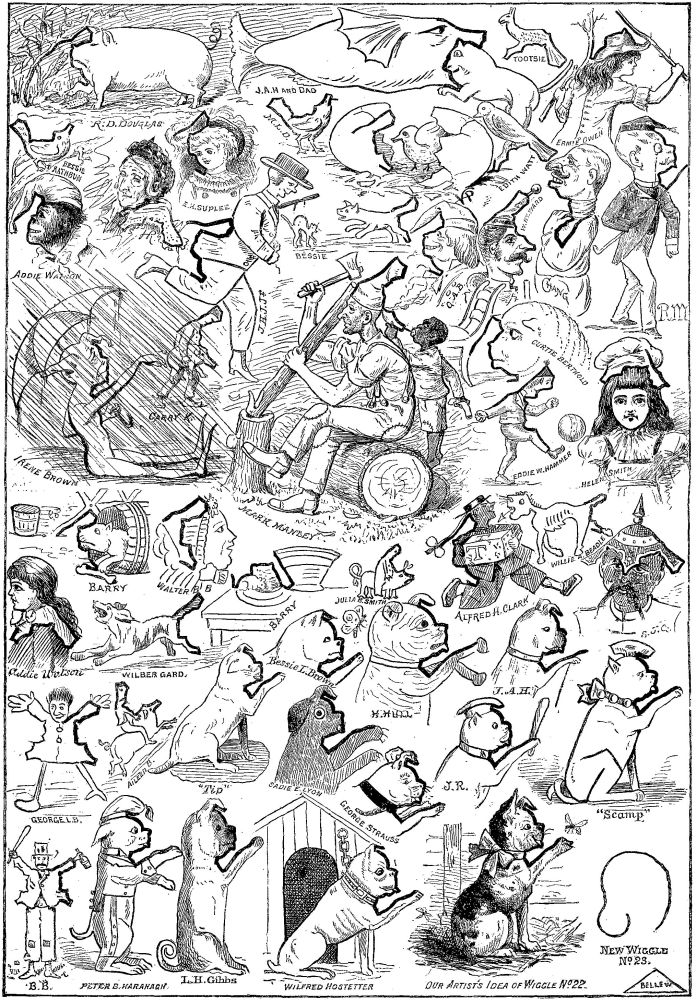
SOME DRAWINGS OF WIGGLE No. 22, OUR ARTIST'S IDEA, AND NEW WIGGLE, No. 23.