THE MAGIC CLOCK;
Reading edition
OR,
THE REWARD OF INDUSTRY.
A Trick Pantomime for Children.
BY G. B. BARTLETT.
The Farmer,afterward the miserly King.
His Wife Jane,"the Old Woman with the Broom.
Polly,"Little Miss Muffit}
Mabel,"Cinderella}The Farmer's
Margaret,"Bopeep}Daughters.
Isabel,"A Beggar}
Willie,"A Beggar.
Robin, a Servant,"the Prince.
Jack,"the Insatiate Hen}The Farmer's
Tom,"the Spider}Sons.
The Fairy, disguised as a poor Old Woman.
One small boy is concealed in the chimney, and another under the table.
The clock, fire-place, table, fowl, etc., are fully explained, so that they can be easily prepared by children.
This pantomime, can be acted in any room with a simple curtain, or in a large hall. Lively music adds to the spirit of the performers, and enables them to give directions to each other without being heard.
SCENE.
The farmer's kitchen, a fire-place at the right, with a crane from which a kettle hangs, with great logs which rest on high brass andirons. A tall old-fashioned clock case stands against the back wall, nearly in front of which is a large table covered with a white cloth, and set for supper. At the left is a small table, over which hangs a mirror. Six chairs and two stools, a rocking-chair, broom, and dishes, are also needed. The tanner sits at the right of the fire, counting money from a leather bag. His wife sits in the rocking-chair, knitting.
Mabel is employed in brushing the hearth. The proud daughter Isabel is trimming a showy hat; as she adds new decorations to it, she contemplates her face in the mirror, and tries it on with evident delight, occasionally walking about the room, and appealing for admiration.
Polly is cooking the Christmas supper, and often swings forward the long crane, from which an iron pot hangs over the fire, adding a little salt from time to time. The idle Margaret reclines in a low chair; her sewing has fallen from her listless hands, which lie idly in her lap, and she seems to be careless of all around her. Jack sits by the fire, and is constantly eating from the contents of his pockets, which are full of nuts, apples, cakes, and candy.
ACTION.
Willie enters, struts about the room with a profusion of low bows, of which little notice is taken by any one but the farmer's wife, who shakes his hand, and gives him a cordial welcome. She leads him toward Isabel, who rises, makes him a low courtesy, taking hold of her dress with both hands, to do which she lays the hat in a chair. Willie seems struck with the courtesy, and imitates it so clumsily that all laugh. In his confusion he sits down on the hat, and jumps up quickly. Isabel picks up the hat, which is crushed flat, and tries in vain to restore it to shape; then claps it on Willie's head as if to try the effect, while he sits in a very stiff attitude in imitation of a milliner's block.
Robin then enters, rubbing his hands as if suffering from the cold; he approaches the fire to warm them; the farmer looks scornfully at him, and motions him away; he seems ashamed, and retreats to the back of the room, and sits on a stool beside Willie, who laughs and upsets the stool with his foot. Robin sits heavily down upon the floor, and in falling hits Willie's foot, who falls forward. Isabel laughs, but Mabel runs to his aid, forgetting her dusty hands, which cover his coat with ashes, as he clumsily regains his seat.
Robin rises, and nearly sits down upon Tom, a small boy who has picked up the stool, and is lying across it. Tom crawls away just in time, and tries to wake up Margaret, tangles his mother's yarn about his feet, and seems intent upon mischief. The farmer rises as if angry at being disturbed, but Mabel goes toward him, as if apologizing for the accident; then runs to the door as a knock is heard. A poor old woman enters, and asks alms from each, begging money from the farmer, who refuses, and points to the door, which motion all follow in turn, except Robin and Mabel. Jack pretends to give her an apple, which he holds near her lips, but withdraws it as she is about to taste, and crowds it into his own mouth; then claps his hands as if he had done a clever action. The old woman next tries to lift the lid off the kettle, but Polly resists, and pushes her away so hastily that she burns her fingers, and begins to cry. Mabel and Robin try to comfort her, and Mabel takes a cake from Jack, and hands it to the old woman, who eats it as if she was very hungry. Jack begins to cry for his cake, and Mabel motions that he has plenty more, but he shakes his head and cries again. A great cake then comes from the chimney, strikes Jack on the head, and fastens around his neck like a gigantic old-fashioned doughnut with a hole through the centre.
Jack seems much pleased, and tries to taste his new collar, but finds it impossible to get his teeth into it. The farmer begins to scold at the old woman, and lays down his purse upon the settle, in order to push her out, when the purse flies up the chimney, and hangs just out of his reach. He jumps for it, and it begins dancing up and down. All the rest except Mabel and Robin chase the old woman round the room, led by the farmer's wife, who secures a broom, and tries to strike her. The old woman rushes from side to side, and Mabel opens the clock, into which she springs, and is concealed in a moment. The farmer makes a frantic leap for his money bag, and knocks over the kettle. Jack and Tom jump about violently as if scalded, while Mabel picks up the fowl, places it upon the table, and persuades her father to come to supper. Robin places chairs, and all sit down.
The clock strikes, and as the farmer turns around, he sees instead of the face of the clock, that of a pretty little girl with blonde hair. He calls the attention of the rest of his family to this change, but when they look the clock face alone appears. The farmer seems very much astonished, and puts on his spectacles, when he again beholds the sweet face, which disappears as soon as he has called the attention of the family.
They resume their meal. As the farmer attempts to cut up the fowl, it lifts itself up and gives a loud crow. The farmer drops his knife in fear and trembling, but is encouraged by Jack, who expresses in pantomime that he is very hungry. The farmer makes a second attempt, at which the fowl leaps from the table and disappears up the chimney. The farmer and his wife rush out of the room in eager haste, followed by all the family.
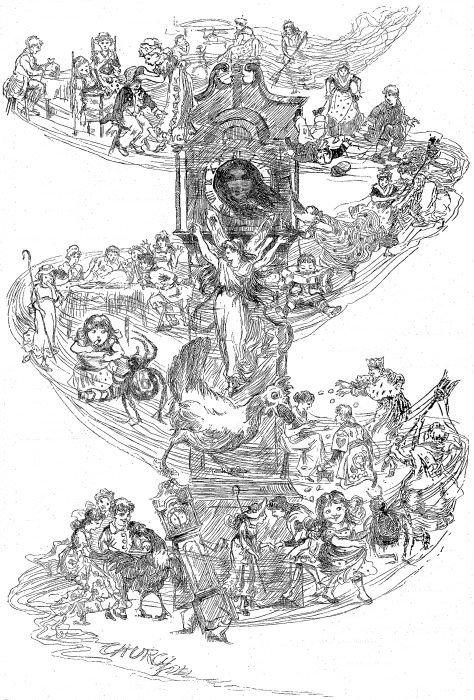
The clock case opens and shows a beautiful fairy, who waves her wand in the air five times, and transforms the whole family into Mother Goose personages. The farmer returns dressed in a long red robe with a huge crown on his head, and personates the King who spends all his time counting out his money. This he constantly does, taking it from a large bag; and as soon as he has counted all the pieces, he puts his hand up to his crown, trying in vain to lift it off, as if it made his head ache; then he begins again to count over and over his tiresome money.
The farmer's wife comes in next as the old woman with the broom. She rushes about, raising a great dust, and then jumps up and down, brushing the ceiling of the room, as if trying to brush the cobwebs from the sky.
Isabel then flaunts into the room, followed by Willie, taking long strides, and seeming full of vanity, turning their heads from side to side as if lost in admiration of themselves. The others all laugh at the sight, for they have become the beggars, and are flaunting about in rags and tags, which they are as proud of as if they were dressed in velvet gowns.
Margaret enters next as little Bopeep, groping around in search of her lost sheep; she sometimes leans upon her crook with her left hand, and points off eagerly with her right, and finally throws herself into her chair and goes to sleep.
Polly appears as little Miss Muffit, eating curds and whey from a large bowl which she carries in her left hand; she draws a stool toward the fire-place, and sits down. Tom, as the spider, rushes out from under the table and sits down beside her, at which Polly drops the bowl and spoon in fright. She then rushes round the room three times, pursued by the spider.
Jack then enters as the insatiate hen, who eats more victuals than threescore men; he rushes around the room, and seems wholly unsatisfied with all he can devour. Mabel is changed into Cinderella, and sits by the fire in a dejected attitude, upon which the fairy comes down from the clock, and calls her attention to the Prince, Robin, whose rough frock flies away up the chimney, and he kneels before her as a Prince in gorgeous raiment. Mabel's old robe then disappears in the same manner. Robin fits a glass slipper upon her foot, which makes her dance with delight. He leads her to the upper end of the room toward the King her father, who is so overcome by her beauty that he forgets his avarice, and bestows the whole of the money upon her.
The happy pair, followed by the King, then march around the room to each of the personages, and the old woman sweeps a path before them, as if eager to make their way pleasant and easy. The beggars seem to forget their pride, and their ragged dresses fly away up the chimney, and they appear neatly clad. The fairy touches the spider with her wand; he stands upright, offers his arm to Miss Muffit, and they join the procession.
The fairy then enters the clock, which marches twice around the room followed by all the characters, and then resumes its place. All join in a grand reel; the King, taking the old woman for his partner, stands opposite Cinderella and the Prince, who take the head of the set. The two repentant beggars take one side, with Miss Muffit and the spider opposite. They dance all hands round, then the first lady promenades around the set outside, followed by her partner, who then joins her, and all promenade together around once. The ladies then go forward into the centre, and the gentlemen turn them into place with their right hand, and then turn corners with the left, after which they go into the centre again and form basket, go once around, divide in front, and march forward in the same position. The gentlemen raise their hands, and the ladies go forward alone, the gentlemen march after, and turn them into place. The hen then wakes Bopeep, and all form a semicircle, with the Prince and Cinderella in the centre. The clock then advances and takes up its position behind them, bowing to each in turn. The fairy springs forward into the centre of the group, and after waltzing around, stops in the centre, and all salute as the curtain falls.
COSTUMES.
The farmer has a plain brown suit, over which he throws a loose robe of Turkey red cloth, trimmed with ermine. This ermine is made of white cotton flannel, with black marks drawn upon it with charcoal. He also wears a crown made of gilt paper. His money bag has a black linen thread fastened to the top, one end of which is in the hand of the boy concealed in the chimney.
The farmer's wife has a plain black dress with white kerchief, and a high cap on which a neat front of white tow or yarn is fastened in the centre, so that the ends can be pulled out quickly when she assumes her second part. For this she wears a red skirt under the black, and ties a long red cloak over her shoulders, the cape of which she draws over her cap.
Polly wears a long-sleeved checked apron, which covers her next dress. This is made of bright cretonne tucked over a gay skirt. The waist is long and pointed, with a high ruff of white.
Mabel wears a dark skirt and loose white waist, under which is a pretty silk dress with long train, and a square-necked waist trimmed with wax beads. She changes the black dress for a ragged loose robe, and when first transformed to Cinderella sits in the chimney-corner while the thread is hooked on to the robe by which it can be drawn up chimney.
Margaret has a bright skirt and loose waist over her Bopeep dress, which is composed of a skirt of blue cambric with a red waist, the flaps of which are cut in squares, which as well as the skirt are trimmed with yellow braid. Under the work which lies in her lap is a straw hat trimmed with flowers.
Isabel may wear the most showy dress which can be found.
Willie has a black dress-coat, which can easily be made by sewing tails on a jacket. He can have white pantaloons, and ruffles of white paper on his shirt, a showy neck-tie, and white hat. Both he and Isabel for their next dress have long robes, which may be water-proof cloaks covered with rags of every color.
Robin wears a long farmer's frock over his Prince's dress, which may be made of satteen for less than one dollar by an ingenious girl. It consists of a loose pink body, and blue trunks, or knee-breeches, with a cape of blue from the shoulders, each garment trimmed with long points of the opposite color. Pink stockings, and lace collar and cuffs, and pink and white bows on the shoes complete the costume. He has a small slipper covered with glass beads for Cinderella.
Jack and Tom appear in shabby boy's dress at first, and their next dresses are put on over them. The hen is made of a long garment like a shirt, one half of brown cambric, the other half of yellow, and the sleeves of large size are sewed up at the ends. It is drawn over the boy's head so that the brown part covers his back, his feet go into the sleeves, and then his hands also, with which he grasps his knees. A cap of brown cambric, with a red comb, and marked with eyes, is drawn over the head and pinned to the robe, and the ends are tied in a bunch opposite.
The spider has a suit of snuff-brown cambric, the feet and arms of which are sewed up like bags; on his back is fastened a pointed stuffed bag, and a false leg cut from brown pasteboard is fastened to each side; he runs on all fours at first, and shakes his head, which is enveloped in a cambric bag ornamented with two curved horns, and points of yellow cloth are sewed upon the back and around the legs. He hides under the table until it is time to appear.
The fairy is dressed in white tarlatan, trimmed with tinsel, over which she has a long cloak with a hood, into which white hair is sewed. She has a cane, and bends forward.
PROPERTIES.
The clock is a frame seven feet high, two feet wide, with a door in front, all made of thin strips of wood covered with brown cambric, dull side out; the face, painted on pasteboard with movable hands, slides up and down in a groove, and is kept in place by a button at the bottom. A high stool is hidden inside, on which the fairy climbs when she shows her own face. She has her hand directly under the clock's face, so that she can push it instantly into place. Straps are arranged at the height of the fairy's shoulders, by which she can walk forward with the clock. There are hinges near the top, so it can bow forward, and also a bell which will strike. The fire-place is a large box three feet high, with the upper portion taken off. Boards, painted a dull red, with lines representing bricks, are slanted from the front and sides to the ceiling. Turkey red cloth is nailed at the top of the box inside, which is drawn tight by the logs which lie on the andirons. The effect of fire is produced by a lamp behind the red cloth, and pieces of red gelatine pasted on the logs.
A small boy, concealed by the chimney, holds four threads, to which the articles to be drawn up are fastened. The fowl is hooked on to the thread by Jack. A real fowl may be used, which is elevated by a wire thrust through the table by the boy, who also imitates the crowing; or a good chicken can be made of paper. Any table will do in which a hole can be made; there must be one also through the tin dish. The cake is made of brown cambric. The action should be distinctly marked, and keep time with the music, and all performers should bow as the curtain falls.
Notice.—The Serial Story, Post-office Box, and Exchanges, omitted from our Christmas Number, will be resumed next week.