EMBROIDERED CANVAS RUG.
Reading edition
Fig. 1.—Rug.—[See Figs. 2-4.]
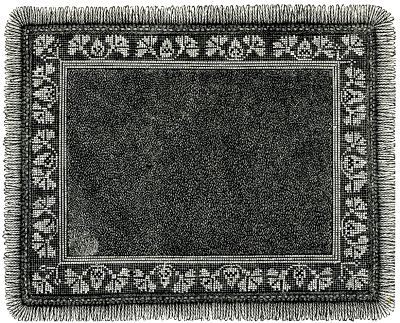
The pretty glove-case published in No. 2, November 11, was warmly welcomed, and our young friends are eagerly clamoring for more holiday gifts that they can make readily and cheaply. In compliance with their wish we will occasionally furnish fancy articles that can be manufactured by little hands. One of the most tasteful and useful presents that we can suggest is a handsome canvas rug, which can be easily made with the help of the accompanying pictures and description, and which is sure to prove a successful Christmas gift. The rug is made of écru linen Java canvas, which, with the border, can be bought cheaply in any large fancy store. The centre of the rug is twenty-eight inches long and nineteen inches wide, and is embroidered in loop stitch with claret-colored worsted. The border is four inches wide, and is worked in cross stitch with similar worsted. That useful periodical, Harper's Bazar, gives full directions for working these and many other stitches. Almost every little girl, however, knows how to make these simple stitches, or can find some one to show her. The rug is lined with gray drilling, and edged with fringe, of which the illustration Fig. 4 shows a full-sized section.
Fig. 2.—Reel for Rug, Fig. 1.
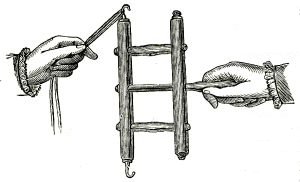
Fig. 3.—Reel for Rug, Fig. 1.
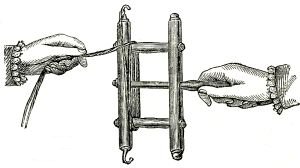
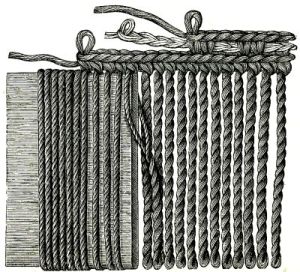
To make the fringe first twist together threads of claret-colored worsted. For this purpose use a wooden reel, the middle rod of which forms a movable handle. One side of the reel is furnished with brass hooks on the ends. Lay a thread of claret-colored worsted on the upper hook as shown by Fig. 2; turn the reel quickly, holding the thread double with the left hand and the handle of the reel with the right hand until the thread has been twisted long enough to be wound on the reel, with the hands in the position as shown by Fig. 3. When the threads have been twisted of sufficient length, wind them tight on a long wooden board four inches and seven-eighths in circumference (see Fig. 4), and for the heading of the fringe crochet on each thread 1 sc. (single crochet) with claret-colored worsted. Withdraw the board from the loops, twist these, and on the sc. work a second round of sc. with similar worsted, at the same time fastening in a chain stitch foundation worked with écru cotton. In doing this, work alternately 2 sc. on the foundation and 2 sc. without the foundation.
Fig. 4.—Manner of making Fringe for Rug, Fig. 1.
Another simple fringe is made by winding the worsted on a suitable-sized book, then cutting it through on one end, and knotting strands of four threads each into the edge of the rug.
Electric Ornaments.—Some curious trinkets, to which certain motions can be given at will by means of electricity, have recently been devised by an ingenious Frenchman, M. Trouvé. Two of these are scarf pins; one has a death's-head, gold or enamel, with diamond eyes and lower articulated jaw; the other has a rabbit seated upright on a box with a little bell before it, to be struck with two rods held in the animal's fore-paws. An invisible wire connects these objects with a small hermetically closed battery, the ebonite case of which is about the size of a cigarette. It is kept in the waistcoat pocket, and acts only when turned horizontally or inverted. When a person looks at the pin, the owner, slipping a finger into his pocket, moves the battery, whereupon the death's-head rolls its eyes and grinds its teeth, or the little rabbit beats the bell with its rods (through electro-magnetic action). A third kind of ornament is a small bird set with diamonds, to be fixed in a lady's hair, and the wings of which can be set in motion electrically.
The Great Wall of China.—An American engineer engaged in the construction of a railway in China, gives the following account of this wonderful work. The wall is 1728 miles long, 18 feet high, and 15 feet thick at the top. The foundation throughout is of solid granite, the remainder of compact masonry. At intervals of between two hundred and three hundred yards towers rise up, twenty-five to thirty feet high, and twenty-four feet in diameter. On the top of the wall and on both sides of it are masonry parapets to enable the defenders to pass unseen from one tower to another. The wall is carried from point to point in a straight line, across valleys, plains, and hills, sometimes plunging down into deep abysses. Rivers are bridged over by the wall, while on both banks of large streams strong flanking towers are placed.