JIM, THE FERRY BOY.
Reading edition
BY WADE WHIPPLE.
Waterview is in West Virginia. It overlooks the Great Kanawha River, and a very pretty river it is, too. You would think so if you were permitted to look out of any of the eastern windows of Waterview some bright summer morning, and see the willow and plane trees nodding to you from the opposite shore, and opening here and there to give you a glimpse of beautiful hills crowned with snowy clouds and bright blue sky.
And maybe if your eye chanced to rest on the cabin just at the foot of those beautiful hills, with its white-washed face peeping out of the maze of green and gold that almost hid it from view, you might wish to live there, even though the only way to bring it about would be by exchanging homes and natures with Jim, the Ferry Boy.
Jim was the light of that little cabin—yes, the light, for though his skin was as dark as the dusk, his happy and contented spirit shone out of his laughing eyes like sunbeams breaking through the chinks in a black cloud.
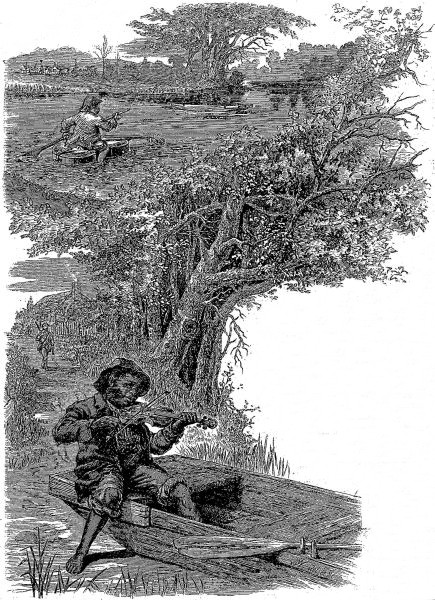
He was the ferryman at Waterview—a boy, and yet a man in all that was needed to fit him for his calling, being strong, courageous, and faithful. To be sure, "the ferry" was nothing more than a skiff of one-boy power, but it called upon Jim to get up at all hours of the night, and face the wettest kind of storms and the roughest kind of people, and these elements would have taken all the picnic flavor out of the business for you.
It was all the same to Jim, however. You could shake him out of the knottiest of naps, and drop him into the dingiest of nights, and he would take hold of the oars with as good a will as any of you would reach out for a box of bonbons. But with not quite as good a will, perhaps, as he would take to an old family fiddle during the gaps between work. His "mammy" insisted upon it that Jim got his good-nature out of that fiddle.
"Dar's a drefile heap o' fun in dem chil'en w'en dey's togedder," she would say; "and wedder Jim stirs de fiddle or de fiddle stirs Jim dar's no tellin', on'y dey tickles each udder mos' pow'ful, now I tells yer."
And it is a little circumstance connected with that very same fiddle that I have undertaken to tell you of. You see, Jim had a habit of taking that instrument with him on his trips across the river, and when waiting for a passenger he would prop himself up on the shore end of his boat, and coax "Dan Tucker" and "Clar de Kitchen" out of the strings in a way that might have made the frogs dance if there had been any one else about to call off the figures.
Well, on one occasion Jim had just laid his fiddle on the bank to help a passenger aboard, when a signal from the other side of the river caught his eye, and in his haste to get over and "bag his game" he rowed away without his old musical friend. On a bluff overlooking this part of the river, standing at his doorway, as Jim moved away, was Colonel Turner; and seeing the deserted fiddle lying on the ground, under cover of the trees and rocks along shore he stole down there, captured it, and brought it into the house. You see, he had a joke in mind.
Among his household goods was an old bass-viol—one of those very, very big fiddles you have seen in orchestras, that keeps a man bobbing up and down over its giant body like a washer-woman doing her best to rub the wrinkles out of a wash-board.
Well, the Colonel took that out of its hiding-place, and in a few moments it was lying in the very spot whence he had taken Jim's queer little music-box.
Presently the swarthy young ferryman came paddling across with his passenger, and running his boat into the little cove his frequent landings had cut in the river-bank, landed fairly on shore before he discovered the bass-viol lying there, with its great neck reaching out toward the river as if to take a drink.
Was he surprised? You would have thought so if you had seen his eyes bulge out, and his mouth open in a way that suggested the yawn of an alligator, as he exclaimed, "Sakes! how dat fiddle's growed!"
Then, with a degree of reverence in keeping with the measure of his surprise, Jim walked about from side to side of the monster, and finally ventured to reach out and thrum one of the great strings. If it had been run through him it could not have shaken him more than did the whirring sound which followed, and caused him to exclaim:
"Massy me! I done feel de ruts ob dat note movin' 'way down un'er my heel!' Lucky I warn't big 'nuff ter set de hull machine go'in', else dar'd been a earfquake sho' 'nuff.—Hullo dar!"
This exclamation was caused of the fact that his interest in the wonderful growth of the fiddle had caused him to forget his boat, which had meanwhile drifted from shore, and was being carried down stream as rapidly as a rather brisk current could bear it.
Before the Colonel (who was watching the comedy from his doorway) suspected his intention, the little ferryman had seized an oar that was lying on the bank, launched the big fiddle, and, astraddle of its bridge, was vigorously paddling in the wake of the escaping truant.
"Hey! you Jim!" shouted the Colonel, "where are you going with that fiddle?"
"Whar de fiddle's gwine wid me, I 'speck," was Jim's response, as he glanced back over his shoulder.
"But don't you know the water'll shrink that machine, and take all the music out of it?"
"Hit'll stan' a heap o' shrimpin', Kurnel, 'fo' it gits back ter my meshure; but dis chile's bizness won't stan' any shrimpin', an' dat's why I's ticklar 'bout dat ar boat. Bizness 'fo' pleshure, Kurnel."
Did he catch the boat? He was gaining on it when they turned a bend in the river, and it is very likely he caught it. At least he "caught it" from the Colonel when he came back with that soaked fiddle.