LITTLE COUSIN RANNA.
Reading edition
BY MRS. LUCY MORSE.
"Will and Almida Handly were rather sorry when they learned that their little cousin Marianne Joy was coming to make them a long visit.
"She won't know a bumble-bee from a butternut," said Will. "City children don't know anything, and she'll be awfully in the way. Won't she tag after you and me, though, Almy?"
"Oh dear!" said Almy, in a complaining tone; "we'll have to keep her every speck of washing and baking days."
"I wish they'd leave her where she belongs," said Will.
The children were silent awhile, and then Almy heaved a sigh, and said: "I s'pose that's just the trouble, Will. If her mother has—has died, where does she belong? Where would you and I—"
"I know it," exclaimed Will, gruffly. "Come on, if you want me to help fix up your old baby-house for her."
The day after Marianne came the children's feelings were altered. Walking down the lane all together, the little cousin was dazzled by buttercups, and ran hither and thither gathering them in such wild delight that she came upon Dowsabell, the cow, unexpectedly. Dowsy only raised her sleepy nose from the grass to sniff at the buttercups, but Marianne dropped the whole bunch, with a cry of terror, and ran like the wind to Will for protection. She flung herself upon him with such a pretty confidence that Will took her right into his big boyish heart, and wished on the spot that Dowsy was a raging lion, or, to say the least, Neighbor Stethaway's cross bull.
"After all," he confided to Almida, "she's only a poor city child: what can you expect? I don't mind seeing to her."
"Laws, no," said Almida, with a matronly air. "And if her father's gone to Europe, and every day is baking, or washing, or mending, or something, who is there besides you and me for her to look to, I'd like to know? Only you needn't think you're going to have more than just your own half of the care-taking, Will Handly."
The mother looked on in silence, and understood perfectly the very things which her children thought she had not noticed.
"At first I was troubled lest Will and Almy wouldn't notice the child," she said, one afternoon, to Mrs. Stethaway, as they watched the three children crossing the opposite field. "Next I thought they would tyrannize over her, and that Will would tease her to death."
"And now," said Mrs. Stethaway, "it looks as if they would neglect everything just to follow her bidding. What are you going to do about that?"
"Well," said Mrs. Handly, smiling after the children as they disappeared among the daisies, "it isn't always that old folks know the best turn to take. I'm going to see what the little one's course will be. It seems very much as if my own two children were in the way of getting some lessons in gentleness and self-forgetfulness from the poor little motherless child, which I don't know so well as she does how to teach them."
The children went through the field, the orchard, and over the bars into the lane, through which Ria Bell was just driving the cows.
"Quick! quick! Oh! oh!" screamed Marianne, as soon as she saw the cows.
"Not that way; you're running right into the face of the enemy, Ranna," said Will, laughing, and taking hold of her as she was trying to climb the bars.
But Ranna struggled, crying, "Get me over! get me over! I ain't 'fraid of tows; it's the birds;" and was so excited that Will on one side and Almida on the other lifted her into the lane as quickly as possible.
"Oh, goodness!" screamed Almy, as Ranna made a dive, right under Dowsabell's very nose, toward a little mound of leaves. Crouching down and spreading her arms over it, she looked up at Dowsy so savagely that Will exclaimed, much amused: "Thunder and lightning! what has poor Dowsy done? I thought you were afraid of her, Ranna, and now you look ready to take her by the horns, and are frightened at two poor little robins flying overhead."
"No, I ain't. Nor I won't mind Teazle even if he is going to bite my—my—my head off," cried Ranna, pale with fright, as the dog ran his nose into her face.
Will called Teazle away, while he and Almy tried very hard not to laugh.
"What have you got under the leaves?" asked Will, while Almy stooped over Ranna, and said, tenderly,
"Show us your treasure, darling, and we won't tell Teazle, nor Dowsy, nor anybody a word about it."
THE FALLEN NEST.—Drawn by S. G. McCutcheon.
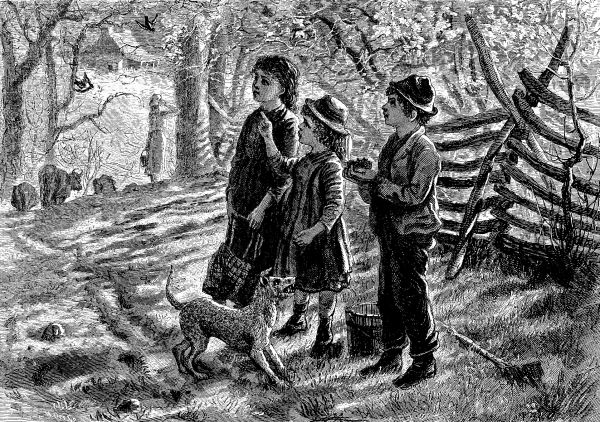
Ranna sat up, brushed away the leaves, and took from under them a pretty little nest full of young robins. "They're my own baby birds, and I thought Dowsy would step on them," she said. "I found them just before I ran to bring you, only the nest was in a great, ugly, dark bush, where the poor little birdies couldn't feel any sun shinin', and I brung them here, and tovered them with leaves, so the chittens wouldn't frighten them while I was gone. What are those big birds flying round me for? Tover my birdies up again; they are crying 'cause they are frightened."
"Hi! ho! hum! Harry!" exclaimed Will. "Those two birds are the excited and anxious parents of your baby birdies, Ranna, and they feel just about as comfortable as your father and mother would feel if a great giant—" But Will remembered suddenly that poor little Ranna had no mother, and, blushing fiery red, said: "I'm a good-for-nothing old blunderbuss. You tell her, Almy; it's girl's talk, anyway."
Almy, with her arms around her little cousin, explained the situation. Ranna eagerly pointed out the exact spot from which she had taken the nest, and when Will had carefully restored it, watched with great delight the old birds return to it.
"I'll never touch another nest in my life," she said; and holding one arm tight around Almy's neck, she beckoned to Will with the other. Putting it around him, she drew his head close down to Almy's, and whispered: "I don't think you're a bundlefuss, Will. I think you and Almy know just as well how to take care of little birds when their papas and mammas can't find them, as you do of little girls when their mammas is—is—is lost. And I'm going to tell all the children in the world that when they lose their mammas, the best thing they can do is to find my cousin Will and my cousin Almy."
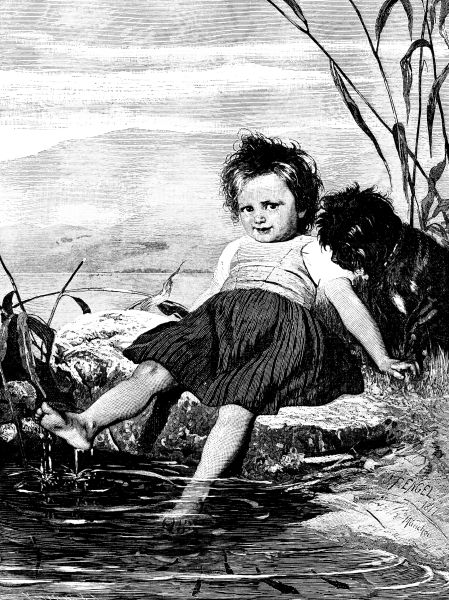
"I'S LEARNING TO SWIM, MAMMA."

We wish to express to our young correspondents our sincere regret that our limited space compels us to simply acknowledge so large a number of the pretty letters which reach us daily from every part of the United States. Do not think, because your letters are not printed, that we do not consider them as well written or as interesting as those that are. We are very sorry not to print all your little histories of your pet dogs, and kittens, and birds, and other little domestic creatures, or the excellent descriptions many of you write of the beautiful natural scenery surrounding your homes; but if there is no more room in Our Post-office Box, your letters can not be printed. We thank you heartily for the pleasure you express in "Across the Ocean," "The Moral Pirates," "Miss Van Winkle's Nap," and other stories and poems; and the eagerness with which you "run to meet papa when he brings home Young People" is very gratifying. We trust you will continue your pretty favors to us, and we, in return, will print all of your letters that we can possibly make room for, and will promise to give you more and more pleasure with every new number of Young People.
Camp Carling, Wyoming Territory.
I have wanted to write to the Post-office Box for a long time, but mamma said there were so many children writing that my letter would not be printed.
We live in a camp, and see many curious things. When we look out of our windows, we see the aparejos, which are the saddles put on the mules when they are loaded. The saddles are arranged in long rows, with pieces of tent cloth thrown over them. Every day we see a great many mules going out and coming in. Then there is another queer thing. It is the "condemned heap." Almost every day my two little brothers go down to the pile and find a great many treasures. Every month lots of things from the warehouses are condemned, and brought to the heap to be burned. There are sixteen warehouses here, filled with government stores.
A great many of the men who were in the first Ute fight under Major Thornburgh went from this camp, and we know some of those that were wounded.
Every night and morning we hear the bugle-call that tells the soldiers when to get up, when to go to work, when to stop work, when to change guard, and when to go to bed. We always feel safe here, because we are guarded by soldiers.
Edna S. B.
Needy, Oregon.
I like to read the letters in the Post-office Box of Young People so much that I thought I would write one from 'way out here in the backwoods of Oregon. I live in the Willamette Valley, where we can see Mount Hood any time when the weather is clear. It is a glorious sight, especially in the evening just before sundown. In the winter and spring the mountain is hid behind clouds more than half the time. Sometimes the top of it will peep out above the mist. Then it looks so strange. It is considered to be nearly 12,000 feet high.
Estelle M.
Philadelphia, Pennsylvania.
It is so nice to have a new Young People every week. My papa is an artist, and I am going to be one too. I draw a picture from Young People almost every day, and I read about Rosa Bonheur, and Miss Thompson, and all the great painters.
I have been to the Zoological Gardens. I rode the donkeys and the elephant, and I have made their pictures. I have a little Zoo in our back yard. I have a nice cat, two rabbits named Jack and Jill, and a turtle, and a fish in an aquarium that eats flies from my hands. My bird died, and papa painted its portrait. I called the picture "The Burial of the Dead Bird."
M. Electa F.
Ottawa, Ohio.
I am nine years old, and for my birthday present mamma gave me one year's subscription to Young People, beginning with the first number. I like "The Moral Pirates" very much, and I was just wishing for a serial with girls in it, and the very next paper had the beginning of "Miss Van Winkle's Nap." I was delighted with it. I think the stories about Mr. Martin and Miss Pamela Plumstone's piano are so funny.
As Fourth of July came on Sunday this year, we had no public celebration, but some of the children in our neighborhood got up a celebration of their own at our house. Mamma made the oration, and played the national airs on the piano, after which we had a parade. We all had paper caps, and we had a flag and a drummer-boy. My little two-year-old cousin Gordon brought up the rear of the procession, with a paper cap on, and as gay as any of us.
Bertha K.
Jericho, Long Island.
I am a little girl ten years old, and I have a sister one year younger. We have very nice times together.
About a week ago my papa found a poor little bird with its wing broken. We took it home and fed it, and we thought it was getting better, but it died.
I have seen some letters from the children about little turtles. Once we had one, and we used to dig worms for it to eat. It was in a globe, and once when we did not dig worms enough it ate the tail of one of the gold-fish.
We tried Sadie McB.'s recipe for candy, and it was a success.
M. J. L.
Lockport, New York.
I saw some letters in Our Post-office Box asking for remedies for songless canaries. We have used "Sheppard's Canary Powder, or Song Restorer," for our canary, and found it very beneficial.
Alice.
Bridgeport, Connecticut.
My mamma raised four canaries this spring. The first one mamma had to feed, and it is very tame. We are training it to do tricks. When our birds are sick and do not sing, mamma gives them "Dr. Gunning's Universal Bird Tonic," and it always restores their song.
I have two gold-fish. I did have three, but one died, and I buried it in the yard, under the Madeira vines.
Blanche T. S.
San Jose, California.
I tried Louisa W.'s recipe for Everton taffy, only I added half a tea-cupful of water. I like it very much.
Here is a recipe for white candy: Two cups of white crushed sugar; three-quarters of a cup of water; one table-spoonful of cream of tartar. Boil quickly, trying a little in water occasionally until it crisps. Then add half a tea-spoonful of soda. Pour it in a buttered pan until it is cool enough to pull. I am ten years old.
May J.
I love Young People very much. Soon as papa brings it home I read it to my two little sisters. We are very much interested in "The Moral Pirates." I am ten years old, and I go to school every day. Can any one tell me if the flamingo is of any use?
Here is a recipe for the cooking club. Marble cake—light part: One and a half cups of white sugar; half a cup of butter; half a cup of sweet milk; the whites of four eggs; two and a half cups of flour; half a tea-spoonful of soda; one tea-spoonful of cream of tartar or one tea-spoonful of baking powder; beat the eggs and sugar together, mix the cream of tartar with the flour, and dissolve the soda in the milk. Dark part: One cup of brown sugar; half a cup of molasses; half a cup of sour milk; the yolks of four eggs; two and a half cups of flour; half a tea-spoonful of soda; half a tea-spoonful of clove and of cinnamon. Put a layer of the dark batter in the pan, then a layer of light, until the pan is full.
I should like to exchange pressed flowers with any little girl in California.
Myrta Gates, Clarion, Wright County, Iowa.
Everything has its uses in the great economy of nature, and although we can not always see why it is necessary for certain things to exist, we may be sure that they were all created for some purpose. The flamingo, however, is useful as an article of food. In certain parts of Egypt and the East roast flamingo is considered very delicate eating, and in ancient times a stew of flamingo tongues was a royal dish. It is also a very beautiful bird. Travellers say there is no sight more magnificent than a flock of scarlet flamingos wading in the green waving water grasses, hunting for their breakfast in the morning sunlight. The flamingo, if it could speak, might answer your question in the words of Mr. Emerson, the poet:
"Tell them, dear, that if eyes were made for seeing, Then beauty is its own excuse for being."
Philadelphia, Pennsylvania.
I am nine years old, and I wish to send the cooking club a recipe for "one-two-three-four cake": One cup of butter; two cups of sugar; three cups of flour; four eggs; half a cup of milk; the grated rind of one lemon; a pinch of salt; one tea-spoonful of royal baking powder.
Clara S. A.
New York City.
I have taken Young People from the first number, and I think it is a very nice paper. I like to read about the pets of the other children, and I will tell them about a pet cat I had when we lived in Chicago. Her name was Daisy, and as she was black and white, we thought it a pretty name for her. My little brother Jack had a pair of bantam chickens. One day when Daisy was asleep in the yard the rooster flew on her back and picked her left eye out. Grandma, who was in the yard at the time, told the cook to bring Daisy in, while she went for her feather and goose-grease, and put some on the wounded eye. The next day it was healed, but the sight was gone. Once when Daisy had some little kittens she put them in a hen's nest. When the hen came into the nest she would keep the little things quiet by pecking them on the head if they cried. The kittens and chickens grew to be great friends. They would eat out of the same dish, and when night came they would all go to the chicken-coop together. The kittens slept in the nest, and the chickens on the roost. Were they not a happy family?
Bessie G.
Brooklyn, New York.
I am very sorry I forgot the flour in my recipe for apple-cake in Post-office Box, No. 37. There should be enough prepared flour added to make a stiff batter. It is better to bake it in a shallow pan.
L. Grace P.
Keene, New Hampshire.
I think "Across the Ocean" was a splendid story. I read it all. But now I like "The Moral Pirates'" the best.
I have forty-six pet rabbits. They all have black eyes and black ears. And I have two kittens which are very pretty. Their names are Tiger and Malt.
Walter H. P.
My sister and I have just tried Kitty G.'s recipe for butter-scotch, and found it very nice indeed.
We are making a collection of postage stamps, and would like to exchange with any correspondents of Harper's Young People.
Alfred Hussey, 23 Hawthorn Street, New Bedford, Massachusetts.
I would like to exchange birds' eggs with any one living in the South or West.
F. Noble, Milldale, Connecticut.
Lula Barlow can preserve eggs by piercing a small hole at each end of the egg, and blowing out the inside. Eggs can be sent safely by mail in a box filled with cotton.
I would like to exchange postage stamps of different nations with any of those correspondents asking exchange, or with any other readers of Young People.
Harry Dubbs, 229 West Chestnut Street, Lancaster, Pennsylvania.
I would like to exchange specimens of woods indigenous to this climate for those of other climates, specimens to be about three inches long by three-quarters of an inch thick, and to have a knot in them if possible. I have cypress, magnolia, mimosa, Cottonwood, althea, prickly ash, fig, crepe myrtle, sweet-gum, and black-gum. Correspondents willing to exchange will please send me a list of what woods they can obtain, and their full address.
Bery C. Brown, Jun., P. O. Box 870, Little Rock, Arkansas.
I am collecting postage stamps, and would be glad to exchange with any of the readers of Young People. I also have a collection of bugs.
Vernon L. Kellogg, Emporia, Kansas.
I have made the acquaintance of several boys who read Young People, through the Post-office Box, as I am collecting postage stamps. If others who have not yet written are doing the same, I would like to exchange with them. I wrote to Sidney St. W., but he has not yet answered me. I am eleven years old. My younger brother, Charlie, is collecting postmarks, and has already eleven hundred and seventy-five. He would like to exchange with any of the boys.
Lewis S. Mudge, Princeton, New Jersey.
We have Young People, and like it very much. I would like to tell some of the boys and girls who live far away something about my home and pleasures. The name of my home is Baywood Lodge. It is within a stone's-throw of a beautiful sheet of water known as Hempstead Bay. We sail, row, swim, and fish, and we have horses, and enjoy riding horseback too.
There is a camp very near us, in the woods. There are about thirty people, and they have five tents, and their horses.
I would like to exchange foreign postage stamps with any boys who read Young People.
Arthur Lawrence Valk, Baywood Lodge, Port Washington, Long Island.
I am making a collection of postage stamps, and I would like to exchange with any of the readers of Young People in Canada. I will exchange United States stamps for Canadian stamps.
J. M. Wolfe, P. O. Box 423, Lewisburg, Union County, Pennsylvania.
H. P. C.—The quail builds its nest on the ground, among bushes or tall grass. The nesting-time is early in June, and when you find ten or more little white eggs, you may be sure the bird has commenced setting. The eggs are about the size of a pigeon's egg, and pointed at one end like a boy's wooden top. When the little birds are hatched they are as strong as little chickens, and the mother bird takes them off to ramble about the thicket in the same way as a hen leads her brood. The quail is a plump grayish-brown bird, speckled with black and white. Its peculiar whistle may be heard anywhere in the country all the long summer day. Children often imitate the sound, and imagine that the quail is always screaming "more wet"; and in truth the quail's note does resemble those words, with a short, quick accent on the last sound, as if the bird was constantly entreating nature for a refreshing summer shower.
A. S. Daggett.—You do not need cards to play the geographical game. If you wish, you can get blank cards, and write them yourself; but the game is made more lively and instructive by leaving the answers to the geographical knowledge and quick memory of the players.
Edith H. Thomas.—Write directly to the correspondent you wish to exchange with.
Anna M. R.—Many thanks for your description of the curious things exhibited at the Nashville Centennial. We are sorry it is too long to print.
Wat H. T. M.—We acknowledge with thanks the account you send us of Washington's birth-place, near which historical locality you live.
Favors are acknowledged from Charles S. R., Rena and Frank Stearns, Bessie Clark, Romeo and Juliet, W. W. Eaton, Charles L. B., Thomas H. Van T., Katrina, Charlie D., Leila Mackay, Gracie D. Ely, Charley J. Kennedy, Louis L. G., Mary W. W., V. Fannie L., Susie Mulholland, John B. Maxwell, Asa M. Steele, Arthur McKeen, Lulu E., Charles C. M., Belle Matteson, Annie H. R., John Leeper, Carrie B. Thompson, Albert Smith, Eddie M., Freddie Hyers, Mary E. P., Alice Green, Carrie E. Riley, Hallie S. Morgan, Louie Van A., Thad. B. Tobey.
Correct answers to puzzles are received from Alice Grady, "North Star," Benny W. L., Ermie Garden, Allie Mason, Eddie A. Leet, Ernest G. Young, Fred Haswell, Marguerite Bucknall, Willard H. Francis, Willie and Henry Western, Fred J. Purdy, Leon C. Bogart, Hugh Downing, Alson A. G., Clara L. Kellogg, Sarah B., Willie T. B., Alice Williams, Willie C., "Dominus," Bessie Guyton, T. L. Drew, Mary L. McVean, George L. Osgood, W. V. Fowler, K. R., Albert and Laura Ellard, Alfy G. Dale, Rebecca Hedges.
PUZZLES FROM YOUNG CONTRIBUTORS.
No. 1.
ENIGMA.
One-third of sun, one-fourth of none, One-fifth of weary, one-sixth of dreary, One-third of oak, one-fifth of broke, One-fourth of kite, if read aright, And placed in line correct and true, Will give a city's name to you. A. B.
No. 2.
DOUBLE ACROSTIC.
A beast. A chain of mountains in Asia. An eatable. To observe. Something used in ancient warfare. Answer—Two wild beasts.
H. F. P.
No. 3.
NUMERICAL CHARADE.
I am a large island lying far away toward the south pole, and am composed of 14 letters. My 9, 6, 4, 13, 3 is not small. My 10, 8, 12, 7 is food for beasts. My 1, 14, 11, 5 is a journey. My 10, 2, 13 is a fruit. Katie.
No. 4.
DIAMOND.
In leopard. Something all creatures do. A flexible substance. A number. In tiger.
W. D. G.
No. 5.
WORD SQUARE.
First, congealed vapor. Second, a number. Third, formerly. Fourth, a division of time.
M. E. N.
No. 6.
ENIGMA.
My first is in laugh, but not in cry. My second is in tall, but not in high. My third is in fig, but not in plum. My fourth is in speak, but not in dumb. My fifth is in yours, but not in his. My sixth is in been, but not in is. My seventh is in tame, but not in wild. My eighth is in infant, not in child. My ninth is in village, not in town. My whole was a general of renown. Ada.
ANSWERS TO PUZZLES IN NO. 37.
No. 1.
Shark, hark, ark.
No. 2.
Diamond.
No. 3.
DASH
AREA
SEAL
HALO
No. 4.
T
RAT
TARRY
TRY
Y
No. 5.
ChathaM
AnconA
SantandeR
PotsdaM
IsalcO
AyR
NicaraguA
Caspian, Marmora.
No. 6.
Oliver Goldsmith.