KNOTS.
Reading edition
BY LIEUTENANT WORTH G. ROSS.
There are many knots used by sailors that would prove of good service to people on shore if they only knew how to make and apply them. Boys on a farm can put to excellent advantage these simple contrivances when they have to rely upon their own resources in the use of ropes and small lines. On shipboard there is a great variety of knots, hitches, bends, splices, etc., but the larger portion of these can only be adapted to the particular requirements of a vessel, many of them having a special duty to perform. The chief virtue of a knot is to hold well and be easily cast off.
There are three parts to a rope besides the ends: the standing part, which is the part leading from the end made fast; the running part, which is the part used or hauled; and the bight, which is the curve of the rope.
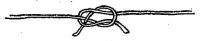
Fig. 1.
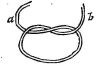
Fig. 2.
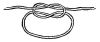
Fig. 3.
A square or reef knot.—First make a plain overhand knot as in Fig. 1. Take the uppermost end b, place it over and under the part a, and draw the ends tightly. Then it will appear as in Fig. 2. If you pass the ends in a contrary direction, you will make what sailors call a granny knot, which is a term of ridicule to the green hands, who often tie them through mistake. A story is told that a sea-captain, who had on board of his packet a number of passengers, and was continually missing from his well-stocked larder some of his choicest bits, concluded to set a trap, and catch the thief. He was uncertain whether the latter was among the sailors or passengers, so he secured his pantry door with a piece of rope, and made a granny. The next day he found a square knot in its place, and so traced the culprit to his crew, knowing that a passenger would naturally have tied the former over again. The square knot is used mostly in tying reef points, and can be easily undone. Now if you want a knot that will not slip in doing up bundles with twine, take another turn as in Fig. 3.
Fig. 4.
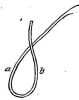
Fig. 5.
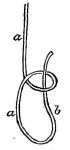
Fig. 6.
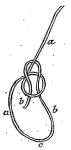
A bowline is one of the best knots in use, and can be applied in many different ways. Lay the parts together as in Fig. 4. Then curl the part a over b, bringing the end up through the loop as in Fig. 5. This little twist must be acquired by practice. Now carry b around and under a, passing it down through the loop as in Fig. 6. Here you have a knot that is perfectly secure, and will not slip. A man can sit in the bight (c), and be hoisted to any height with safety; and if you want to lead an ox, a calf, or a horse, you can pass the bowline around his neck for a temporary halter, without any danger of choking in case of a sudden prance. This is the most important knot, and can be used in more situations than any other, and is always readily undone. It is very handy in making fast a boat's painter, and in tying fish-lines to sinkers.
Fig. 7.
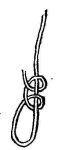
Fig. 8.
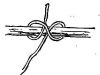
Fig. 9.
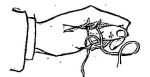
Fig. 10.
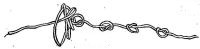
By means of two half-hitches (Fig. 7) one can secure with the end of a rope almost anything. When the same hitch is made around a spar it is called a clove-hitch (Fig. 8). A fisherman once had a daughter for whose hand there were two suitors—a sailor and a landsman. The father of the maiden was in a quandary which of the young men to choose for her future husband, as they both seemed to be equally attractive; so one day he summoned them to his side, and gave each a long cord, saying that the one who made the greatest number of overhand knots (Fig. 1) in the least time should be accepted. They started to work in good earnest, the landsman drawing his long ends carefully through the loops, while the sailor rapidly slipped small half-hitches over his thumb as in Fig. 9, and when he had used up his cord in this way, passed the end through all the hitches, and quickly drew it out with the effect seen in Fig. 10, to the astonishment of his rival, who gave up the contest in despair.
Fig. 11.
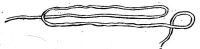
Fig. 12.
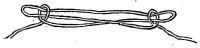
If you have a very long rope and wish to shorten it, the best way to do is to make a sheep-shank, which will never slip, no matter how taut the strain may be. Lay the parts as in Fig. 11, and then take half-hitches over the bights as in Fig. 12.
Fig. 13.
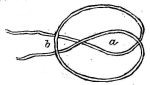
Fig. 14.
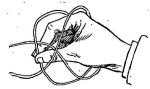
Fig. 15.

A true-lovers' knot is only useful between sailors and their sweethearts. It has the peculiar charm of foretelling the feelings of the one you love. Place your cord or ribbon as in Fig. 13. Then put your fingers down through the loop a, and catch hold of the bight at b as in Fig. 14. Now withdraw your hand, carrying the bight along, and you will have the two knots as they appear in Fig. 15. After this, conceal them with your hand, and ask your fair friend to select one cord from each side and pull. If the knots separate, your hopes have been drawn asunder, but if they remain together, your future prospects are assured. Thus a and b would draw them apart.
Fig. 16.
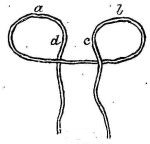
Fig. 17.
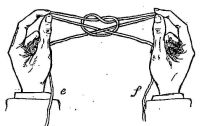
There is a favorite little trick called a Tom-fool's knot. It amounts only to a sleight-of-hand, and must be made very deftly to be effective. First hold the cord by the parts a and b as in Fig. 16. Then pass, with the forefinger and thumb of the right hand, the part c under d and up through the loop. With the left hand pass d over c down through the loop, after which you will have the knot represented in Fig. 17, which can be at once drawn apart by the ends e and f.
Fig. 18.
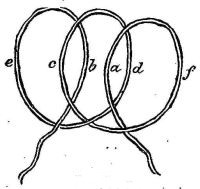
Fig. 19.
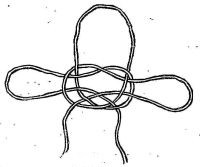
A breastknot is only an ornament. It can be tied with ribbon, and makes a very pretty bow, or can be used by the ladies as a frog for a sacque. It consists, first, of three half-hitches overlapping each other as in Fig. 18. Interweave the part a under b and over c; b over a and under d. Then draw out the bight a over e, and the bight b over f, when we will have the knot as in Fig. 19.
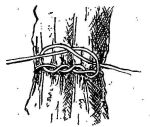
If you wish to fasten together the ends of two ropes on which there is to be considerable strain, form them in the shape of a becket-hitch as in Fig. 20.
Fig. 20.