THE RIVER GETS INTO TROUBLE.
Reading edition
BY CHARLES BARNARD.
A short time ago I told you something about a strange fight that took place between a travelling beach and a river. The beach got the best of it, and the river was obliged to turn aside, and find a way out to sea in another direction. No doubt if there were Indians living there at the time, they thought it a great disaster. Perhaps they were in the habit of sailing down the river to the sea in search of fish and oysters. When the beach closed up the mouth of the river, they thought it a strange and terrible event. If it had happened last summer, the people who live up the river would have called it a great calamity. The river would have found a new outlet, and perhaps have torn up the land, swept away farms and houses, and caused great destruction of property. There were no farms there at the time, for it all happened a long time ago.
There are many places in the world where the sea has cast up sand-bars and beaches, and has changed the whole face of the country. These travelling beaches and growing sand-bars sometimes close up the rivers, and sometimes turn bays into lakes, and these lakes in time turn into dry land. The great South Bay, on Long Island, is one of these places where great changes are going on; the meadow back of Chelsea Beach, near Boston, is another.
When a beach makes trouble for a river, the river behaves very strangely. At first it is quiet, and does not say much. It rests awhile, as if to gain strength, and then some day it makes a grand rush, and tries to break down the barrier the beach has thrown across its mouth. If it fails, it turns aside and goes out another way; but it soon settles down into a kind of sullen silence. It seems to be discouraged, and instead of a swift and pleasant river, it turns into a sluggish stream that does not seem to care for anything except to creep along in a lazy fashion.
Now a great and wonderful change begins. Before, it was swift and muddy. Now, the dull water begins to grow clearer, and the mud and fine sand in the water sink softly down to the bottom. The water spreads wider and wider on each side, and instead of a river running into the sea, there is a broad pool or lagoon behind the beach. Then month by month, year after year, the river brings down the mud and sand from the country and drops them far and wide over the broad salt-water lake.
Perhaps the beach in cutting off the river shut in a part of the sea, so that there are fish and oysters, sea-mosses and crabs, shut in behind the beach. They do not seem to care. They grow all the better in the still water, safe from those terrible waves that used to tear them from the sand in storms. The oysters find the quiet water a good home, and they grow there by millions on millions. As the old fellows die or are killed by the star-fish, the young oysters build their homes on top of the shells of their fathers. Millions of other fish, hermit-crabs, lobsters, and clams, live and die there, and they too cover the bottom of the lagoon with their dead shells. Thus it happens that even the fishes begin to fill up the place by covering the bottom with their empty houses.
Far up the river are weeds and grasses growing along the edge of the water. They drop their seeds in the river, and the seeds float down till they reach the smooth water behind the beach. The sea-birds find the warm waters of the lagoon a good feeding-place, and they gather there by hundreds. They too bring seeds from distant places and drop them here. Perhaps in quiet corners where the water is not quite as salt as in the sea these seeds find a chance to grow. They spring up on the banks of mud left here by the tide. The poor things find their new home very different from the place where they were born, and they have a hard struggle to live. Still they make a brave fight for existence, and even if they die, their dead stalks and leaves serve as a bed for new seeds to live still longer another year.
Then comes another change. The sea plants growing under water find the still water very different from the open sea where they grew before the beach cut them off from their home. The river is all the time bringing down fresh-water, and as the beach cuts off the sea, the water in the lagoon begins to grow fresh. From year to year the water tastes less like sea water, and more like river water. The poor plants were meant for the sea, and the brackish water does not suit them. The beautiful purple mosses, the long brown weeds, and the bright green sea-lettuce fade and die. They fall down, and make a black mould on the bottom of the lake. The poor fish feel it too. The clams and oysters miss the salt-water. Then the terrible mud smothers and chokes them, and they and the other fish die, and their empty shells cover the muddy bottom of the still water.
All this may take years and years, yet the change goes steadily on. The grasses grow higher, and higher, and tiny spears of marsh grass stand up out of water where once it was quite deep. The lake is filling up, and year by year the grass spreads over the water.
OFF BARNEGAT, NEW JERSEY COAST.
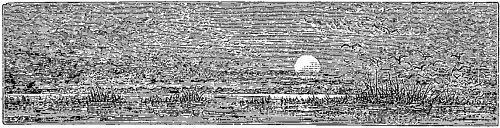
In this picture you see just such a place as this near Barnegat, on the coast of New Jersey. The grass has already begun to form islands in the water. The river appears to get discouraged, and wanders about as if it did not know what to do. The grass spreads wider and wider, and the lake begins to look like a green and level meadow. Men come in long boots wading through the shallow water and cut the grass. When it is dried, it is called salt hay. Cattle like to eat it, for it has a flavor of the old, old sea that once rolled over the place.
Every year the black wet soil grows firmer. Men dig trenches through it to let the water drain away. Along the banks of the river they pile the black peaty sods in long rows. This makes a dike or dam to keep the river from spreading over the grass in floods. Now the land begins to dry very fast. Wild cranberries, "cat-o'-nine-tails," and young bushes spring up. Perhaps a road is laid out over the meadows, and then houses are built, and boys and girls come to live on the smooth plain that grew out of the sea.
If you should visit the meadows at Chelsea, in Massachusetts, you would see just such a lagoon shut in by a travelling beach. It is nearly dry now, and in summer you will see the farmers cutting the salt grass. The Great South Bay on Long Island is another place where the change is going on. If you cross the Hackensack Meadows near Jersey City, you will see the work nearly finished. This vast level plain was once all water. The Passaic and the Hackensack rivers still wind through the level fields, but the work has gone so far that the land is now nearly dry. How it happened that all this great lake came to be filled up we can not tell, but we can plainly see that it was once water and is now turning to dry land.
How do we know all this about these meadows along the coast? Some of the places look very nearly the same to-day as two hundred years ago. The Indians never said that the water once flowed here. There is no record of these things. Indeed! There are plenty of records.
In the first place, you can almost always find the beach at the outside of the meadows. Nearly all the beaches on Long Island have meadows behind them. There may not be a river near, but that makes no difference, for sometimes a beach may grow across a bay between two capes.
If we dig a hole deep down into such a meadow we may find the whole story. First we turn up the black sod full of stems and roots of the grass. Under this the soil is finer, for the roots and leaves have moulded away. What's that? The spade strikes something hard. It is flat and rough, and covered with fine black mould. Wash it well, and we find it is a shell—an oyster shell. Strange that it should be there. Dig deeper, and we find more, perhaps a great quantity of them, bedded thickly one over the other. Here's the truth of the matter. This is an old oyster bed. These oysters did not come there by chance. They must have lived there, and as they live under salt-water, it is plain that where we stand was once a part of the sea.
We may dig deeper, and find more records of the old lake. See those black stones. How smooth and round they are! You remember the smooth stones we saw rolling in the surf on the beach? We can not help thinking that these stones were once tumbled about in the surf on some old beach. This is the way the marsh tells its own story, and repeats the wonderful tale of its birth from the sea.