GLUCK.
Reading edition
BY MRS. JOHN LILLIE.
When I was a child I used to be very fond of a faded little picture which hung in my grandmother's house. It was on a staircase, and going up and down we liked to stop and look at it, and make up stories about it.
THE OLD PICTURE ON THE STAIRWAY.
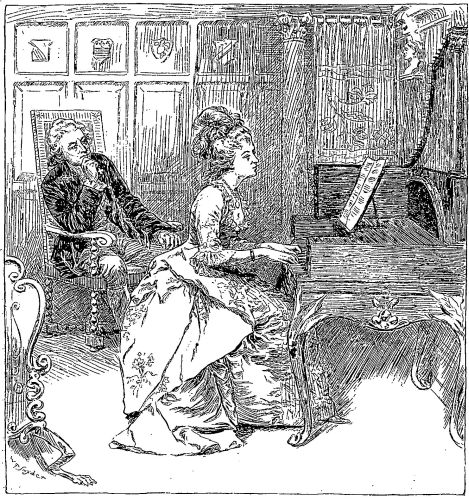
The picture represented a fine room, evidently in a palace, and a very splendidly dressed lady, with a tremendous coiffure and a brocaded gown, sitting before a spinet, or old-fashioned piano.
Near her was seated a gentleman, also dressed in the fashion of 1770. He seemed to be teaching her to play. The young lady was charmingly pretty, we thought. The gentleman had a strong, rather stern face, high cheek-bones, and a big forehead; but the look of his eyes was by no means unkindly. Underneath the picture was engraved in script, with any number of flourishes, "Gluck and Marie Antoinette."
The little picture was of no particular merit as a work of art, yet it possessed such an extraordinary fascination for my childish eyes that the other day, when at a concert I listened to some of Gluck's grand music, the strains seemed to bring it back in a flash to my mind's eye. In imagination I saw again clearly the little ebony frame, the faded tints, the pretty smiling young Dauphiness, and the stern, kind-hearted master.
Christoph Willibald, Ritter von Gluck, was born at Weidenwang on July 2, 1714. His destiny was to improve the form and style of operatic music, and to leave behind him some of the most enchanting compositions the world has ever listened to.
Gluck's father was in the service of a Prince, and Christoph had all the musical advantages of the period. He learned the violin, the organ, and the harpsichord, and early tried his hand at composition. His ideas were mainly dramatic, but the opera of that day was very unsatisfactory, and Gluck's first operas were not a great advance on those of other writers. However, he felt quite sure that something much better could be done, and when in 1736 he went to England, he visited Handel, who was then prosperous and busy in the court of George II.
Gluck was only twenty-two, an eager, restless young man, with his head full of ideas and his pockets full of manuscripts. To old Handel he came, and showed him his music, and begging for criticism, but Handel would only admit that it "promised well." Off went Gluck to Paris, and there met with much encouragement from the poets and writers of the day, as well as from the King and Queen. I do not think that, with all his work and his success, his life could have been very happy during those years. He was easily excited, easily depressed. He hated the wickedness of the people about him, their light ways, their frivolous ideas, even their splendor and riches. Paris in those days was a place in which it was hard for a young man to fear God and himself, and that Gluck lived free from the sins of those about him ought to make us less severe in judging the weakness of his later years. He began to use stimulants for his health, and gradually became addicted to drinking to drown thought and fire him for his work.
Fashion governed art and music very curiously in those days. It was in 1746 that there was a rage in England for what was called the "glasses." This was in reality a harmonica—an instrument made of glasses, and which, by applying a finger moistened with water, produced what were considered agreeable concords. It is odd to think of the great composer Gluck making his bow before the public at the Haymarket Theatre as a performer on the musical glasses. In one of Horace Walpole's famous letters he writes of this event as stirring the fashionable world. The instrument later became very popular, and Mozart and Beethoven did not disdain to write music for it.
Gluck's work went on very steadily in spite of the controversies of his friends and enemies and his personal annoyances. Final success came with his grand opera founded on the mythological story of Orpheus and Eurydice.
I have told you that Gluck reformed the style of the opera. He modelled his work upon the old Greek ideas of dramatic art. He felt that so far the opera had been more like a concert—a mere collection of melodies and ballets. He bent all his energies to making a lyric drama of opera, and he succeeded. To Gluck we owe the best that we have had in opera since his day.
In Vienna much of his time and his work had to be given to the princes and princesses who were his patrons. On one occasion the royal family performed his opera of Il Parnasso. It was about this time he taught the Archduchess Marie Antoinette, and later she wrote from Paris to her sister speaking of him as "notre cher Gluck" (our dear Gluck).
It was Gluck who first introduced cymbals and the big drum into the orchestra. He fought hard over this innovation. His enemies got out satirical pamphlets, in which his "big noises" were ridiculed, but Gluck went his own way, determined to carry his point and prove himself right.
Gluck's last opera was Echo et Narcisse. This was produced in 1779, and soon after he retired to Vienna, where he passed his last years among the kindest friends. In 1787 he died suddenly.
The great object of Gluck's life was thoroughly attained. He made himself felt in every branch of operatic performance. He improved the method, arrangement, and especially its dramatic power. He made it a drama, and its music classical.
This word classical, as applied to music, I am sure many of our young people do not fully understand. To define it completely would be difficult, but I will try and give you some idea of what it means.
Strictly speaking, then, classical music is that which is written according to rule and law: with an intention of producing the most complete harmonies. Bach, Handel, Haydn, Mozart, Gluck, and countless other composers wrote strictly classical music, although Gluck was not remarkable for his counterpoint.
Counterpoint is the "art of combining melodies." The name had a very natural origin. In old times, when notes were designated by little points or pricks, and several of these were joined together to produce a harmony, it was called "point against point," or counterpoint. If the rules of counterpoint are strictly observed, the piece is said to be composed "in perfect counterpoint."
Sometimes you will find a fragment of simple old music with various parts added. This would be "adding counterpoint to a subject."
Handel, when Gluck went to him first, said "he knew no more of counterpoint than his cook," but the master of modern opera had many other strong points, and the music of Orpheus and of Iphigenia will endure while there are hearts to listen.