THE WHITE RABBITS AND THE TAR BABY.
Reading edition
BY AGNES CARR.
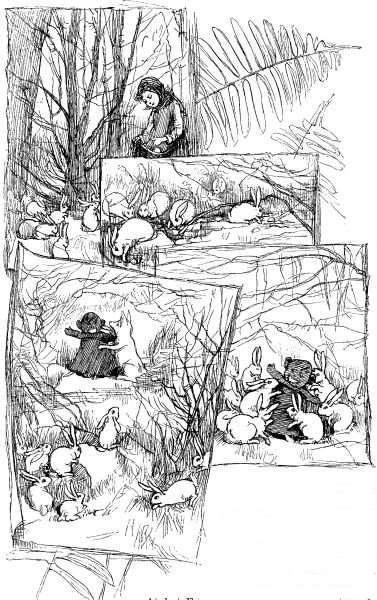
Ten little white rabbits once lived on the edge of a wood, in a snug little hole at the foot of a tall tree; and they were as happy as ten rabbits could be, for every day a good little girl, who lived just back of the wood, brought them their breakfast of white rolls and brown gingerbread; and near by there was a beautiful stream of clear, sweet water, where they went to drink, and which sang a merry tune to them as it went rippling along.
But one morning when the little rabbits went for their water, they found the brook full of sticks and stones, and the water so muddy they could not drink it at all.
"Who has done this?" asked Frisky, the oldest and wisest of the rabbits.
"It was old Reynard the fox," said the brook; "and I am so choked up I can not sing."
So the little rabbits set to work to clear away the dirt and rubbish, and did it so well that before long the brook began its gay song again, and the water was clear enough for them to drink.
Next day, however, the stream was filled up again, and they had all the work to do over, until their little paws ached. So when, on the third morning, they found the water as muddy as ever, they all sat down on the bank and cried.
At last Frisky jumped up and said, "It is no use to cry over muddy water; but we must do something to punish this old rascal of a fox, and make him leave our brook alone."
"But what can we do?" asked his brothers and sisters.
"Come with me, and I will show you."
So the little rabbits followed Frisky to a pile of tar and pitch that some men had left; and out of it they made a black tar baby, which they set up on a rock close by the edge of the brook, with a piece of gingerbread in its mouth; and when night came, and the moon shone bright, they all hid behind a tree to see what would happen.
Pretty soon the old fox smelled the gingerbread, and spied the baby on the rock.
Then he came up close and said, "Little girl, little girl, give me a piece of your gingerbread, or I'll box your ears."
The baby did not answer, so the old fox climbed up on the rock, and boxed her on the ear; and his paw stuck so fast he could not pull it away again.
Then he said, "Little girl, little girl, give me a piece of your gingerbread, or I'll box you on the other ear."
The baby did not say a word, so he boxed her on the other ear, and his other paw stuck fast.
Then he said, "Little girl, little girl, give me a piece of your gingerbread, or I'll bite off your nose." Still the baby would not answer, so the fox bit at her nose; and his teeth stuck tight in the pitch, and he was almost choked with the tar.
The little rabbits then all came out and danced around the wicked old fox, saying, "Now you can't choke the pretty brook, for your own mouth is choked with tar!"
At last Frisky asked, "Now what shall we do with him?"
"Leave him to starve," said one. "Set fire to his tail," said another. And they all proposed something, except Snowflake, the youngest and prettiest of the family, who said nothing until Frisky turned to her and asked, "And what would you do?"
"I should let him go," replied Snowflake, "if he would promise not to trouble the water again."
"Snowflake is right," said Frisky; "he has been punished enough. We will let him go."
So they first loosened his mouth, and rubbed his teeth with butter to take off the tar, and when he had said three times, "Hope my tail may drop off if I ever hurt you or the brook again," they set his paws free, and he scampered off, and hid himself in his den in the wood.
And the little rabbits lived happy forever after.

Buffalo, New York.
I am a teacher in one of the public schools of this city. I take Harper's Young People to school with me, and my pupils enjoy it very much.
I have the oldest children in the building, and they can understand all of the pieces. I read them the articles as a reward for good behavior and well-learned lessons, and let them copy and work out the puzzles.
It would please you to see how anxiously they wait for each new issue, and how happy they are when it comes. We are reading the touching story of "Biddy O'Dolan" now, and I hope it will lead them to think more about these unfortunate children, and try to do what they can to make the life of some one a little happier. Permit me to congratulate you on the success your paper has achieved both here and abroad.
A Teacher.
Pinal City, Arizona Territory.
I am a little girl ten years old. I live in Arizona, where the great silver mines are, and where the cactus grows forty feet high. There were only three white families in this place when we came, three years ago. The place was called Picket Post then, because soldiers were stationed here. I have several pets. Nuisance is my pet deer. She is almost two years old, and is as tame as my cat. She wears a red collar, so hunters will not kill her. Bub is my pet donkey. I love my Arizona pets very much, but not so much as my dear pet grandma, whom we left in Chicago. When papa strikes it rich, we are going home to her.
Pearl R. Brown.
Philadelphia, Pennsylvania.
I have had a great many different kinds of pets, but two that amused me the most were Charley, a snow-white rabbit, and Jet, a black kitten. The two were good friends, and played together, and ate out of the same dish. One day bunny stole a large red rose, and came running into the house with it in his mouth, and Jet at his heels. The deep red of the rose, the snowy rabbit, and black Jet made a picture pretty enough to paint. After a while bunny became very troublesome, and ate the paper off the dining-room wall as high as he could reach. Then he was sent away, and Jet seemed lonely for days. Soon after he disappeared, and my pets since have been birds and dogs, but none were brighter and prettier than Jet and Charley.
Aggie R. H.
Philadelphia, Pennsylvania.
The alligator I told you about [Post-office No. 19] was finally found in a dark corner of the cellar. It only lived two days after we found it.
Puss.
Ishpeming, Michigan.
In a late number of Young People, Edwin A. H. wrote about his cabinet of curiosities, and inquired if any other readers had one. I would like to tell him that my brother and I each has a small one.
F. B. Myers.
New York City.
In answer to L. H. N.'s question in Young People No. 20, I would say that the whale is dead.
John R. Blake.
Cambridge, Massachusetts.
In Young People No. 18 there was a letter from Nellie R. asking what to do for her parrot. In Holden's book on birds I found if you feed your bird with too rich food, it causes a skin disease and an itching sensation which the bird tries to relieve by pulling out its feathers. The only remedy is to feed it on raw or boiled carrots, or well-roasted pea-nuts.
Lydia R. F.
New York City.
I would like to have you tell E. L. M., of Washington, that the reason the mouse she used to feed is wild now is because mice are very shy, and when they can get their supper without going in danger, they will not take any foolish risk. Before E. L. M. fed the little fellow, I suppose he was almost starved, and did not think anything about getting hurt.
Mabel H. B.
Enterprise, Mississippi.
I read Young People every week, and I like it very much. I am now reading "Biddy O'Dolan." We have not had any snow and ice here this winter, so we can not make snow images and skate, like our little friends in the North. But we find other ways to amuse ourselves. Our flowers are blooming very pretty. I wish I could give you one of our fresh bouquets.
Addie Chambers.
Old Westbury, Long Island.
This morning I made cake from Puss Hunter's recipe in Young People No. 19. Mamma measured the things; but I made it all myself, and it was lovely. I hope some other little girl will try it. I baked it in two saucers. One cake we ate, and the other I cut in two, and sent a piece to each of my grandmothers. I have a little brother Sam. He is six years old, and the dearest little fellow in the world. He and I have a nice dog. He is a pointer, and his name is Perie. He is very handsome, but he is very naughty to cats. He chases and kills them, so we can not have a kitty. I have six dolls—three are French, and three are wax.
Nellie T. Willets (8 years).
Fort Preble, Portland, Maine.
I thought you might be interested to hear about some Indians who were confined in the old Spanish fort at St. Augustine, Florida, when I was there. They were sent from the West, as disturbers of the friendly relations between us and their tribes. When they first came they looked very wild and savage, with their red blankets, and long black hair, of which the men were very proud: but when they went away their hair was short; they wore shoes and collars and neck-ties, and the United States uniform. They behaved so well that they were allowed to post their own sentinels, were drilled by the officer in charge of them, and made a very respectable company. Many of them learned to read and write, and a large number are now at school in Pennsylvania.
Campbell Hamilton.
Groesbeck, Ohio.
My cousin Harry and I found some pepper-and-salt (or erigenia, as my big sister calls it) on the east side of a hill in our woods on the 28th of February. We also found spring-beauties and pepper-root in bud. I never found wild flowers so early before. Last year we found the first on the 11th of March.
Hazie Poole.
Gallipolis, Ohio.
I am seven and a half years old, and I go to school. I had a canary named Sweet. It died, and I buried it under the kitchen window. I take Young People, and like the Post-office best of all. My cousin Lizzie made me a fire-fly out of pasteboard, and it flies nicely.
Herbert H. Henking.
Topeka, Kansas.
I am a subscriber to Young People. I think it is a very nice paper. I have a little pet antelope, and we feed it out of a bottle.
Henry Blakesley.
Philadelphia, Pennsylvania.
When I was four years old we had a young mule. The day it was born my brother and I were going to see a little friend who lived near us. I asked mamma if the mule could not go too, because it looked very anxious to go. After that we always called it the anxious mule.
Walter H. C. (9 years).
Eldred, New York, March 10.
The picture of a little girl pulling the Chinaman's pigtail, and asking if it would ring, amused us very much, for it reminded us of something that happened to my little brother. He went with papa and mamma to the Centennial Exhibition. At first he was very shy of the life-size groups dressed in the costumes of different countries; but when he found they were not alive, he would go and examine them very closely. When he visited the Chinese Department, a gentleman stood there in full Chinese costume. The little fellow ran up and touched his dress, thinking he was a figure like the others, and was frightened almost to death when the supposed figure stooped down and patted his cheek. Willow "pussies" were here two weeks ago.
Elizabeth E. Beck (10 years).
St. Louis, Missouri.
I like Young People very much. My father is a clergyman, and he says it is a good paper for boys and girls. I like to make "Wiggles." I made a big pig from No. 9, but it was very crooked, and looked like a calf. When I get to be a man, I will learn to print newspapers, and I will put in lots of "Wiggles." I like the new story, "Across the Ocean," very much.
Theo. F. John.
Hastings, Minnesota.
In our school we use Harper's Young People for a reader, and we all like it so much. We had a lesson to-day about "Tracking a buried River." On Saturday before Washington's Birthday our teacher let us have a school party. He bought candy and oranges for us, and the boys and girls brought pies and cake. Some of the teachers from the other schools came, and we set a table, and made tea.
Lucy A. T.
Xenia, Ohio, March. 8, 1880.
I have been to a sugar camp, and I saw how maple sugar is made. When I did not want to stay in the camp, I ran over the hills, and I went with the boys on the sled to gather sap, and I found some pretty moss and flowers. When they made sugar, one of the boys made me a little wooden ladle to eat it with.
Jessa Hooven.
Fort Concho, Texas.
I wish that every boy and girl would read Harper's Young People, for I like it very much. I like the puzzle part best of all. I have read Bertie Brown's letter. I live at an army post too, but there are no Indians here. We have prairie-dogs, all kinds of cactus, and mesquite-trees. I have seen some big tarantulas, too. I go to the post school every day. We have good times out here. I am a little over ten years old.
Arthur W. Dunbar.
New York City.
I would like to inquire if the pupils of a big school, of which I am one, each send a short story, essay, poem, or a drawing to Young People, if the one the editors think the best would be published, with the name of the author.
B.
We will publish such contributions, giving full name and address of author. But before being sent, the stories, poems, essays, and drawings must be submitted to your teacher, and only those forwarded to us which the teacher considers the best. We will ourselves make the final decision. The copy must be neatly written, and on one side of the paper only.
Arthur M. M.—There will be a table of contents published at the end of every volume of Young People.
Harry S.—An answer to your question would occupy too much space in this department. It will, however, be made the subject of a separate article in some future number of Young People.
J. U. B.—Any taxidermist will give you the desired information.
Jessie S.—The great Greenland whale which is found in the Northern Ocean has a throat so small that it can not swallow anything larger than a herring. Its principal food consists of a small marine mollusk, about an inch and a half long. It catches its dinner by rushing through the water with its immense jaws wide open. When its mouth is full, it ejects the water, while the whalebone fringe with which it is provided catches all the little sea-creatures, which serve as food for the monster. The sperm-whale has a much larger throat, and is said to be able to swallow a man.
Charles H. B.—There are so many kinds of worms, snakes, and other little creatures which may be the architects of the holes you have noticed, that you had better dig open some of the little dwellings, and see what you can find. Dig very carefully, and send word to Young People's Post-office if you discover anything curious.
Birdie S.—Thanks for your very kind notice, but your pretty puzzle is so complimentary to ourselves that we can not print it.
Emmet M. L.—The American, your amateur paper, is very neatly printed, and well made up.
Marie L.—The extra number of brakes on Mount Washington steam-engines is to increase the safety of the descent.
Sallie Floyd reports Japan quinces in bloom at Carthage, Missouri, on March 7; Nellie Sands, of Lawrence, Kansas, writes that robins and redbirds have lived all winter in the evergreens in her garden; "Henry," of Philadelphia, says the dandelions have been in bloom almost all the time; and Lillie Cassiday writes that it snowed hard on March 14 and 18 in Winterset, Iowa—the only snow of the winter in that locality.
Lizzie S. S.—You can make an Æolian harp of a box of thin pine. The box should be the length of your window, about five inches broad, and three deep. Put a row of hitch pins at one end, and tuning pins at the other, and two narrow bridges of hard wood about two inches within the pins, over which to stretch the strings. Eight strings will make a good harp. They should be of catgut, and if you tune them in unison, the sound will be sweeter than if they are tuned in thirds or fifths. The tension should be rather slack. The ends of the box should be raised about an inch above the strings to support a thin pine board upon which the window rests. The draught of air passes over the strings stretched midway between the upper board and the sound-board, which should have two round holes cut in it. The harp will sound sweeter if placed in a window which is struck obliquely by the wind.
Charlie Cubbery, Lizzie Brown, Blanche T. S., Grace Roberts, Lizzie Falconer, and M. M. Coleman write pretty stories of gold-fish, canaries, turtles, goats, and other pets, which we sincerely regret we have no room to print.
PUZZLES FROM YOUNG CONTRIBUTORS.
No. 1.
ENIGMA.
My first is in swine, but not in cow. My second is in quarrel, but not in row. My third is in rip, but not in tear. My fourth is in pretty, but not in fair. My fifth is in herb, but not in root. My sixth is in inch, but not in foot. My seventh is in rake, but not in hoe. My eighth is in yes, but not in no. My whole is a precious stone. Katie.
No. 2.
WORD SQUARE.
First, not any. Second, a part of a stove. Third, necessity. Fourth, extremities.
Louisa.
No. 3.
DIAMOND PUZZLE.
A consonant. A pronoun. A dwelling. Utility. A vowel.
Reginald F.
No. 4.
DOUBLE ACROSTIC.
Cunning. Something always found on board of ships. An article used in soap-making. A girl's name. Something good to eat. A number. The name of a large river. Answer—Capitals of two of the United States.
Johnny R. G.
No. 5.
NUMERICAL CHARADE.
I am composed of 19 letters. My 9, 7, 3, 5, 10 is an animal. My 19, 15, 16 is a problem. My 2, 4, 6 is to strike. My 16, 4, 1, 10 are small animals. My 8, 7, 6 is an article of kitchen furniture. My 14, 18, 16, 17, 10, 11 is used in building. My 12, 13, 6 is a small bed. My whole is the name of an eminent navigator. George B.
No. 6.
WORD SQUARE.
First, parts of the fingers. Second, a girl's name. Third, the name of a line of ocean steamers. Fourth, deceivers. Fifth, understanding.
Harry Van A.
ANSWERS TO PUZZLES IN NO. 20.
No. 1.
Rio do la Plata.
No. 2.
CorD
OdoR
WhY
PlaiD
EmbracE
RaiN
Cowper, Dryden.
No. 3.
Orion.
No. 4.
FALL
SEAT
TRIM
KEEP
No. 5.
STEP
TIDE
EDIT
PETS
No. 6.
A
APE
APPLE
ELI
E
A Personation, on page 264—Charles the First of England.
Favors are acknowledged from A. A. Gilmore, Jun., Bessie Comstock, J. A. Bokee, Roscoe C., Thad and Jennie V., Pearl L. M., Willie MacMahan, Richard Graham, H. B. N., M. H. Tod., Grace Putnam, Bessie T., L. A. Barry, William B. B., Louis Pomeroy, H. S. T., Mary L. B., Barton Scales, C. D. H., Willie Everett, Bertie Wheeler, S. M. Nelson, Nick O. D., Clara Commons, Maggie Zane, Mary Maxey, Edith Cragg, Abbie Parkhurst, Arthur Ellis, James Penner, Fannie Hartwell, Ada Hathaway, Arthur Jones, Beatrice Gower, Jessie Evans, Vince Applegate, Sallie Walton, H. A. Forster, G. C. Leiber, Beecher Stephens, L. C. M., Fred Anderson, Jessie Kelsey.
Correct answers to puzzles are received from Herbert Parmenter, C. H. Gilson, H. and B., Lulu Pearce, Mary Nesmith, A. L. Bliss, A. H. Bechtold, C. F. Langton, "Blind Floretta," Aggie R. H., Charlie A. P., Louise Gates, "Jupiter," Isabel and Marion Copeland, Johnny Glen, May S., John Blake, Fannie and Belle M., Gertrude H., Stella and Harry M., James Smith, E. S. Robinson, F. B., Jennie S., Effie Talboys, C. Frank H., "Sleepy Dick," Willie Kurtz, Helen Mackay, Florence MacCulley, George Duncan, Fannie MacCulley, Edward Keeler, John G. M., John MacClintock, Stella, William Lewis, Mary Liddy, Mary Randal, Mabel Hatfield, Marguerite Bucknall, G. C., Charlie Rosenberg.