INDIAN CHILDREN.
Reading edition
Although Indian children have their games and good times as well as their more civilized brothers and sisters, they also have much hard work to do, and are taught to help their poor tired mothers almost as soon as they learn to walk. One of the principal duties of Indian children is that of supplying their camp or village with water. These camps are always near a river or stream, for of course wandering tribes of Indians can not have wells or cisterns, and from the river the children must carry up to the lodges all the water used in cooking.
In this work they call to their aid their playmates, the dogs, always plentiful in Indian villages. To the collars of the dogs are fastened two long light poles, one on each side, that drag on the ground some distance behind them. On these poles, about half way to the ground, is fixed the kettle or earthen jar that is to be filled with water, and then the dogs are driven down to the river.
Some of the larger boys have ponies, to which they attach heavier poles in the same way that the light ones are fastened to the dogs, and on which they can carry as much as a barrel of water at a time.
At the river-side the children have great fun while filling their various jars and kettles; they duck and splash each other, run, scream, laugh, and often forget entirely that the village is waiting for its daily supply of water, until the shrill voice of some squaw mother warns them that they are neglecting their duty, and if they do not attend to it at once they will have to suffer the consequences.
GETTING WATER FOR THE VILLAGE—Drawn by W. M. Cary.
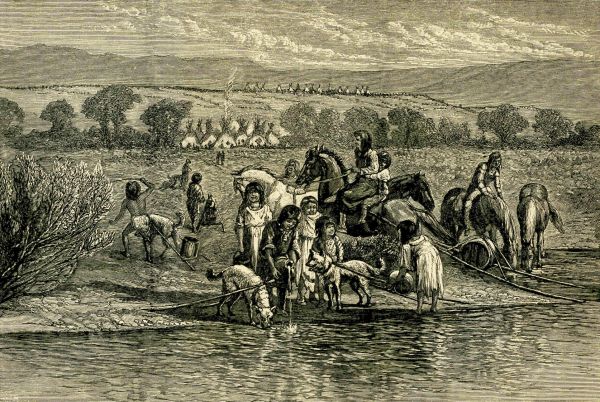
The sketch for the accompanying picture was made in Dakota one bright morning last summer, and represents the children of a Sioux village near Fort Berthold, going down to the Missouri River with their dogs and ponies for a supply of water. These dogs look more like wolves than the dogs to which we are accustomed, and to strangers or those whom they regard as enemies they are very savage, but with their little Indian masters they are very patient, and from them will bear any amount of abuse.
The jars that the children are filling are made by their mothers from the clay of the river-banks, and resemble in shape those borne on the heads of the Egyptian women who carry water on the banks of the Nile.