SHOOTING THE CHUTE.
Reading edition
BY WALTER CLARK NICHOLS.
More swiftly than the lightest-feathered swallow wings her flight southward in the fall, more rapidly than any railroad train in the world sweeps along its iron road, you speed down a long slide at an angle of about thirty-seven degrees. Your heart leaps into your throat as the boat you are in strikes the water and skims unevenly over the surface of a small pond, and then your heart comes back to its right place as you find you are unhurt. Then you give a gasp of pleasure, and are ready to try it all over again. For you have "shot the chute."
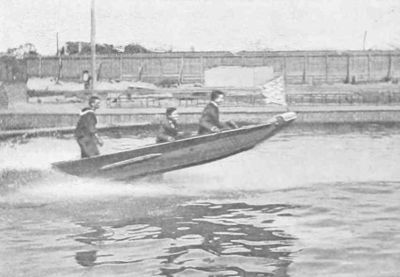
YOU SEE THE BOAT LEAP FORTY FEET AT A JUMP.
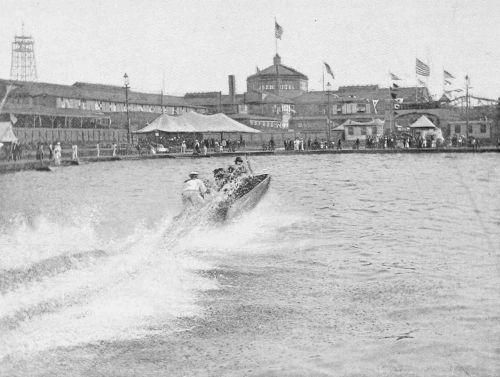
"Shooting the chute" is the invention of that intrepid swimmer and bold paddler Captain Paul Boyton. Captain Boyton, who is as brave as he is modest, is the man who has paddled over twenty five thousand miles on the principal rivers of the world in a peculiarly constructed rubber suit, over great falls, and through dark cañons, in Europe, Africa, and America; who has fought sharks and seals, and has had all sorts of strange adventures. The idea of the "chute" first came to him, he says, while shooting down the raging Tagus in Spain. In his book he says:
"The thought struck me as I was going into some subterranean passage, the perpendicular walls seeming to close in and swallow up the entire river. I was swept down by the mighty current, and was beginning to feel sure that I was being carried into some underground rapids, when I was suddenly dumped into a deep pool, where the course of the river was running smooth and placidly along."
The first chute in America was built in Chicago, and opened for business on July 4, 1894. It is nothing more nor less than an inclined roadway of wood or iron, starting at a height of from 60 to 75 feet, which, with a run of about 250 feet, descends to the surface of the water. On this roadway there are tracks upon which boats, each holding eight passengers, glide rapidly down. When the boat strikes the water, the impetus acquired in the descent causes it to "skim" over the water in a series of bounds, like a stone thrown by a boy in "ducks and drakes," some 300 feet to a landing-stage, where the passengers are disembarked.
But such a brief description doesn't even suggest the fun and the excitement of "shooting the chute." It is a sport where old and young can meet on common ground. In fact one poet has recently told how
"Little Jimmy was a scholar, And his aptitude was such That his parents and his teacher Were afraid he'd know too much. So his grandmamma said, 'Bless him, I will take him into town, And we'll go to Captain Boyton's, Where they'll water-shoot us down.'"
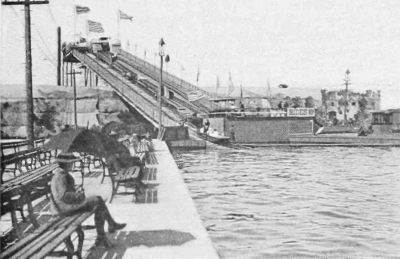
Suppose you were to go down to the chute—for there are four chutes in different parts of the country now, in Chicago, Atlanta, Baltimore, and at Coney Island—you would see something like this: There is a big enclosure, with a high board fence around it, from which a huge incline stretches up. It looks like a toboggan slide, only far bigger than most. The man at the stile-gate says, "Tickets, please." So you pay twenty cents for each ticket, admitting you to the grounds and one ride each on the chute. Just as you go in you hear a roaring, rattling sound, and a boat comes rushing down the slide into the lake in front of you. You see the boat leap forty feet at a jump over the surface of the water, like some ocean demon, until it finally quiets down and allows itself to be paddled easily up to the bank. As the people in the boat are helped out by several of the fifty attendants dressed in sailor suits, you expect them to cry out some expression of disapproval, for you certainly heard them shouting out in a frightened manner as they rode down the chute. But no.
THE "CHUTE."
"Wasn't it perfectly splendid?" says one woman.
"It beats tobogganing!" exclaims another.
"Let's do it again!" says a small boy.
A little reassured, you move around with the crowd towards the entrance to the slide, and, after giving your tickets to the gateman, you all get into little cars—similar to those in use at Niagara Falls running down to the whirlpool rapids—attached to endless chains, which drag you up to the top of the chute as slowly as the boats in the other part go rapidly. As you get a little more than half-way up, a boatload of people rattles by within ten feet of you, and you wonder again whether you will have the courage to make the first trial.
Once up, you follow the others around to the other side of the chute, where boats are sent down every fifteen seconds. You glance down the slide. It looks very long, and the water, which the steersman says is only three feet deep, seems very far away and very deep. At last, with a sudden gulp of courage, you jump in, holding tight to the railings as the guard bids you. You see little streams of water bubbling up and trickling down every few inches or so along the slide, and 'way below the big pool of water looks yawningly upward. The boat-despatcher has his hand on the lever which holds the boat back. And now that is turned.
"Hold fast, ladies and gentlemen. Hats under the seat! Now, then, you're off!"
THE FIRST JUMP.
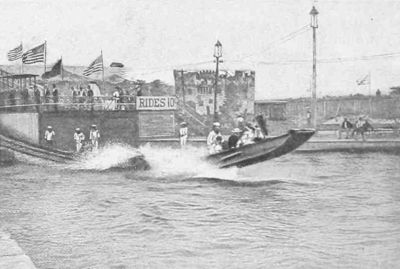
Quickly the boat rattles into the incline. A fraction of a second, and you are rushing along so fast that you almost scream. A second or two more, and you are going at the rate of seventy-four miles an hour. You have lost your breath, but the fresh air that rushes into your lungs gives you a delicious sensation. You feel as if you were flying through the air.
Boom! Splash! The boat strikes the water, almost jolting you off your seat, and whirling the spray high into the air. The people on the banks of the little pond whiz by, for the speed is still terrific, and the boat jumps forward in crazy leaps. After two or three of these spasmodic efforts the boat glides to the landing, thanks to the assistance of the man in the stern. Your breath comes back. You find you weren't hurt a bit, or even wet. You feel as if you jumped from the top of the barn into the lowest but softest hay-mow. You give an ecstatic gasp, this time of extreme delight, and plead with papa or Uncle Tom to "try it again."
THE SECOND JUMP.
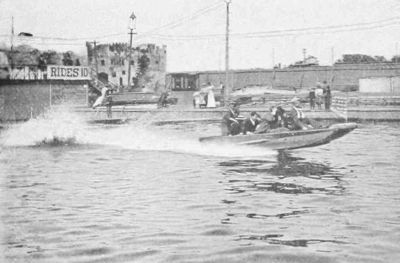
You "try it again," and this time you are not scared a bit, just simply delighted. As you are being paddled over to the shore after the last violent plunge of the ride, you take a look at the boat, and notice that it is very strongly built—of hickory and oak, the boatman says, and costing over a hundred dollars. It has a long slope upward in the prow, less sharp than a yacht's bow, and thus the danger of getting wet is almost entirely done away with. Each boat has four seats, seating eight people altogether, besides the man who steers.
Perhaps you go down the chute a few times more. If you do, you will have acquired the "chute craze," and then it is only a question of how much money you can have spent for you. Abroad, several of the royal families acquired the "chute craze," and some of them have had amusing times on it. When the present Emperor of Russia, then the Czarovitch, was visiting England in July, 1893, he, the Prince of Wales, and the King of Denmark, went to Captain Boyton's water-show to "shoot the chute." An eye-witness, who wrote about it to a Chicago paper, said:
"TRYING IT AGAIN."
"They climbed to the top of the high incline, and the Czarovitch, with a twinkle in his eye, invited the King of Denmark to take the front seat in the boat in which they were to make the swift descent. His Majesty took the place, and his nephew quietly stepped in behind and put his silk hat under the seat. The Indian guide pushed off, and in a moment the boat was flying like mad down the steep incline. The King, who thought the boat would certainly plunge under the waters of the lake when it struck, crouched down and held on like grim death. The Czarovitch stood up and yelled with excited glee. The flat-bottomed boat dashed into the water with a tremendous splash, leaped four or five feet into the air, and a drenching shower of spray covered his Majesty on the front seat. As the boat approached the opposite shore the Czarovitch turned to the Indian who was steering, grinned, and put out his hand; the Indian grinned wickedly, and something slipped into his fingers. There had been a similar bit of pantomime before the boat started, and as skilful guides can take their boats through the exciting trips without wetting their passengers, it is supposed that the young Czarovitch played a little joke on his royal uncle. The Prince of Wales came down in another boat, and they all liked it so much that they all went back and tried it again."
So popular has the pastime been at the chute near New York that over 30,000 persons have frequently "shot the chute" in a day.