Part 2 — STAMPS!
Reading edition
160 VARIETIES, many rare. 25c.; 500 Mixed Foreign, 16c.; 50 varieties United States, 27c.; 6 Peru, 8c.; 8 Brazil, 10c.; 9 Chili, 10c.; 3 Samoa, 8c.; 6 Servia, 10c.; 6 Egypt, 8c.; 6 Persia, 20c.; 10 Greece, 10c.; 7 Turkey, 10c.
Edwards, Peeke & Co., 2728 Calumet Ave., Chicago. Ill.
100 all dif. Venezuela, Costa Rica, etc., only 10c.; 200 all dif. Hayti, Hawaii, etc., only 50c. Ag'ts wanted at 50 per ct. com. List FREE!
C. A. Stegmann, 2722 Eads Av., St. Louis, Mo.
50 var., all dif., 5c.; 12 var. Heligoland, 15c.; 6 var. Italy, 1858 to 1862, 5c.; 3 var. Hanover, 6c.; 35 var. C. American, 50c. Agents wanted.
F.W. MILLER, 904 Olive St., St. Louis, Mo.
$3 worth of stamps for $1. All perfect specimens selected from collection; cannot be bought for twice our price. Satisfaction guaranteed or money refunded. Send $1 bill. Old Colony Stamp Co., Plainville, Mass.
FREE! 8 Handsome Japan Postage Stamps for 2c.; 100 all different, 10c.; 100 mixed, 5c.
J. A. WILSON, 1108 Fairmount Ave., Phila.
POSTAGE DUES.—50c. and 30c., at 70c. each; the pair for $1.25. Diamond Stamp Co., Germantown, Pa.
Varying Farm Life.
I live on a farm twenty-four miles from New York city, but am fond, as you may see from my letter, of reaching out beyond the farm and farm life and making inquiries about other things. I collect stamps, and have some old coins, one, a 1720 piece, which I found in the field one day while cultivating corn. I am sixteen years old. Could you tell me how to make an induction coil for taking shocks? Could you also tell me how to make a blow-pipe? I am thinking of making an electric telegraph. Could you give me some points on it? I have the Morse telegraph alphabet, but don't understand it or know how to use it.
Here is a game to be played when there are many to play it. Each one is provided with a slip of paper and a pencil. There are three persons who are in the secret—a confederate, the clairvoyant, and medium. Each one writes a word or short sentence on the paper. The clairvoyant seats herself before the writers, and the medium rubs her forehead with a handkerchief to put her in a trance. Then the medium collects the papers, takes any one of them (except the blank one, which must be left till last), and puts it on the clairvoyant's forehead. She makes up a sentence, which sentence must be claimed by the confederate, who really wrote nothing. Then the clairvoyant takes it from her forehead to see if she was right. Of course she reads it, and when the next paper is put on her forehead relates what she read on the preceding slip, greatly to the amusement and often the surprise of the writer.
Do you want some riddles?
H. A. Kretchmar. West Nyack.
You cannot make an induction coil save at considerable expense, and even then it is not as good as the one you may buy for less money. Apply to any dealer in electrical supplies.
A blow-pipe is simply a small pipe or tube a few inches long and bent at a right angle very near one end. Insert one end in your mouth, the bent end in a gas or even lamp flame, and blow gently. The effect is a flame many times hotter than the still flame.
You can make a telegraph key. Make a walnut or oak base four by eight inches. Erect two uprights in the centre, one inch apart and two inches high. Put between them a wood lever six inches long. In one end of the lever insert a common screw, and from the base raise a metal contact—a common nail will do—about two inches back of the uprights. Any metal surface, as two brass buttons, will do for the screw and nail to "click" against, a hand-pin may be made from the end of a common spool. This key, of a good pattern, may be bought for $2, in brass. You can get along without a "sounder." Get some practical operator to show you about the alphabet. Do not try to learn it from instruction books. If you do you will be sure to learn at the same time many faults. We want good riddles—new, not old ones.
Costa Rican Country Life.
Costa Rica, or, translated into English, "rich coast," is the most progressive of the Central American republics. The people are very home-staying, that is, they do not like to travel, as do the English and Americans. They all seem to like their country, and rightly too, for there are few prettier lands or more delightful climates. It is very mountainous, but not many very high peaks. All the way from the port at Limon to San José, the capital, there is grand scenery. Passing along on the train up a steep grade one looks back and wonders how the road-builders ever got up. In some places along on the mountain-sides, as the train passes, you can pick ferns out of one window and out of the other can see the valley far below, with little houses that look as if built for dolls. In some of these places it is very dangerous, and the train has to go very slowly.
Arriving in San José and just leaving the station you can see the city lying below you. A little to the left, and at about the middle, you can see the large round dome of the cathedral, and a little way back the large red roof of the new theatre. To the right lie the new school building and the Plaza de Toros. Entering more into the city one is surprised and pleased at the numerous pretty parks that are scattered all through it. San José is called the "Little Paris," as here you can see the Spanish beauties dressed in the latest Parisian styles. Sunday afternoon is the time when the señoritas take a promenade in the Parque Central, where the music is playing and all is gay.
Let us leave the city life and people and look at the poor folks of the country, who toil that all these city people may be comfortable. The average country people can neither read nor write, because until quite a recent date schools have not been general. Although they cannot read or write, most of them have very intelligent faces, and are well informed about their position. The houses of these people are very mean structures, built of only rough boards lapped over and nailed. The roof is of sugar-cane leaves, or, at the best, tiles made out of mud and clay baked. Inside the houses there are rarely more than two rooms, neither of them having other floor than the bare ground. The cooking range is only a platform covered with sand. There are three stones to set the kettles on. The smoke wanders off through the roof or door, for as a rule there are no windows. The furniture is not very extensive, and consists of a table and one or two "taburetes" (chairs covered with the skin of an ox).
In every house you enter you will find some corner or shelf whereon is placed some image or saint. The picture of their patron saint is hung on the wall. The house is as free to the chickens, pigs, and dogs as to the people themselves. The pigs run around, picking up what can be found to eat on the floor, and then crawl away under the bed or table and sleep the sleep of the—pig.
The people are generally strong and healthy. Their food consists, year in and year out, of rice and frijoles (black beans), and the great Costa Rican bread called tortilla. A tortilla is dried hulled corn ground on a stone and made into a sort of pancake, which is laid amongst the ashes and baked. When one has learned to eat it, it is very good. The people are not such thieves as they have been represented to be by many. To be sure, they will steal food, eggs, vegetables, and firewood, but nothing more. I have known a mill to be open for over three months, with valuable tools lying around, but never a one missing. The people are very polite, and when passing one in the road they always say adios (good-by), or buenos dias (good-day). The men all carry a large knife suspended at the belt, but it is for such use as we make of a pen or pocket knife.
Sir L. E. Tower. San José, Costa Rica.
The Helping Hand.
A friend of the Table and of the School Fund wrote recently to Jules Verne, telling him about Good Will Farm, and asking him for a letter to be sold to that American admirer who would bid highest for it. The great novelist readily responded, and the letter, wholly in Mr. Verne's own hand, is now in our possession. Of course it is in French, but here is a translation of it:
March 27, 1895.
Dear Sir,—I hasten to reply to your letter, which is inspired by such a touching idea. I should be happy if these few lines, which you request, could contribute, in some slight degree, to the success of your charitable undertaking. I believe that I have in your country many friends, unknown but sincere, judging from the letters I receive. This will afford me an opportunity to pay my tribute of gratitude to them, and I beg you to accept, with my entire sympathy, the assurance of my sincere regard.
Jules Verne.
The Table much appreciates the gentleman's kind act, and warmly thanks him. The original of the letter is to be used in an exhibition of other similar letters, and at the close of that exhibition will, with some other rare manuscripts, including one by James Russell Lowell, kindly given to the Fund by Professor Charles Eliot Norton, and original letters by Sir Walter Scott, Victor Hugo, Alexander Hamilton, Charles Dickens, William M. Thackeray, Louis XV. of France, and Emperor Napoleon I. and others, all belonging to the Fund through the kindness of its friends, be offered for sale to the highest bidders.
Our Fund grows slowly. Have you helped it along yet? We reprint the Mite for your use. Any one of any age may contribute. Write plainly that no errors may be made in the Honor Roll.
GOOD WILL MITE
HARPER'S ROUND TABLE
INDUSTRIAL SCHOOL FUND
Amount, $..................... ............................... Contributor.
If you use this Good Will Mite, simply pin it to your letter, in order that it may be detached for filing. If the amount is given by more than one contributor, add blank for their names, but attach the added sheet firmly to the Mite, that it may not become detached and lost. Include a given name in each case, and write plainly, to avoid errors on the Honor Roll.
Want Corner.
John Frame, 926 Main Street, Stevens Point, Wis., wants to trade pressed flowers and to correspond about botany. G. Edward Harrison, room 708, Fidelity Building, Baltimore, is interested in amateur journalism and wants samples. Similar requests are made by Claude Reno, 399 Chew Street, Allentown, Pa., who wants to contribute essays and funny paragraphs; and by F. R. Pyne, 717 Grove Street, Elizabeth. N. J., who wants to join a Chapter that publishes a paper and that trades stamps. Bert Segal sends money for a badge, but sends no address.
We should like to oblige Lantie V. Blum by telling the Table about his store, but cannot well do so. Josephine Moulton Shaw sends a diagram about the familiar bird-case and bird illusion. She also sends "Kink" answers which are correct. She may write again.
This Department is conducted in the interest of stamp collectors, and the Editor will be pleased to answer any question on the subject so far as possible. Correspondents should address Editor Stamp Department.
It is stated that Germany issued a special postal card to commemorate the birthday of Bismarck. Some think the cards were issued by private parties, as was the case of the Columbian cards issued at Chicago.
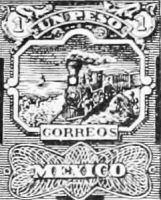
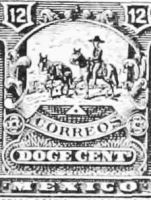
The new stamps of Mexico were given to the public on April 2d, there being thirteen adhesives in the set, of which two are here illustrated. Four of the designs represent the different modes of carrying the mail in Mexico, and the other design shows the statue of Montezuma.
L. Dorr.—The United States stamps of current issue break when folded, because the paper is brittle. The thirty-cent State Department stamp is sold at $4, the fifteen-cent Justice at $3.
James Edmonds.—The Confederate States 1862, ten cents, is sold at $3, the others have no value.
Edward Tatnall.—The Hartford die of the United States Centennial envelope has a double line under the word "Postage" The Philadelphia die shows only a single line.
S. H.—The set of Columbian postal cards is sold for about fifty cents.
E. P. Tripp.—The blue Special Delivery stamp was brought out again after the orange color was retired from use. It is the same plate as formerly used, and is practically the same stamp as was issued before the orange color.
A. S. S.—The stamps used at the period of the celebrated "Stamp Act" were for the collection of revenue. The stamp dealers may be able to supply them, but it is hardly probable.