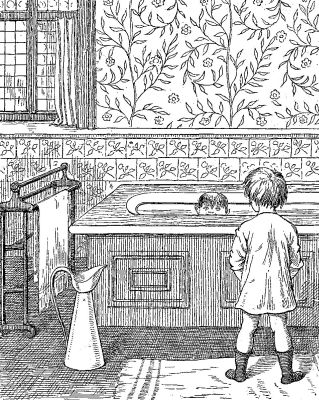
THE BATH-ROOM.
Reading edition
Cries Tom, in the bath, "I'm a seal at the Zoo." Says Ted, on the rug, "Then I'm glad I'm not you." "Ah, but, Ted," answers Tommy, "you know you're my brother; And if I am a seal, why, you must be another!"

We want to tell you a little story, by way of introducing the letters this week. The other day three boys we know went off for an afternoon's skating. The ice was as smooth as glass, and they flew over it like the wind, sometimes describing great circles, sometimes spinning around like tops, then cutting all sorts of pretty fancy figures, and again racing along as fast as their skates could go.
After a while Fred paused for breath. On the bank of the pond he saw a schoolmate, who was watching the sport with wistful eyes.
"I declare, boys," said Fred to Harry and Phil, "I don't believe that fellow has had a chance to skate this winter. He hasn't any skates, I'm sure."
"Skates?—not he. A good many days, I'm afraid, he don't get any dinner," answered Harry, as he finished a splendid pigeon-wing.
"Well"—Fred smothered a little sigh as he spoke, but he spoke bravely—"I think it's mean for us to have so much fun while he has none, and here goes! I say, Dan," he shouted to the boy on the bank, "come, take a turn on the ice. I'll lend you my skates awhile."
Dan needed a little urging, but the other boys, who liked their comrade none the less because he happened to be poorer than themselves, insisted, and the rest of the time he was among the skaters instead of Fred.
They all went home happier than usual, for those who do kind things are always repaid by the double delight they feel, and those who accept kindness gracefully are the happier for it too. How many of you boys and girls are enjoying the luxury of helping others along the way? We like to think that every day some of you are making the world gladder by simply doing the best you can wherever you happen to be. Do not wait for the chance to distinguish yourselves by great deeds, but seize the little opportunities as they come. It may be only amusing a fretful child, or helping a dull one to learn a hard lesson, or sewing a rip in an unlucky brother's gloves, or, as these three little fellows did, loaning a pair of skates, but believe me no unselfish action is ever done in vain.
Palmyra, New York.
I have a nice auntie in Washington, who sends me Young People every week, and I have all but the first six numbers. I was out at Shortsville this summer visiting my cousins; and while I was there we had the play given in Young People No. 92, "Mother Michel and Her Cat," and it was a great success. I was Mother Michel.
I have a toy Mr. Stubbs, sent me by a kind gentleman in Washington who had read the story of "Toby Tyler." We have three birds— But there! I must not write any more, for if I do I fear my letter will be too long to publish, and I want it to be printed, as I would like to surprise my auntie. I am glad Mr. Otis is having so good a time with his little yacht.
Mina L. C.
The little people who, like Mina, wish Mr. Otis a pleasant voyage, will be glad to read another letter from his pen:
On the Pasquotank.
Since it is neither a large nor important water-course, some of the readers of Young People may not know where the Pasquotank River is; but as it can readily be found on the map, those who care to read more about the cruise of the Toby Tyler should learn about it from their books, in order to better understand the direction taken by the little yacht after it came out of the Dismal Swamp. It will be remembered that the yacht arrived at the terminus of the canal quite late at night, so that it was impossible for any of the party to judge of the river they were to enter; but they had been told it was very crooked, and, without any other reason, all believed the journey of twenty-three miles to Elizabeth City would be a tedious one.
Never were travellers more pleasantly surprised than were those on the Toby during that Saturday morning sail.
The start was made about eight o'clock, just after the birds had cleared the breakfast things away, and were beginning their forenoon concert. The large audience, composed of the crickets, flowers, and leaves, were all in the best of moods, because the singing was really good, as well as in perfect harmony, and everything around was as bright and gay as possible, save, perhaps, the steward, who had fallen against the boiler and burned one of his ears.
The first two miles sailed after the last canal lock had been passed was not different from the trip through the swamp, for the little stream which ran into the river from the canal had been widened and straightened until it had almost ceased to be a natural water-course. But when the yacht glided around a sharp curve of the stream into the river, each one rubbed his eyes to assure himself that he was awake, and not dreaming of some land enchanted by the perfume and beauty of the flowers that were everywhere in the greatest profusion. They had crept to the very tops of the tallest trees, and then reaching down to the water, had left behind long, beautifully colored wreaths; they hung from every branch, and peeped from behind each tree trunk, disputing possession with the long gray moss, that seemed suddenly to have grown pale because of the almost overpowering perfume. Each side of the river seemed to be a bank of flowers, from out of which the branches of the trees rose like stems, while one could almost fancy the country one immense dish of water, in which flowers had been placed profusely, and that the wind had blown them apart, leaving a narrow channel for the yacht.
In the midst of such beauty the Toby seemed suddenly to have grown dingy-looking and dirty, and although she was at once decked out in her brightest flags and most brilliant adornments, the flowers put to blush any such feeble attempts at beautifying.
There was no question as to the truth of the statement that the river was crooked; it was much as if some one had marked out a number of W's, into which the water had flowed. It was necessary to sail almost directly first toward one bank, and then back, in the opposite direction, to the other, in order to keep in the channel; but no one regretted the devious course that made the journey longer, since the way was through the flower-trimmed trees on water so smooth and mirror-like that the foliage appeared as if painted on it.
Sometimes, when sailing around a bend in the river, the voyagers would come suddenly upon the gnarled and bleached trunk of some gigantic tree that uprose from amid the blooming forest like a withered stalk in a bouquet, causing everything around it to look more bright and cheerful because of the contrast.
There had been times during the journey when the yacht did not move through the water fast enough to satisfy some of the party, but during this sail there was not one who did not regret he was leaving so quickly a river so beautiful as this.
Although the Pasquotank is a charming stream throughout its entire course, its banks are not thus literally lined with flowers more than ten miles, but after that the scenery is sufficiently beautiful to make it interesting without approaching so near to enchantment.
When the Toby was about ten miles from Elizabeth City a draw-bridge was seen just ahead. It was not different from most other bridges, and yet it was approached with wonder and curiosity, for on it were nearly as many negroes as could be crowded there without too much risk that some of them would fall overboard. There were old men and women, young men and girls, and children of all ages, from a good-sized boy down to the tiniest and blackest of darky babies. Perhaps they were surprised at seeing the little yacht coming so swiftly toward them; certain it is that those on the Toby were surprised at seeing such a company, and awaited the meeting with no small degree of curiosity.
"Is yer gwine ter 'Liz'beth?" asked an old gray-headed darky, as he opened the draw of the bridge cautiously, as if he feared the yacht might escape him if he made ready for her coming too quickly.
On being told that the yacht was on her way to Elizabeth, he, assisted by nearly all present, told the reason of the assembling. They were all anxious to reach the city in order to attend a Conference which was to be held on the following day; the steamer, due some hours earlier, had not arrived, and they were waiting for her with many fears as to whether she would come during the day. As soon as the story had been told, the entire party began to plead that they be taken on board the Toby, with a force and earnestness that resulted in a terrible din.
There was not room enough on the little boat for one-tenth of the would-be passengers; but it was almost impossible to convince the anxious ones of that most palpable fact, and after every one on the yacht had screamed himself nearly hoarse in the effort, they were made to understand that but five of the party could be taken. It was comical, the sight they presented as they tried to decide as to whom the fortunate ones should be; each one urged that he or she was most needed at the Conference, and as each was overruled by the rest, they would loudly urge their claims to the party on the yacht, one old man proposing that he be taken on board, "an' leave der odder fool niggers ter fight it out."
It was fully half an hour before the question was decided, and then the Toby went on her way, with an addition to her passenger list in the shape of five as happy and inquisitive darkies as ever sailed down the Pasquotank Paver. They peered in at the cabin, careful not to touch anything, but anxious to see all the little room contained; they examined the machinery in the engine-room critically, while the oldest tried to explain how the boat could be propelled by the confusing-looking assortment of steel rods and bars. Then they went forward, where they gave themselves up to the enjoyment of the hour, as enthusiastic in their praise of the little steamer as one could wish they should be. After their delight had subsided in a measure, they began to be troubled about the amount they might be called upon to pay for their passage, but all their joy returned when they were told no money would be received. From that moment they were as happy as children, and insisted on singing a great number of camp-meeting songs as a means of showing their gratitude.
It was ten o'clock when the Toby was made fast to the dock at Elizabeth City, where the passengers were landed, evidently sorry to leave the little boat, even though it was to a Conference they were going.
James Otis.
Germantown, Philadelphia, Pennsylvania.
I sent you a letter a little while ago, but when I read in the last number about somebody seeing a dandelion on December 9, I thought I would write and tell you that to-day my cousin came in, and holding up a dandelion, said, "Look at that!" We have a pet cat. I went skating last Monday, and saw a man break through the ice.
W. S. N.
Woodside, near Lincolnton, North Carolina.
My dear Young Friends,—There are so many things I want to talk to you about that I am almost afraid to begin this letter, for fear I may take up too much room in the precious columns of the Post-office Box.
Our great feast and Christmas pleasure is over. The tree, thanks to your dear, generous, kind little hearts, was a perfect success. We had some nice garments of clothing for them all, toys and books for the children, and candy for every one. They were so happy! I would have given almost anything to have had you all here to see the tree you had done so much to make, and to see the happy school. Some little ones who were so eager to taste it, and could not get into their candy quickly enough, sucked the sweet through the lace bags that it was in. In fact, we were all very happy; as my children said, it was the "best part" of Christmas to us all.
More new scholars keep coming all the time. We want to start a school also for the many poor little white children, who need one as badly as the colored ones did; so you see I will have use for the books, papers, and all the other things you may send.
I must thank the lady who sent the presents to my own family; also thanks for the Scribner and Nation sent me; and, once more, thanks to the little boy who sent me the pretty Christmas card. The work on the school building will begin immediately. I will write you when we have it done. I have kept all your names; they are all to go in there in paint on tablets. I have not quite decided how. I will write you again when it is done, for I am going to do that part myself. Packages, Sunday-school papers, and cards have come from kind hearts and hands in many places, and in every instance have been appreciated and used where they were needed. The one cent sent by many little children was accepted with much pleasure, as were the nice large boxes of clothing, candy, and toys sent by many kind ladies. Uncle Pete was radiant when he came to wish a Happy New Year in his nice suit that had grown on the tree for him, with all the others in their nice wristlets, mitts, and the other welcome gifts that they received. They have been smiling ever since Christmas. Adieu, dear friends.
Truly yours, Mrs. Richardson.
Mrs. Richardson inclosed as usual a list of the names of the kind friends who make her their almoner, but we have not room for it among the good things which crowd the Post-office Box this week. They will each please accept her general acknowledgment as intended to include every individual.
Fayette, New York.
I am a little boy six years old. I have not taken Harper's Young People very long, but I like it very much. I have a pet cat which I call Nero. I have also nine bantams; one I call Gyp, and I often bring him in the house and set him on the back of a chair, and then I say to him, "Crow, Gyp," and then he crows very loud. My pa has a farm about two miles from the village where we live. We often drive over there, and I enjoy it very much. I have no brothers nor sisters, but I have a nice little playmate named Edward, who lives across the street. I am just beginning to write a little, but not well enough to write myself, so I told mamma what to write.
Roy H.
Oakdale, Pennsylvania.
I thought I would write you a letter and tell you of two nice games, one for in and the other for out doors. The one for the house is called "Going to Jerusalem." One person plays the piano, or makes some kind of a noise. Place the chairs in a row across the room, every other chair in an opposite direction, one less than there are players to go round the chairs, and when the music stops, each player must sit down, and of course one will be left out. Then one chair is taken away, and the person who could not get seated can not play any more, and so on until there are but two players going round one chair, and the one who gets seated goes to Jerusalem, and wins the game.
The other is called, "I Spy the Wolf." One is wolf, and the others hide their eyes and count, and the wolf hides, and when done counting they go and hunt the wolf, who when spied runs and tries to tag somebody before they tag base, and if so, both are wolf. When the wolf is spied, the person must say, "I spy the wolf," and run and tag base. The game is finished when all are wolf.
I am ten years old. I found two dandelions to-day, January 9.
Mary E. O.
Palatka, Florida.
I live on the St. John's River, opposite Palatka. We have a fine orange grove. We are having bananas this winter, although most of our neighbors lost theirs by the cold last winter. We will have plenty of guavas next summer if we don't have a "freeze," and I hope we may not. I wish some of the readers of Young People were here; we would have lots of fun. I have a puppy three months old. His name is Toby Tyler. I hope Mr. Otis will come to Palatka with his boat. I am nine years old.
T. Robert P.
We hope the bright eyes that have been watching for the flowers that this mild winter has made, like Ben Buttles, "dretful venturesome," will before many weeks of ice and snow be reporting from the South first, and afterward from colder localities, the earliest out-peeping of the spring darlings. There is a stanza of Mrs. Whitney's which we like very much:
"God does not send us strange flowers every year; When the spring winds blow o'er the pleasant places, The same dear things lift up the same sweet faces, The violet is here."
We must have storm and snow first, dears; but courage! the violets will be here by-and-by.
Calumet, Michigan.
Will you make room for another stranger?—one who from her cold Northern home, wishes to come into a corner of the Post-office Box to be warmed and comforted. Will not some of the writers to the Post-office Box tell of their Christmas vacations, and how Santa Claus treated them on his journey round the world Christmas-eve?
We have a debating society here, in which all the boys and girls, and grown folks too, are very much interested. We meet once a week, and have, besides the debate, one or two essays, a reading, declamations, and music, and altogether have a very enjoyable time.
Then we go skating on the lake, and coast on the terrific-looking hill behind the town. We go with our sleds to the top of the hill, and slide all the way down, and away out on the lake, without stopping.
We have a very pleasant school, too. Where the boats come in, in the summer, we can look right down over the town, and see everything that is going on.
Ray R.
Buffalo, New York.
I am a little boy three years old. Have taken Young People from the first number. Mamma reads the stories and letters, and tells me about them, and I am every day measuring myself to be big and do my own reading. On the 26th of December we saw dandelions peeping out of the grass, and looking out to Lake Erie, wondering what had become of all the boats of last summer. Mamma had a bunch of cherry blossoms on New-Year's Day. One of our neighbors cut a bunch from a cherry-tree in November. The buds were very large then, after the warm rains. The water was changed every day; now it is covered with blossoms, and the leaves are coming out.
I have a little sister Ruby, and we have great fun together. When papa brings Young People, he takes her on his lap; then she teases to have me get up, and says, "Come, Bover," and "Up, Bover," and will not look at the pictures until I am up too. Then we enjoy them together. Mamma is writing this for me. I hope soon to write for myself. A Happy New Year to Harper's Young People!
Ernest.
C. Y. P. R. U.
"Old Mortality."—Sir Walter Scott's novel of Old Mortality is one of the recognized masterpieces of English literature. Its scenes are laid in Scotland during the reign of Charles the Second and James, his successor, a period which was characterized by intense religious excitement, and fiery struggles between the Royalists, on the one hand, and the Covenanters, or Presbyterians, on the other. In this novel Colonel Grahame, of Claverhouse, cool, dauntless, and insensible to pity, is one of the central figures. There is a tender love-story running through the book, but its main interest, after all, is derived from its splendid descriptions of battles and forays, which stir the blood to enthusiasm, and rouse the martial impulse which is latent in the most tranquil natures. The third, fourth, and fifth chapters of Old Mortality are full of power, and of that vivid word-painting which is the highest style of writing. They possess the Homeric quality of dramatic movement and majestic strength, and for reading aloud on a chill winter night, when the wind is raging outside and the fire is bright within, they are surpassed by nothing else that the Postmistress remembers.
"Old Mortality" himself is scarcely an ideal character, as Sir Walter drew his portrait from a peasant who for thirty years wandered through the western districts of Ayr, Galloway, and Dumfries, spending his time in freshening the inscriptions on the graves of the martyrs. Mounted on a gaunt white pony, his gray locks straggling beneath an immense blue "bonnet," his old coat of hodden-gray the worse for years of hard service, his feet incased in hobnailed shoes, and his limbs covered with leggings of strong black cloth, this old man, whose real name was Robert Paterson, went from one church-yard to another among the wild moors and lonely hills, removing the moss from the rude tombstones, and deepening the fading letters with his chisel. He lived from house to house, entertained by hospitable farmers, who revered him, and finally, when very aged, was found expiring upon the highway, his faithful white pony standing on guard by his side.
Willie F.—Your idea that time spent in the study of the dead languages is lost time, and that you would prefer to devote yourself wholly to your native tongue, is perhaps a natural one, but it is based on an error. Latin and Greek are dead languages in the sense that they are not spoken in any land by living people to-day. But they are not dead in the sense of having lost their vitality. They enter largely into our modern languages, and no one can be a precise and thorough scholar in English without some acquaintance with Latin at least. Study your Latin grammar patiently, as your teacher advises, and though you do not yourself see what good it will do you, believe me that after a while you will find yourself repaid. There are some things which we must acquire by way of discipline, for it is the disciplined mind which does the best work with ease, just as the trained soldier can march farther and fight better than the raw recruit.
The Postmistress is fond of looking up the history of words. Some common words have a very curious history. For instance, demijohn, a glass bottle covered with basket-work, is a sort of puzzler. Why is it demijohn? Why John at all? Or if John, why half-john? The truth is, it has nothing to do with John; but was first manufactured at a town called Damaghan, in Khorassan, a province of Persia, a place once renowned for its glass-workers.—Calico, which is so dainty and pretty, and which the little girls wear to school in summer, derives its name from Calicut in India, from which handsome cotton goods were once imported to England.
There are two articles in this paper that we want the members of the C. Y. P. R. U. to read, because they will add to the stock of solid and valuable information that the society is endeavoring to store away in eager, appreciative minds, viz., "The Waves at Work," by Mr. Charles Barnard, and "The Scullion who became a Sculptor," by Mr. George Cary Eggleston. But there are two others that we want the boys and girls to make the basis of prompt and energetic action. To begin with, we want the article "On Cigarette Smoking" to produce such an impression that the stoves and ranges in all houses inhabited by the coming men of the next generation shall have a grand smoke, consuming in the operation all the compounded horrors in the way of bad paper, bad tobacco, dirt, opium, etc., that we now see defiling lips and destroying the nerve and brain power of the gallant lads to whom the world will soon look for the wit, the wisdom, the sagacity and the command, that shall keep her moving in the right direction. Then we want nobody to omit the sketch of "A School Restaurant," with its pretty illustrations. Papas and mammas do not like to say no when their pets ask them for pocket-money, and the pocket-money is nearly sure to go to the confectioner's till. Suppose you all ask your parents and teachers to consider our idea of a school dinner nicely served every day. Most of you are sensible folk, and know just as well as your physicians, or the Postmistress does how much brighter, better, and rosier you would feel and look if you could have a hearty nourishing meal to sustain you through the labors and pleasures of the latter half of the day.
PUZZLES FROM YOUNG CONTRIBUTORS.
No. 1.
HIDDEN TREES.
1. Please bring me a pin, Ella dear? 2. We could not sleep last night, for we heard the croaking of ravens. 3. Bring me the map, Lena, and help me find the Amazon. 4. Elma is going to boarding-school, and so are Jessie and Sue. 5. Has Helen her books, and has Arthur his slate? 6. I was stung by a wasp or a bee, Charlie. 7. Don't go near the fire, Emma. 8. Tom, bring me your cap, please. 9. What did you do with the tape, Arthur?
Pschye.
No. 2.
CHARADE.
My first is sometimes used When boys are very bad. My second's oft abused, And then 'tis very sad. A pet name is my third, To boys it does belong. My whole's a native bird, Three notes compose its song. Toby Tyler.
No. 3.
NUMERICAL ENIGMA.
I am composed of 49 letters.
My 5, 24, 39, 24, 31, 33, 29 is a peculiarity of the moth's tongue.
My 12, 42, 25, 38, 40, 10 is something the bee uses.
My 1, 22, 26 is peculiar to the feet of some birds.
My 1, 46, 12, 2, 14, 2 is a kind of deer.
My 19, 43, 19, 24 is a large bird.
My 11, 32, 44, 28 is an animal.
My 23, 16, 3, 46, 7, 42, 28, 12, 4, 42, 45, 36, 45 signifies change.
My 9, 17, 47, 21, 49, 49, 13, 8 enables insects to feel.
My 18, 21, 29, 30, 45, 46, 37, 6, 45 is the first change of a caterpillar.
My 34, 15, 49 is part of a fish.
My 42, 28, 17, 48, 20, 21, 42, 28, 4, 30, 10, 41, 21, 24, 45 is a strange animal.
My whole contains a useful animal.
Paul.
No. 4.
BEHEADINGS.
Behead a sharp, quick noise, and leave part of a chain. Behead a wooden shoe, and leave a bulky piece of timber. Behead learning, and leave metal in the rough. Behead a part of a carriage, and leave a part of the body. Behead a useful implement, and leave an apartment. Behead soft mud, and leave delicious ripeness. Behead part of a whip, and leave a tree.
Little Molly.
No. 5.
A RIDDLE.
I am numerous, yet but one. I am found in the rare and curious, and still am in general use all over the English-speaking world. I am found in every school-room, and no collegiate course is complete without me. I am valuable in geography and history, and the poets could not well get along without my aid.
Edna A. Guernsey.
ANSWERS TO PUZZLES IN No. 114.
No. 1.
Addition.—1. Hoodwink. 2. Feather. 3. Capuchin. 4. Philippine. 5. Cornice.
Subtraction.—1. Reserved. 2. Coward. 3. Basket. 4. Market. 5. Socotra.
Multiplication.—1. Pa-pa. 2. So-so.
Division.—1. Adieux. 2. Tick-tick. 3. Chow-chow. 4. Frou-frou.
No. 2.
Wink-el-ried.
No. 3.
Ygdrasil.
No. 4.
N
ROD
ROMAN
NOMINAL
DANDY
NAY
L
Correct answers to puzzles have been received from Ralph Birdsall, Agnes L. Hawley, Edgar Seeman, J. C., "Queen Bess," Louis Burnett, Amy Lee, Grace Arrowsmith, "Peggy," Boland T. C., "Mother Bunch," Earle Demarest, Schuyler Lamb, "Fill Buster," Mamie and Clara Blank, Robert Andrews, Jun., Johnnie Miller.
[For Exchanges, see 2d and 3d pages of cover.]
Fig. 1.